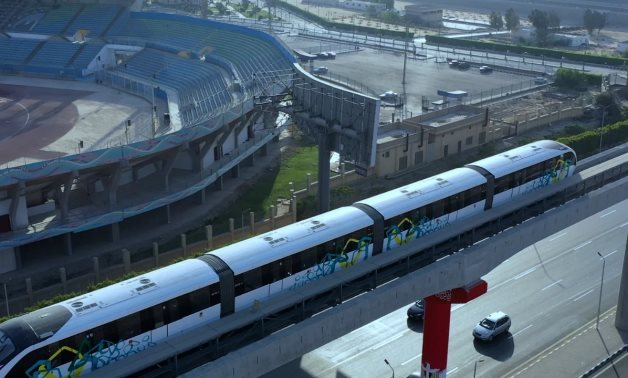
Egypt’s President Abdel Fattah al-Sisi inaugurated the East Nile Monorail which is a driverless system on Friday. The inauguration unveiled a high-capacity transit link linking Cairo’s Nasr City to the New Administrative Capital.
The new line spans 22 stations. Also, it is designed to ease congestion in one of Africa’s most densely populated urban corridors. Additionally, it will improve connectivity to Egypt’s rapidly developing administrative hub.
Following the inauguration, Sisi, alongside families of fallen Egyptian soldiers, rode the monorail from the Al-Fattah Al-Alim Mosque station to the Financial District, passing through key residential zones.
Significance of the Project
Furthermore, Egypt’s Transport Minister Kamel al-Wazir described the project as a “civilizational leap.” He noted that it aligns with government efforts to deploy eco-friendly transport systems. These systems aim to reduce fuel consumption and road congestion. Also, the project highlights how African nations are getting ambitious in their transport infrastructure. Other ambitious rail projects that seek to be developed by the African states include the Afrail Express Project, which will connect several African states.
The rubber-tyred, fully automated system consumes about 30% less energy than conventional electric rail. Also, it operates on elevated tracks, minimizing disruption to existing road networks.
Africa’s Longest Monorail Line
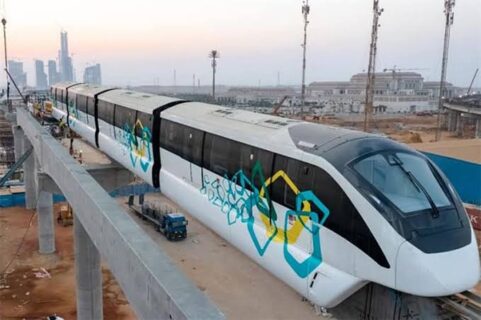
The East Nile monorail currently stands as the longest single monorail line in Africa at 56.5 km. However, it is part of a broader network, the Cairo monorail system, which includes a second line linking 6th of October City.
When both lines are combined, the network stretches to about 96 km. Therefore, this makes it Africa’s largest monorail system overall. In simple terms, the East Nile route holds the record for a single line, while the full Cairo network holds the continental record for total system size.
Developers
The monorail project was built by a consortium including Alstom, Orascom Construction, and Arab Contractors, the project features 40 trains capable of reaching speeds of up to 80 km/h, with intervals as short as 90 seconds.
The system integrates with Cairo’s Metro Line 3 and the Light Rail Transit (LRT), with future links planned to Metro Lines 4 and 6.
Equipped with platform screen doors, LED displays, and accessibility features, the monorail is expected to play a central role in reshaping Cairo’s urban mobility and supporting the shift toward sustainable transport.
East Nile Monorail Project Factsheet
System Length: 56.5 km (35.1 miles)
Number of Stations: 22 Stations
Top Speed: 80 km/h
Journey Time: Approximately 60–70 minutes (end-to-end)
Capacity: 45,000 passengers per hour per direction (pphpd)
Daily Ridership: Expected to serve up to 600,000 passengers daily
Technology: Fully automated, driverless (GoA4), rubber-tyred
Development and Management
- Owner: National Authority for Tunnels (NAT).
- Consortium: Led by Alstom (formerly Bombardier Transportation), Orascom Construction, and The Arab Contractors.
- Investment: Approximately $4.5 Billion for the two-line Cairo Monorail network (East and West Nile).
- O&M: The consortium holds a 30-year contract for the operation and maintenance of the system.
Project Team
Alstom: Responsible for the “brains and brawn” of the system. This includes the supply of 40 Innovia 300 trainsets (manufactured in Derby, UK), the Cityflo 650 signaling system, and overall system integration.
Orascom Construction: Focused on the civil engineering and infrastructure. Their scope included the design and construction of all stations, guideway structures (the elevated tracks), and the main depot.
The Arab Contractors (Osman Ahmed Osman & Co.): Partnered with Orascom on the massive civil works, bridge structures, and utility diversions required along the 56.5 km route.
Sener (Spain): Lead design engineering (special bridges, architecture, and systems assurance).
Shaker Consultancy Group: Local partner to Sener for electromechanical and architectural design.
Elsewedy Electric (PSP): Subcontracted for the installation of power rails and signaling systems.
Hill International (USA): Provided comprehensive project management and design review services.
Indra (Spain): Developed the ticketing and access control systems (QR codes/mobile integration).
Schindler (Switzerland): Supplied and installed 136 elevators and 272 escalators across the stations.
Innova Technologies (USA): Specialized structural engineering for beam fabrication and alignment design.
ALTPRO (Croatia): Supplied safety-critical signaling systems for the infrastructure.
Owner: National Authority for Tunnels (NAT), under the Egyptian Ministry of Transport.
Financing: Supported by UK Export Finance (UKEF), which provided a major buyer credit facility, along with JP Morgan, the EBRD, and the European Investment Bank (EIB).
Leave a Reply