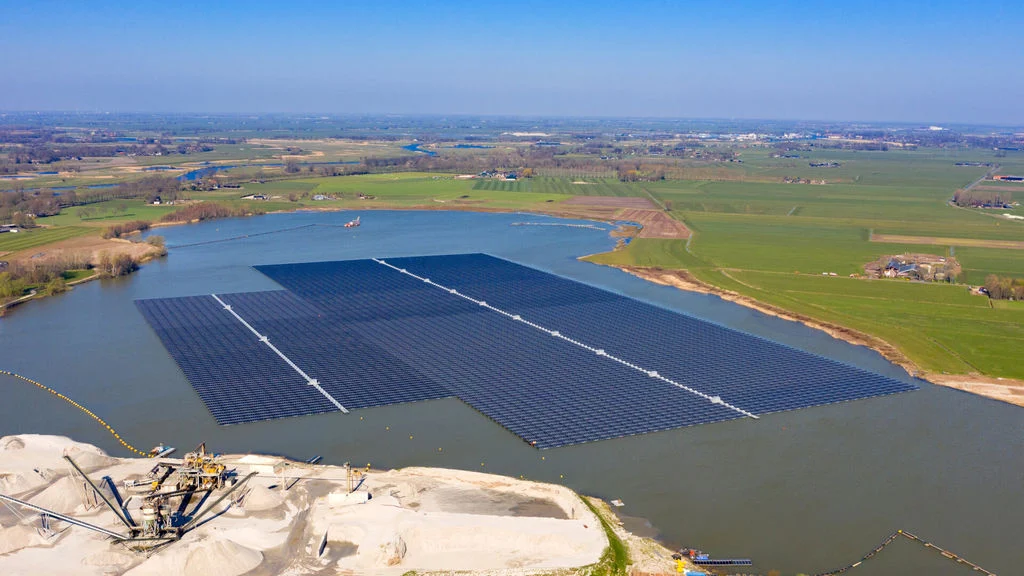
Melbourne-based renewable energy developer Enervest has commenced construction of a 500 kW floating solar array on the Brierly Basin water storage reservoir in Warrnambool, Victoria, marking the start of what will become Australia’s largest floating solar installation upon its completion. The AUD 2 million (approximately US$1.4 million) project is being installed for Wannon Water — a Victorian government-owned regional water authority — and features approximately 1,200 bifacial photovoltaic panels mounted on pontoons that float on the surface of the reservoir. The system is designed to generate more than 600,000 kWh of renewable electricity annually, delivering direct cost savings at the Brierly Basin site, reducing Wannon Water’s carbon emissions by more than 600 tonnes per year, and contributing to the Victorian government’s mandate that all state-owned water authorities reach net-zero emissions by 2045.
Pontoons, Bifacial Panels, and a Self-Adjusting Anchor System
The technical design of the Brierly Basin floating solar installation reflects the particular engineering requirements of a system deployed on a working water utility reservoir — a context that demands resilience, operational flexibility, and minimal interference with the reservoir’s primary function as a drinking water storage and pumping facility. The approximately 1,200 bifacial photovoltaic modules are mounted on pontoons that sit on the water surface, with integrated walkways built into the pontoon structure to allow maintenance personnel safe access to panels, connections, and monitoring equipment without requiring boat access. Cables run from the array to anchors fixed at the bottom of the reservoir, holding the pontoon system in position while the anchoring design specifically accommodates the changing water level of the reservoir — as the water level rises and falls with seasonal variation in rainfall and water extraction, the floating platform rises and falls with it, maintaining the array’s relationship with the water surface throughout.
Project Fact Sheet: Brierly Basin Floating Solar Array
Project Name: Brierly Basin Floating Solar Array
Location: Brierly Basin Water Storage Reservoir, Warrnambool, Victoria, Australia
Developer / EPC: Enervest (Melbourne-based renewables developer)
Client / Asset Owner: Wannon Water (Victorian government-owned regional water authority)
Total Project Cost: AUD 2 million (~US$1.4 million)
Installed Capacity: 500 kW
Number of Panels: ~1,200 bifacial photovoltaic modules
Mounting System: Pontoons with integrated walkways; variable-level anchoring to reservoir bed
Anchoring: Cables to bottom-fixed anchors; designed to accommodate reservoir level changes
Bifacial Advantage: ~20% better energy production from water surface albedo reflection
Annual Energy Output: >600,000 kWh
Annual CO₂ Reduction: >600 tonnes
Net-Positive Value (business case): >AUD 500,000 over project lifetime
Construction Start: March 2026
Significance: Australia’s largest floating solar installation upon completion
Victoria Government Context: Part of mandate for all Victorian water companies to reach net-zero by 2045
Previous Record Holder: Gippsland Water, Drouin WWTP, Victoria — 350 kW floating solar array
Project Team: Brierly Basin Floating Solar Array
Developer / Builder: Enervest (Melbourne, Victoria)
Client: Wannon Water
Government Policy Sponsor: Victorian State Government (net-zero water authority mandate)
Primary Use of Reservoir: Water storage; pumping supply to Warrnambool Water Treatment Plant
Co-Benefits: Algae growth reduction; evaporation reduction
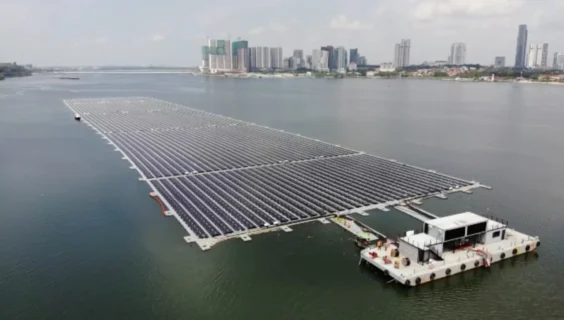
The decision to use bifacial modules is technically well-suited to the reservoir environment. Bifacial panels capture sunlight from both the front face (direct irradiance) and the rear face (reflected irradiance), and the high reflectivity of a water surface — compared with the dark soil, vegetation, or rock that would underlie a ground-mounted array — provides a meaningful albedo contribution to the rear face. Wannon Water and Enervest have estimated this water surface reflection effect will deliver approximately 20 per cent better energy production relative to a standard single-face module installation of the same nameplate capacity, improving the system’s capacity factor and accelerating its payback period. The net-positive value of the project, as calculated in Wannon Water’s own business case, exceeds AUD 500,000 over the asset’s operational life.
Wannon Water, the Business Case, and Warrnambool’s Water Cycle
Wannon Water’s motivation for hosting the floating solar array is embedded directly in the physics and economics of its operations at the Brierly Basin site. Brierly Basin is not merely a storage reservoir — it is the upstream facility from which water is pumped uphill to the Warrnambool Water Treatment Plant for purification and distribution to the city’s residents and businesses. Pumping at elevation is one of the most energy-intensive activities in water utility operations, and the continuous electrical demand of those pumps has made on-site renewable generation a particularly compelling investment for Wannon Water compared with water treatment facilities that rely more on gravity-fed or low-head processes. The authority’s own framing of the business case is telling: the electricity savings from generating power at the point of maximum consumption, rather than purchasing from the grid at retail prices, drive the project’s financial case without requiring any subsidy or special tariff arrangement.
Beyond electricity cost savings, the floating solar array at Brierly Basin provides two additional operational benefits that are specific to the reservoir context and that partially substitute for conventional water management expenditure. The shading of the reservoir surface by the floating panels reduces the amount of sunlight reaching the water, limiting the photosynthesis-driven growth of algae — a persistent water quality challenge in open surface reservoirs during warm weather that typically requires both chemical treatment and operational monitoring. The floating panels also reduce evaporation from the reservoir’s surface, a benefit that compounds over dry summer months and reduces the volume of water lost to the atmosphere before it can be treated and distributed. These co-benefits reinforce the project’s positive net present value and make the Brierly Basin installation a model for how floating solar can deliver value across multiple operational objectives simultaneously at water utility sites.
Australia’s Floating Solar Landscape and the Global Technology Trajectory
The Brierly Basin installation, at 500 kW, will surpass the 350 kW floating system operated by Gippsland Water at the Drouin wastewater treatment plant in eastern Victoria — currently Australia’s largest operational floating solar array — and will comfortably exceed all other existing Australian floating solar installations, including a 100 kW system at the East Lismore Sewage Treatment Plant in northern New South Wales, a 157 kW array at the Jamestown wastewater facility in South Australia, and a 50 kW community installation at Lardner Park in Victoria’s southeast. The step from 350 kW to 500 kW is a modest absolute increment, but its significance lies less in megawatts than in the demonstration effect: that Australian water utilities and the companies serving them are progressing up the floating solar learning curve, with each successive project providing the engineering, regulatory, and commercial reference data that makes the next one easier to finance and execute. This evolution in utility-scale solar is occurring alongside more complex thermal energy developments, such as the progress made in Australia’s first commercial concentrated VS1 solar power facility, which is currently advancing toward its 2026 commissioning in Port Augusta.
Australia’s adoption of floating solar has lagged considerably behind the technology’s global trajectory, particularly relative to Japan, China, South Korea, and the Netherlands, where floating photovoltaic systems exceeding hundreds of megawatts have been constructed on drinking water reservoirs, irrigation ponds, hydroelectric reservoirs, and former mining lakes. The global floating solar market was estimated at approximately 4.5 GW of cumulative installed capacity in 2024, growing at rates exceeding 30 per cent annually driven by land scarcity in Asia and the dual-use economics that make reservoir and water storage surfaces particularly attractive development sites. In Australia, the combination of abundant land for ground-mounted solar, relatively modest electricity prices compared with Asian utility markets, and historically low grid tariffs has slowed the economic case for floating solar’s premium installation cost compared with conventional ground-mounted alternatives. The Victorian government’s water utility net-zero mandate is precisely the kind of policy instrument that changes this calculus — creating a compliance driver that elevates the value of on-site renewable generation beyond simple electricity cost arithmetic and puts floating solar on the agenda for the dozens of Victorian water authority reservoirs that share Brierly Basin’s energy intensity profile.

Leave a Reply