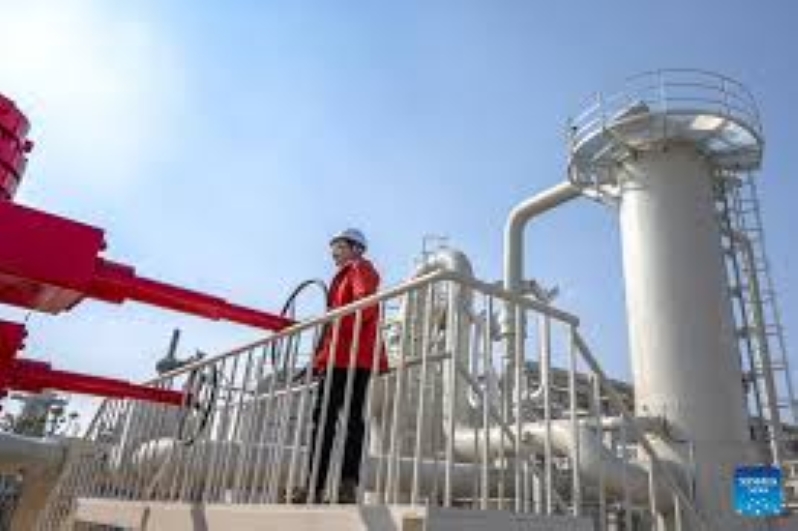
China has taken a major step forward in its hydrogen economy with the commissioning of its first million-cubic-meter salt cavern hydrogen storage project in Pingdingshan, Henan Province. The project, now operational as of April 2026, is considered a breakthrough in large-scale hydrogen storage and also points toward integrated hydrogen industrial systems in China.
First ‘Million-Cubic-Meter’ Salt Cavern Hydrogen Storage in China: Project Overview
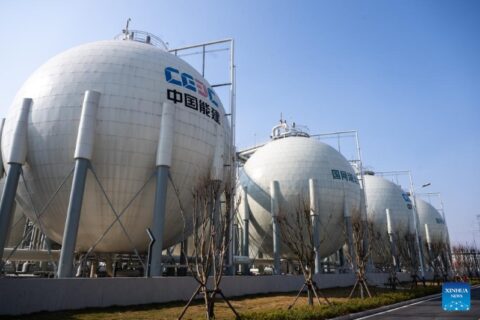
The demonstration project is the first in China to reach a storage scale exceeding one million cubic meters, with a designed hydrogen storage capacity of approximately 1.5 million cubic meters. It is also the largest facility of its kind in Asia, highlighting the country’s ambition to lead in hydrogen infrastructure deployment.

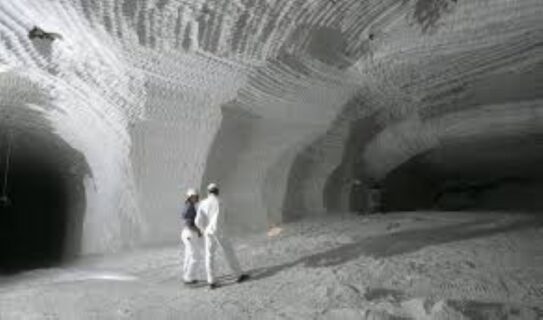
Salt cavern storage works by dissolving underground salt formations to create sealed cavities capable of storing gases under pressure. These caverns offer low permeability and high structural integrity. This makes them particularly suitable for hydrogen storage compared to other geological options.
Fact Sheet for First ‘Million-Cubic-Meter’ Salt Cavern Hydrogen Storage in China
Project Name: Pingdingshan Salt Cavern Hydrogen Storage Demonstration Project
Location: Pingdingshan in Henan Province, China
Status: Operational
Operations Start Date: April 2026
Storage Capacity: 1.5 million cubic meters of hydrogen
Type: Underground salt cavern hydrogen storage
Significance: First million-cubic-meter hydrogen storage project in China; also largest in Asia
Function: Integrated hydrogen production, storage, transport, and utilization
Project Developer, Contractors and Stakeholders
Lead Developer
- China Pingmei Shenma Group
Involved Subsidiaries
- China Pingmei Shenma Group
- United Salt Chemical Company
- Henan Shenma Chlor Alkali Development
Core Technology and R&D Lead
- Institute of Rock and Soil Mechanics, Chinese Academy of Sciences
Engineering, Design and Construction Partners
Government and Institutional Stakeholders
- People’s Government of Henan Province
- Chinese Academy of Engineering
Technology and Innovation
The project also demonstrates the scalability of salt cavern hydrogen storage, a technology long considered important for enabling seasonal and grid-scale energy storage. Unlike surface tanks, underground caverns allow for significantly larger storage volumes at lower cost per unit. This makes them essential for industrial-scale hydrogen deployment.
Importantly, the project also advances the concept of “power-to-hydrogen-to-storage”. This is where excess renewable electricity is converted into hydrogen and stored for later use. This positions the facility as both an energy storage solution and a grid-balancing asset.
Significance of the First ‘Million-Cubic-Meter’ Salt Cavern Hydrogen Storage in China
Start of operations at the first million-cubic-meter salt cavern hydrogen storage project in China marks a transition from pilot-scale deployment to infrastructure capable of supporting massive industrial demand. It is expected to play a key role in stabilizing supply for hydrogen-consuming sectors such as chemicals, heavy industry, and potentially power generation.
More broadly, the project also highlights China’s intent to industrialize hydrogen at scale. By integrating storage into the value chain, the Asian powerhouse is also reducing one of the key barriers to widespread hydrogen adoption – reliable, low-cost storage capacity.
Hydrogen Storage and Global Decarbonization Goals
The project comes at a time when hydrogen is increasingly seen as a cornerstone of global decarbonization strategies, particularly for balancing intermittent renewable energy sources.
Large-scale storage has also been one of the most persistent bottlenecks in hydrogen deployment, limiting its viability beyond niche or localized applications. By making use of underground salt caverns (naturally sealed geological formations), China is addressing the challenge of storing hydrogen safely and cost-effectively at scale.
This development also aligns with China’s push to build a complete hydrogen value chain. The Pingdingshan project is designed not as a standalone storage facility, but as part of a growing hydrogen network, including a $584 million green hydrogen and methanol project in Heilongjiang Province.
First ‘Million-Cubic-Meter’ Salt Cavern Hydrogen Storage in China: Project Outlook
The first million-cubic-meter salt cavern hydrogen storage project in China is likely to serve as a template for future hydrogen storage projects across the region. This is particular to regions with suitable geological formations.
Additionally, as renewable capacity continues to expand, demand for long-duration energy storage solutions is expected to grow. This will likely place salt cavern hydrogen storage at the center of future energy systems.
Scaling this project could also unlock large volumes of stored energy, enabling hydrogen to function as an energy reserve asset and an industrial feedstock.
Risks Associated with Salt Cavern Hydrogen Storage
Despite its promise, the technology faces challenges. Hydrogen storage in salt caverns requires careful management of pressure, leakage risks, and long-term material interactions. There are also economic uncertainties around cost competitiveness relative to other storage technologies.
In addition, deployment is geographically constrained, as suitable salt formations are not universally available. This could limit scalability in certain regions and necessitate other storage solutions.


Leave a Reply