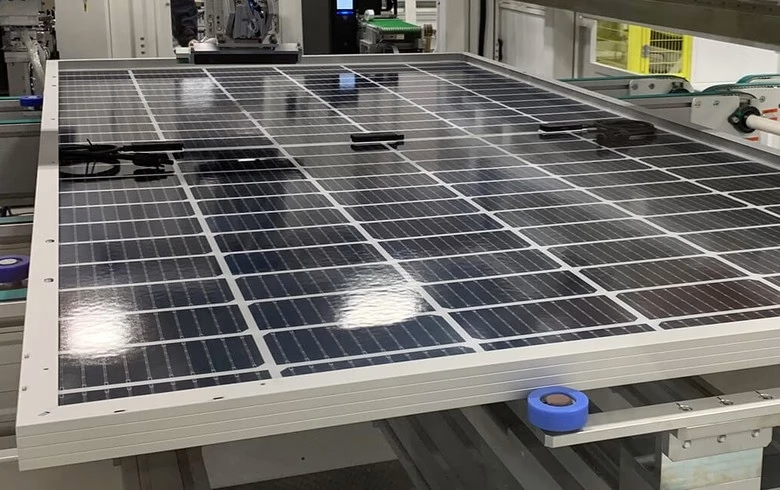
Leading solar-technology firm Boviet Solar has commenced interior construction on a monumental manufacturing plant in Greenville, Pitt County, North Carolina. The facility will soon reach an annual production capacity of 3 gigawatts (GW) of photovoltaic (PV) cells, marking a major milestone in the company’s U.S. expansion. With exterior works complete, attention now turns to mechanical, electrical and process-equipment installation throughout the plant’s interior.
Construction began earlier in 2025 alongside Boviet’s adjacent module manufacturing campus, thereby enabling a vertically-integrated chain from cells to modules on U.S. soil. In contrast with many one-off builds, this project emphasises scale, speed and repeatability. Meanwhile, local officials applaud the facility’s job-creation potential and economic spill-overs for eastern North Carolina. As such, this project offers a standout case study in large-scale clean-manufacturing infrastructure, and what it means for the construction and industrial-engineering sectors.
Project Factsheet
Developer: Boviet Solar Technology Co., Ltd. (Vietnam-based Tier 1 solar manufacturer)
Location: Greenville / Pitt County, North Carolina, USA
Capacity: 3.0 GW annually of PV-cells (Phase II)
Investment & scope: Approx. US$294 million for Phase I; additional ~$100 million for Phase II (~600,000 sq ft)
Job creation: Over 900 skilled local jobs expected in cell manufacture plus indirect supply-chain uplift
Construction status: Exterior build-out complete; interior works now underway targeting H2 2026 launch of cell production

Significance for the Construction & Industrial Sector
Further, this project underscores a shift toward high-volume manufacturing infrastructure that mandates heavy civil works, structural steel erection, and process-plant integration. Contractors will engage in large-floor plate builds, vibration-sensitive foundations, redundant utilities, and environmental-control systems for clean-room processes. Moreover, modular prefabrication, high-capacity HVAC systems and high-volume power distribution emerge as critical scopes, aligning with rising demand for industrial-grade construction. The facility’s integration of cell and module production on-site enables streamlined logistics and creates unique construction sequencing considerations.
Beyond direct works, the ripple effect for the supply chain is substantial: local fabrication, mechanical-electrical-plumbing firms, and trade suppliers will all find opportunities in the build-out and long-term operations. A similar development approach is seen as First Solar unveils plans for a 3.7 GW U.S. manufacturing facility, emphasizing how large-scale renewable manufacturing investments drive regional construction activity and industrial growth. In addition, for construction firms in Africa and elsewhere, this project provides transferable lessons in how large-scale manufacturing hubs can be delivered in regional jurisdictions—combining economic development, workforce training, and high-tech infrastructure. Finally, as the global solar supply chain seeks greater localization, construction companies capable of executing high-specification industrial builds stand to secure more roles in the clean-energy transition build-out.
Leave a Reply