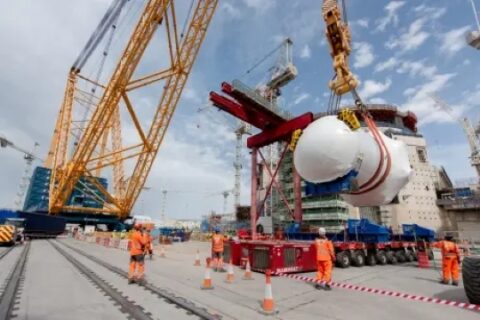
Updated June 1, 2026 – A major construction milestone has been achieved at the UK’s flagship nuclear energy project after the world’s largest crane, known as “Big Carl,” successfully lifted and positioned the second reactor pressure vessel at the two-unit Hinkley Point C nuclear power plant in Somerset, England. The operation marks one of the most technically complex stages of construction and highlights growing efficiencies being realized on the project’s second reactor unit.
How did Big Carl do it?
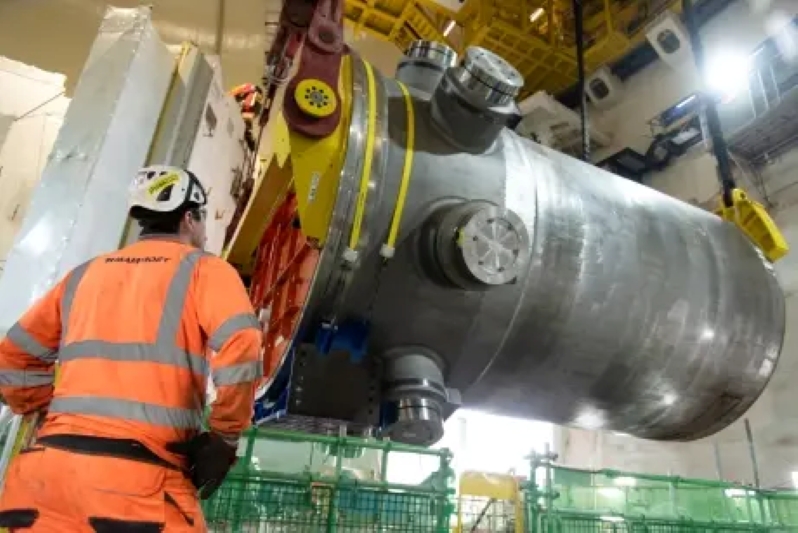
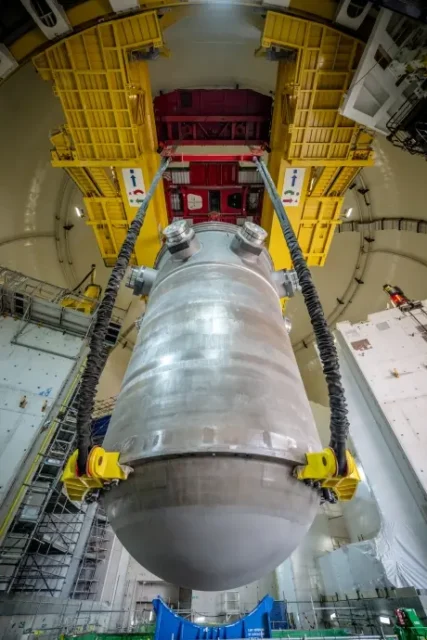
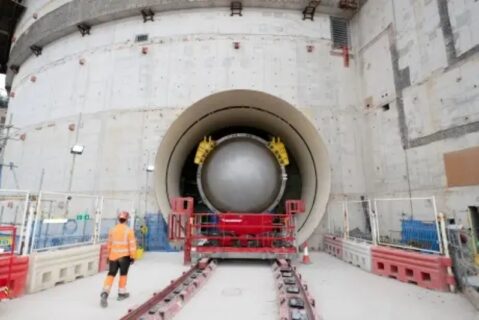
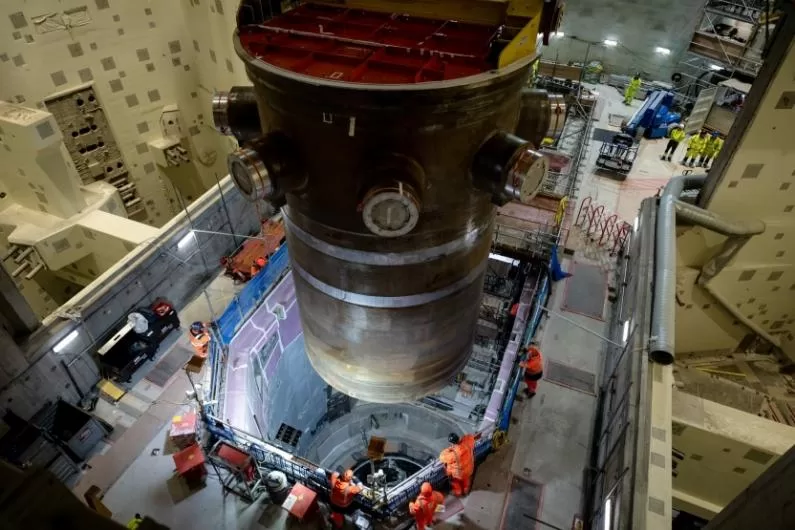
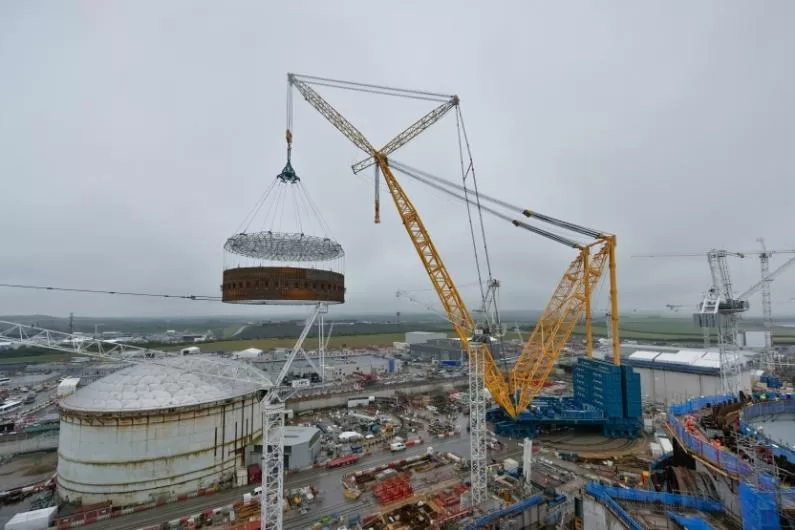
The reactor pressure vessel, weighing approximately 500 tons and measuring 13 meters in length, was lifted by Big Carl before being transferred into the Unit 2 reactor building. Once inside, the station’s massive internal polar crane rotated the vessel into a vertical position. The vessel was then lowered onto a support ring with only 40 millimeters of clearance on either side. This precision installation comes less than a year after the completion of another key milestone – the placement of the reactor building’s steel dome.
Developed by EDF Energy through its Hinkley Point C project company, the power station represents the first new nuclear plant under construction in Britain in more than three decades. When completed, the twin European Pressurized Reactors (EPRs) are expected to generate enough low-carbon electricity. This will supply around six million homes while contributing about 7% of the UK’s electricity demand.
Comparison to Unit 1 Reactor Installation
The latest lift demonstrates how lessons learned from Unit 1 are translating into measurable productivity gains on Unit 2. Unlike the first reactor installation, which required a large temporary overhead lifting system, the second reactor was installed using Big Carl. The project teams say that this method saves time, space and cost. EDF also reports that Unit 2 is currently progressing 30% faster than Unit 1. This has been attributed to accumulated construction experience, increased prefabrication and process optimization.
Hinkley C is also increasingly becoming a test case. The UK government and EDF describe it as a “Build and Repeat” model for large-scale nuclear deployment. By constructing two identical reactors using the same workforce, suppliers and engineering standards, the project team has also been able to improve productivity across successive construction stages. Previous milestones, including the installation of the Unit 2 polar crane and the lifting of the second reactor dome, were completed significantly faster than comparable activities on Unit 1.
These efficiencies are expected to influence future nuclear developments, including the proposed Sizewell C nuclear power project. Sizewell C is also based on the same EPR design and is intended to benefit from the engineering experience gained at Hinkley Point C.
Hinkley Point C Nuclear Power Plant: Project Overview
Located on the Somerset coast near Bridgwater, Hinkley Point C consists of two EPR nuclear reactors designed to provide reliable baseload electricity for decades. The project is being delivered by EDF and its supply chain partners. It is also regarded as one of Europe’s largest infrastructure undertakings.
The reactors at Hinkley C will use nuclear fission within the reactor pressure vessel to generate heat. Steam produced will drive Arabelle turbines for electricity generation. According to EDF, the second reactor building is also currently further advanced than Unit 1 was at the same stage. This cuts across the greater levels of equipment installation, structural steelwork completion and containment construction already achieved. Three large heat exchangers have also been installed on Unit 2, compared with none at the equivalent stage of the first unit.
The project’s modular construction approach has also become a defining characteristic of the development. Large steel structures, prefabricated assemblies and complete equipment modules are manufactured offsite or within dedicated fabrication facilities before being lifted into position by Big Carl. EDF has described the approach as effectively creating a “large modular reactor” construction process for a gigawatt-scale nuclear plant.
Engineering Behind “Big Carl”
One of the most recognizable features of the Hinkley Point C site is Big Carl. The giant crane is supplied by heavy-lift specialist Sarens. Standing approximately 250 meters tall, the crane has become central to the project’s construction strategy and has been used for a series of critical lifts since arriving on site.
Among its previous achievements are the installation of reactor containment liner sections, the placement of the first reactor dome in 2023, the installation of the Unit 2 polar crane in 2025, and the lifting of the second reactor building dome later that year. The latest Unit 2 reactor vessel installation adds another major milestone to its operational record.
Additionally, the frequently use of heavy prefabrication and specialized lifting systems at Hinkley Point C differs from earlier European Pressurised Reactor (EPR) projects such as Olkiluoto nuclear power plant in Finland and Flamanville in France. These relied more heavily on in-situ construction methods. The more recent innovations clearly play a role as important contributors to the improved performance being reported on Unit 2.
Hinkley Point C Nuclear Power Plant Project Financing and Timeline
Despite the significant construction progress, Hinkley Point C continues to face financial and schedule pressures. EDF recently revised project timelines, indicating that first power generation from Unit 1 is now expected around 2030, later than earlier forecasts. Project costs have also increased substantially compared with the original estimates announced after the final investment decision.
EDF has also been exploring additional financing options to support project completion, including discussions with institutional investors and infrastructure funds. Rising material costs, supply chain constraints, labor shortages and the effects of the pandemic have all contributed to budget escalation across the project.
Nevertheless, EDF maintains that the knowledge gained from Hinkley Point C will generate substantial cost and schedule benefits for future nuclear projects in the UK and abroad.
Hinkley Point C Nuclear Power Plant: Project Fact Sheet
Location: Somerset in England, United Kingdom
Technology: Two EPR Reactors
Installed Capacity: Approximately 3.2 GW
Homes Powered: Around 6 million
Latest Milestone (June 2026): Installation of Unit 2 reactor pressure vessel
Reactor Vessel Weight: Approximately 500 tons
Reactor Vessel Length: Approximately 13 meters
Key Equipment: Big Carl heavy-lift crane and polar crane
Expected Contribution to UK Electricity Supply: Approximately 7%
Hinkley Point C Project Team
Developer: EDF Energy
Technology: European Pressurized Reactor (EPR)
Heavy Lift Contractor: Sarens
Outlook on the Development of Hinkley Point C Nuclear Power Plant
The successful installation of the second reactor pressure vessel is a progress-sign that Hinkley Point C is moving from civil construction toward the intensive mechanical and electrical installation phase that ultimately precedes commissioning.
While schedule and cost challenges remain, the project continues to increasingly demonstrate productivity gains. Policymakers and developers hope these gains will underpin a new generation of nuclear construction programs in the UK.
For the UK’s energy transition, the latest milestone at Hinkley C power plant reinforces the role that large-scale nuclear generation is expected to play alongside renewable energy, grid modernization and energy storage investments.
Furthermore, if the efficiencies achieved on Unit 2 can be replicated at future projects such as Sizewell C, the Hinkley Point C experience may become a defining reference point for the next wave of European nuclear development.
Hinkley Point C Nuclear Power Plant Installs Reactor Unit 1
Reported December 20, 2024 – Early December saw the fitting of the Unit 1 reactor at Hinkley Point C nuclear power plant. Hinkley C will to power up to 3 million homes with reliable, low-carbon energy once operational. The installation of the 13-meter long “reactor pressure vessel” (RPV), the first of two, will also supply Britain with up to 7% of its electricity once they are both operational.
The RPV will hold the nuclear fuel used to generate heat that will produce steam for the Arabelle turbine.
This milestone was hailed as a “significant feat of engineering” by UK’s Energy Secretary, Ed Miliband. He termed the HPC milestone as a “major step forward for the UK’s most advanced nuclear project.”
The installation of the Arabelle turbine for the EDF Energy and China General Nuclear Power Group-owned project has already began.
More 2024 Construction Milestones at UK’s Flagship Nuclear Energy Project
February saw the start of tunnel construction connecting to the Bristol Channel. This milestone at the start of the year marked a major step in the construction of the cooling water system for the power station. The six 5,000 tonne shaft liners installed onto the seabed in 2022 were to be connected to the 5-miles of tunnels. Their utility is to allow for water to circulate to the nuclear power station.
July had the installation of the “heart” of the new nuclear power station. This monumental event followed the another – the lifting of the reactor building roof the previous year. The mid-year events featured the prep work for the installation of the first nuclear reactor, steam generators and the world’s largest turbine, the Arabelle turbine. Tunnel construction was nearing completion at this time. Work was also nearing completion on the 50-meter-tall Turbine Hall that was to house the Arabelle turbine.
At this point, more than £5 billion had been spent on the project. This also saw around 3,800 British businesses closely involved in the project. This massive energy investment in Britain is set to provide 6 million households with low-carbon energy – helping Britain achieve new zero and energy security.
October saw the lifting of the third and final steel liner ring at Hinkley Point C’s second reactor building. The 423-tonne, 47-meters wide, and 11.6-meters high steel ring formed the inner part of the containment wall of the reactor building. It will be encased in concrete, and complete the housing for two nuclear reactors at Hinkley Point C. The dome to cover the circular structure will be lifted into place next year.
Investment in Modular Nuclear Construction
Hinkley Point C has also done well in the investment in modular construction. By July this year, their new manufacturing factories in Bristol had cut-back on manufacturing time by 20%, and on site installation time by 75%.
Featured materials for modular construction taken up by the HPC nuclear energy project include:
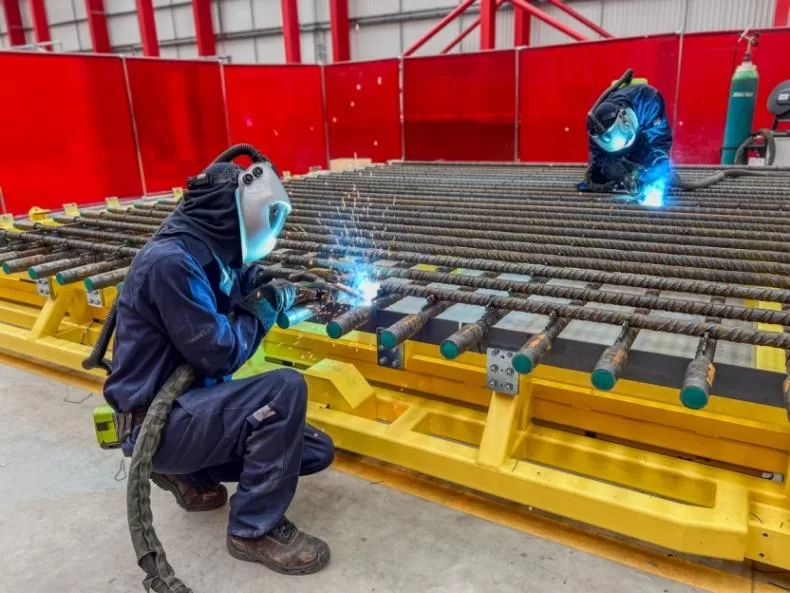
- Steel rebar supplied by the rebar factory in Avonmouth
- Stainless-Steel tanks that have been prefabricated and assembled at Framatome’s factory in Avonmouth
- Loading pit prefabrication. The 1,305-tonne fuel handling structure was lifted in place by Big Carl (world’s largest crane) after on-site assembly
Social and Economic Utility Offered by Hinkley Point C Nuclear Power Project
The Hinkley Point C has also proven all-round utility after nuclear industry figures back in November revealed the following:
- Up to 3,500 jobs in Bristol were now supported by the nuclear industry. The number is around 27,000 in the larger South-West region – an estimate three times more than in 2014
- More than 300 companies in Bristol have won contracts at Hinkley Point C, with more than £2bn being expended
- Laing O’Rourke and Framatome have opened new factories for modular construction in Avonmouth. These employ around 150 people who build modular parts for the Somerset project
- 650 Engineers at the UK EPR Engineering centre based at Aztec West are involved in the Hinkley Point C project. The number is set to increase to support Sizewell C, Britain’s next nuclear project after Hinkley Point C
- Oldbury owned by Great British Nuclear and Berkeley owned by Chiltern Vital Group offer the potential to host small modular reactors and associated economic activity like data centres.
- The University of Bristol supports world-leading nuclear research and training. Bristol also benefits from facilities to support nuclear skills and the National College for Nuclear in Somerset, Bridgwater and Taunton College and South Gloucestershire and Stroud College.
Cost Challenges at Hinkley Point C Nuclear Plant
EDF had pushed back the commencement date of its British 3.2GW Hinkley Point C nuclear plant to 2029. This also had the cost of the undertaking ranging from £31 billion and £34 billion ($43.06 billion) according to 2015 values.
The project is the first new nuclear plant in Britain in the past two decades. It was expected to be up and running by June 2027. The most recent in cost estimates takes a range of £25 – £26 billion.
Why Hinkley Point C Nuclear Plant Project Costs Were Revised
According to a statement released by EDF, based on 2015 values, the project was to come at a cost of £34 billion. It also added that the two main reasons why the cost was revised was due to civil engineering costs and lengthy electro-mechanical phase.
Stuart Crooks, Managing Director at Hinkley Point C, said in a note to staff that the entity has been forced to adapt the plant’s design to meet the country’s regulations. This calls for up to 7,000 changes. Additionally, 70% more steel and 25% extra concrete will also be needed. He also highlighted that the civil works are slower than what they had expected.
Similar Major Nuclear Energy Project in the Region
The British government is looking to invest a further 1.3 billion in the planned 3.2-GW Sizewell C plant. Any extra costs and schedule overruns on the Hinkley Point C will solely be handled by EDF and its partners. This is because HPC is not owned by the government. The statement reflects those of the spokesperson for the Department of Energy,
Other new nuclear projects in Europe also saw delays midst huge costs increases. These include those in Olkiluoto, Finland and Flamanville, France.
Also read:
Sizewell C nuclear power station in the UK
The UK to Develop Eight Additional Nuclear Power Plants
Hinkley Point C Nuclear Power Plant, First of its Kind to be Built in UK Since 1995