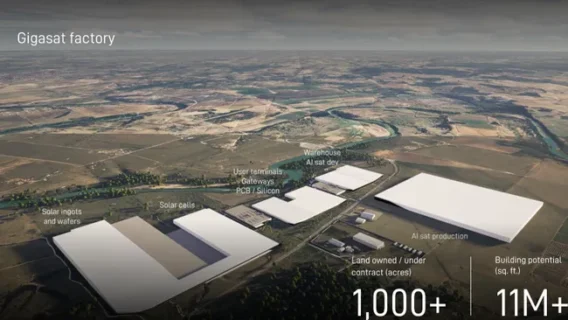
Space-based data center manufacturing takes a historic leap forward with the Gigasat factory, SpaceX’s most ambitious construction undertaking to date. Spanning over 11 million square feet across a 1,000-acre site in Bastrop, Texas, the facility will manufacture AI satellites designed to deliver computing power from orbit.
Announced by CEO Elon Musk, the project targets 1 gigawatt (GW) per year of space AI compute capacity by late 2027. Furthermore, the Gigasat factory is more than ten times larger than Starfactory, SpaceX’s current largest spacecraft manufacturing complex. Altogether, the undertaking signals a fundamental shift in how the company and the broader tech industry envisions the future of AI infrastructure.
Gigasat Factory Construction Reshapes Space-Based Data Center Manufacturing
Construction at the Bastrop site is already underway. Solar manufacturing facilities broke ground first, with equipment installation accelerating through April and May 2026. Additionally, the AI satellite production building is about to break ground, according to Musk. The solar cell factory alone covers a planned 1.1 million square feet, with potential to expand to roughly 1.6 million square feet. Moreover, the plant targets an annual solar production capacity of 10 gigawatts, split across two production floors each rated at 5 GW. These are not conventional rooftop panels they are aerospace-grade cells purpose-built to power AI workloads in orbit.
The Gigasat facility will vertically integrate much of its supply chain on a single campus. Consequently, the site will manufacture solar ingots and wafers, solar cells, printed circuit boards (PCBs), silicon-based electronic components, user terminals, gateways, and the AI1 satellites themselves. Satellite development and testing facilities, warehousing and logistics infrastructure, and a large-scale AI satellite production line will also be included. SpaceX expects to produce a meaningful volume of orbital data center satellites by the end of 2027, with two prototype AI1 satellites scheduled for launch in early 2027.
The AI1 Satellite: The Core Product of Space-Based Data Center Construction, Gigasat factory
At the heart of the Gigasat project is the AI1 satellite—SpaceX’s first-generation orbital data center platform. The satellite spans roughly 70 meters (229.66 feet) in wingspan, wider than a Boeing 747-8. A massive solar array, generating power at a density of 250 W/m², makes up the bulk of its structure. In addition, AI1 features vertically oriented, double-sided radiators for heat dissipation, with a 150-kilowatt (kW) peak compute payload positioned at the center. A 110-square-metre liquid radiator sheds waste heat as infrared light into the vacuum of space.
Each AI1 satellite carries 150 kW of compute power and uses laser links to transfer data between satellites and back to Earth. The compute payload is interchangeable, allowing for upgrades over time. SpaceX has filed plans for a mega constellation of up to one million satellites. Therefore, the Gigasat factory must scale production to extraordinary levels launching over 6,000 AI1 satellites annually just to meet the 1 GW/year compute target by end of 2027. For scale, Starlink had approximately 10,500 active satellites as of June 2026.
The ground-based data center industry continues to expand in parallel. The $2.5 billion CloudHQ campus in Mount Prospect, Illinois, broke ground on a 1.5 million square foot site, converting a former United Airlines hub into three data center buildings, each demanding over 80 MW of power. That project illustrates the enormous land and energy footprint that ground-level AI infrastructure requires the very constraints that make SpaceX’s orbital approach compelling.
Gigasat factory, Space-Based Data Center Ambitions Beyond 2027
Musk has outlined an aggressive scaling roadmap beyond the initial 1 GW milestone. He targets 10 GW per year by 2029 and as much as 100 GW per year by 2030. To put that in perspective, Meta’s Hyperion data center in Louisianathe largest AI data centre ever announced on the ground is designed to scale to only 5 GW at full buildout for over $100 billion. xAI’s Colossus 2 in Memphis, currently the world’s largest single-site AI installation, operates at nearly 2 GW for approximately $18 billion. Consequently, SpaceX’s 100 GW/year goal equates to roughly 20 Hyperions or 50 Colossus-2 facilities per year, delivered from orbit.
To support the chip supply needed at that scale, SpaceX together with Tesla and xAI is developing Terafab, a proposed 100-million-square-foot semiconductor factory in Austin. The facility aims to produce 100 to 200 million advanced chips annually at the 2nm node, ultimately targeting 1 terawatt of compute output. However, industry observers have noted widespread skepticism about the project, since none of the three companies has previously manufactured chips at any scale.
Nevertheless, the Gigasat factory itself rests on more solid footing. Manufacturing solar arrays, wiring, and satellite bodies at volume largely builds on technology SpaceX already produces for its Starlink V3 satellites simply at far greater scale. Moreover, the business model mirrors SpaceX’s terrestrial strategy: lease the compute. The company already rents AI capacity from ground data centers and its IPO filing reportedly names two anchor customers. As energy constraints increasingly limit ground-based AI expansion, orbital compute is emerging as a credible long-term alternative and the Gigasat factory stands at the center of that bet.
Project Fact Sheet
Project Name: Gigasat Factory
Type: Large-scale aerospace and satellite manufacturing facility
Location: Bastrop, Texas, USA
Site Area: Over 1,000 acres owned or under contract
Total Building Potential: Over 11 million square feet
Solar Cell Factory Footprint: 1.1 million square feet (expandable to ~1.6 million sq ft)
Solar Production Capacity: 10 GW per year (two 5 GW production floors)
Estimated Project Investment: Part of SpaceX’s broader $55 billion Terafab/Gigasat infrastructure program
Construction Start: Solar manufacturing facilities began construction in late March 2026
AI Satellite Production Building: Breaking ground mid-2026
Target Production Commencement: End of 2027
Primary Product: AI1 orbital data center satellites
AI1 Satellite Wingspan: ~70 metres (229.66 feet)
AI1 Compute Payload: 150 kW peak; 120 kW sustained
Solar Power Density – AI1: 250 W/m²
AI1 Cooling System: 110 m² liquid radiator (passive, infrared emission into space)
Compute Target (2027): 1 GW/year of orbital AI compute
Compute Target (2030): 100 GW/year
Mega constellation Filing: Up to one million satellites
Prototype Satellite Launches: Two AI1 prototypes planned for early 2027
Comparable Scale: More than 10x larger than Starfactory, SpaceX’s current largest spacecraft manufacturing site
Project Team
Developer/Owner: SpaceX (Space Exploration Technologies Corp.)
Chief Executive Officer: Elon Musk
Director of Solar Production: Noah Cowles
Anchor Compute Customers: Two undisclosed anchor customers named in SpaceX’s IPO filing
Strategic Partners (Terafab chip supply chain): Tesla and xAI — co-developers of the Terafab semiconductor facility in Austin, Texas, targeting 2nm chip production
Local Permitting Authority: Bastrop County, Texas
Reported IPO Adviser: SpaceX is heading toward a public offering as early as June 2026, with an IPO valuation reported at approximately $1.75 trillion
Related Government Contract: U.S. Space Force awarded SpaceX a $2.29 billion contract on May 26, 2026, to build the Space Data Network backbone, with a fully operational prototype required by end of 2027


Leave a Reply