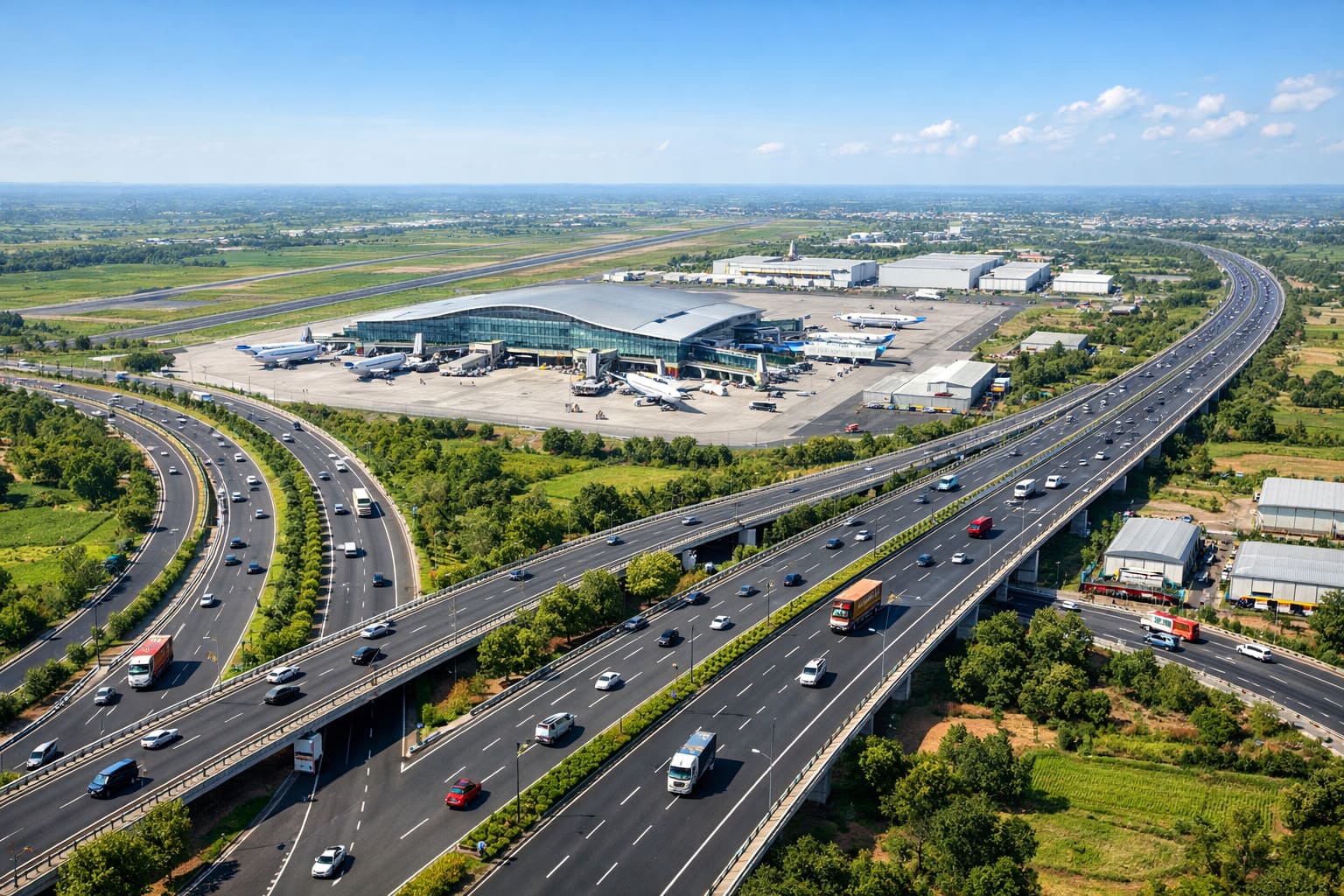
Greenfield Connectivity to Jewar International Airport has received a revised capital approval from India’s Union Cabinet to strengthen regional transport infrastructure. The government approved the project at about $395 million, enabling faster road access between the Delhi–Mumbai Expressway and the upcoming airport. The corridor will improve mobility across the National Capital Region while supporting logistics efficiency and economic growth in northern India.
The Cabinet Committee on Economic Affairs, chaired by the Prime Minister, Narendra Modi, approved the revised cost estimate for constructing the 31.42-kilometre Greenfield corridor. The route will connect the Delhi-Faridabad-Ballabhgarh-Sohna spur of the Delhi–Mumbai Expressway to the upcoming Noida International Airport in Jewar. The project will proceed under the Hybrid Annuity Mode (HAM) across the states of Uttar Pradesh and Haryana.
Greenfield Connectivity to Jewar International Airport Strengthens NCR Mobility
The corridor will provide direct, high-speed road access from South Delhi, Faridabad, and Gurugram to the airport. Consequently, it will reduce travel time and enhance connectivity for passengers and cargo traffic.
Furthermore, the highway will integrate several major transport corridors across the National Capital Region. The alignment will intersect the Eastern Peripheral Expressway, the Yamuna Expressway, and the Dedicated Freight Corridor. This integration will strengthen multimodal connectivity and improve freight movement efficiency across the region.
Additionally, the corridor will support large-scale urban expansion planned under the Faridabad Master Plan 2031. As a result, planners expect the project to stimulate industrial investment and commercial development along the route.
Elevated Section within Greenfield Connectivity to Jewar International Airport
The project includes a significant elevated segment designed to improve traffic flow and maintain uninterrupted connectivity. Approximately 11 kilometers of the corridor will run as an elevated highway between the DND-Ballabhgarh Bypass and the airport link road.
This elevated portion will cost around ₹689.24 crore, forming a critical component of the airport access infrastructure. The Government of Haryana has agreed to contribute roughly ₹450 crore toward this section.
Moreover, the elevated alignment will help minimize congestion in densely developed urban zones. It will also ensure uninterrupted traffic movement between the Delhi–Mumbai Expressway and the airport corridor.
Strategic Role in Airport Infrastructure Development
The road project plays a strategic role in supporting the operational readiness of Noida International Airport. The airport recently secured its aerodrome license from India’s aviation regulator and is expected to begin operations soon.
Therefore, the new connectivity corridor will ensure efficient passenger and cargo access once the airport becomes operational. The project will also complement other transport initiatives linking the airport with expressways, freight corridors, and industrial clusters across northern India.
In addition, improved connectivity will strengthen the logistics ecosystem surrounding the airport. Analysts expect faster cargo movement and enhanced regional accessibility across the NCR.
Meanwhile, the connectivity corridor will directly support the development of Noida Jewar International Greenfield Airport in India, one of India’s largest upcoming aviation hubs. The airport project, which is being implemented in phases, will eventually handle more than 100 million passengers annually once fully expanded.
Regional Economic and Logistics Impact
The corridor will reinforce the government’s strategy to expand multimodal infrastructure across India. Improved connectivity between expressways, freight corridors, and airports will support efficient supply chains and trade networks.
Furthermore, the project will unlock new development zones around Faridabad, Greater Noida, and Jewar. Urban planners anticipate growth in logistics parks, manufacturing hubs, and residential developments along the corridor.
Consequently, the road link will serve as a key infrastructure component supporting the expansion of Noida International Airport as a major aviation hub. The corridor will also strengthen economic integration across Uttar Pradesh, Haryana, and Delhi.
Project Fact Sheet
Name of project: Greenfield Connectivity to Jewar International Airport
Project Cost: Approximately $395 million (₹3,630.77 crore)
Length: 31.42 km
Project Type: Greenfield highway corridor
Implementation Mode: Hybrid Annuity Mode (HAM)
States Covered: Uttar Pradesh and Haryana
Connectivity Route: Delhi-Faridabad-Ballabhgarh-Sohna spur of the Delhi–Mumbai Expressway to Noida International Airport
Elevated Section: Approximately 11 km
Elevated Section Cost: ₹689.24 crore
Funding Contribution: Haryana government contributing ₹450 crore for elevated section
Key Intersections:
- Eastern Peripheral Expressway
- Yamuna Expressway
- Dedicated Freight Corridor
Strategic Objective:
- Improve connectivity to Noida International Airport
- Support regional logistics and cargo movement
- Enhance mobility across the National Capital Region
Estimated Economic Impact:
- Reduced travel time to airport
- Improved freight efficiency
- Accelerated urban development along corridor
Project Team
Project Owner: National Highways Authority of India (NHAI)
Policy Approval Authority: Cabinet Committee on Economic Affairs
Central Government Stakeholder: Government of India
State Government Stakeholders:
- Government of Uttar Pradesh
- Government of Haryana
Airport Development Entity: Yamuna International Airport Private Limited
Supporting Infrastructure Authorities:
- Uttar Pradesh Expressways Industrial Development Authority (UPEIDA)
- National Industrial Corridor Development Corporation
Implementation Model: Hybrid Annuity Mode concessionaire (to be appointed by NHAI)
Leave a Reply