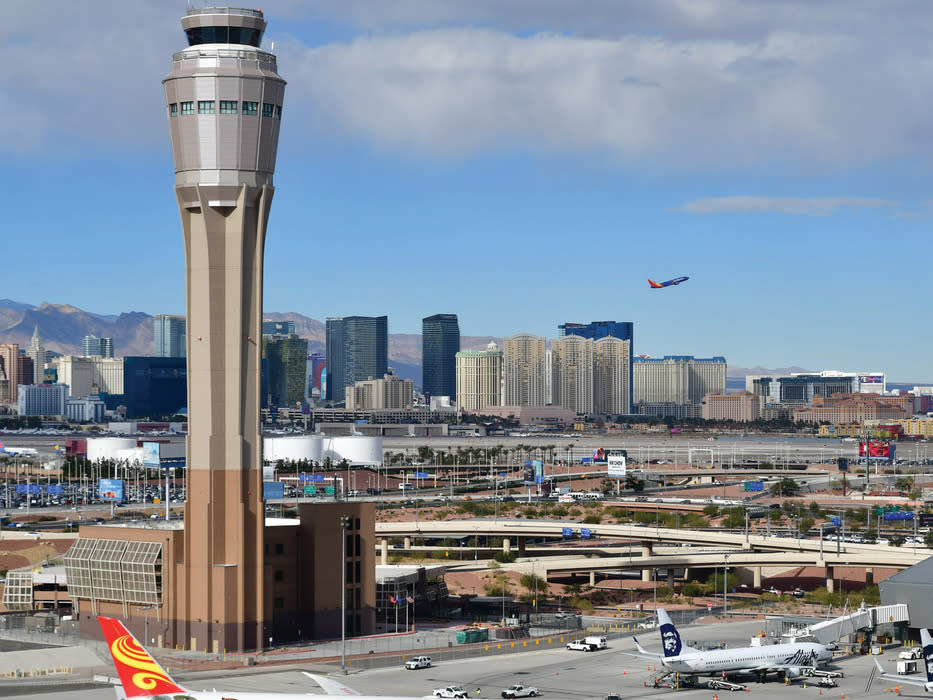
The Harry Reid International Airport Terminal 1 redevelopment in Las Vegas has moved from concept to detailed blueprint, with the Clark County Department of Aviation laying out a multibillion dollar modernization program designed to keep the landlocked hub from hitting a hard capacity wall. Officials warn that the airport is closing in on its practical ceiling of 65 million passengers a year and is projected to be severely capacity constrained by 2033, a forecast that has given the plan real urgency. Because the existing 2,800 acre site is boxed in by urban density and resort development, engineers have no room to add runways, so the entire strategy rests on squeezing more throughput out of the terminals that already exist. The centerpiece is a structural overhaul of Terminal 1, whose gate count would grow from 39 to 65 by replacing the dated A and B cluster buildings with a modern pier design and building a new wing on the former Terminal 2 site. The work also widens security checkpoint lanes, reconfigures baggage claim, and broadens interior corridors to ease congestion at peak. County leaders have framed the upgrade as essential to a tourism economy preparing for Super Bowls, Final Fours, Formula 1, and a possible NBA franchise, with the airport positioned as both the first and last impression visitors carry of the city.
Las Vegas Airport Expansion Joins a Wave of Western US Terminal Builds
The Las Vegas project lands in the middle of a broad reinvestment cycle across major Western airports, where landlocked sites are forcing operators to rebuild rather than sprawl. The closest comparison sits 270 miles southwest at Los Angeles International, where airport commissioners broke ground on the Midfield Satellite Concourse South, an eight gate complex linked to the Tom Bradley International Terminal that added roughly 150,000 square meters using a first of its kind off site build and relocation method. Both schemes share the same underlying logic, adding gate capacity within a fixed footprint instead of acquiring new land, and the Los Angeles concourse program offers a useful benchmark for how phased, operations sensitive construction can proceed at a live hub. Scale and cost are the obvious differences. Harry Reid’s last marquee build, the $2.4 billion Terminal 3, opened in 2012 after about four years of construction, and that figure gives the clearest public yardstick for what a full Terminal 1 rebuild could cost, since the aviation department has not yet attached an official price tag to the new program. The modernization also carries a longer game. Clark County is advancing the separate Southern Nevada Supplemental Airport in the Ivanpah Valley near Jean and Primm, roughly 30 miles south, though that twin runway facility is not expected to open until at least 2037, which is precisely why Terminal 1 must absorb growth in the meantime.
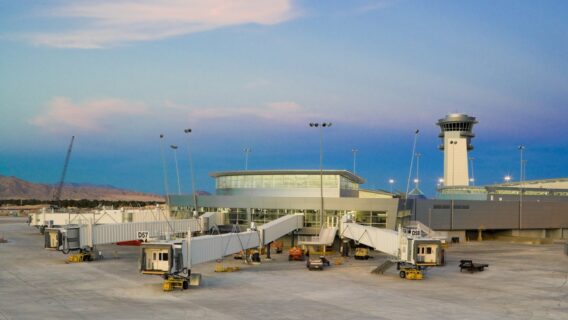
Harry Reid International Airport Terminal 1 Timeline and What Comes Next
On current planning, the timeline runs across the next decade rather than a single build season. The aviation department aims to complete design and secure a federal record of decision to proceed by May 2028, with construction starting around 2029. Roadway improvements, including a terminal to terminal flyover that separates airport circulation from commuter traffic, are targeted for mid 2030, followed by two multimodal transit centers on the north and south boundaries by mid 2033 and the fully rebuilt Terminal 1 by late 2034, which is the headline completion date travelers are watching. Terminal 3 will be renamed Terminal 2 and fitted with curbside self bag drop technology, while airlines are redistributed across the campus to balance loads. Senior officials have stressed that the design is not final and will evolve as airline negotiations continue, so gate layouts and sequencing could still shift. The biggest open questions are funding and approvals. The department expects to draw on user fees from parking, gaming, concessions, and airline charges rather than a single capital appropriation, which keeps the latest plan flexible but ties delivery to sustained passenger revenue across the build window.
Project Fact Sheet
- Project Name: Harry Reid International Airport Terminal 1 Redevelopment (Modernization and Maximization Plan)
- Location: Las Vegas, Clark County, Nevada, USA
- Project Value: Not officially disclosed; the comparable Terminal 3 build cost $2.4 billion in 2012, per Clark County records
- Client / Owner: Clark County Department of Aviation
- Key Components: Terminal 1 gate expansion from 39 to 65 gates, new pier design concourse, new wing on the former Terminal 2 site, widened security lanes, reconfigured baggage claim
- Supporting Works: Terminal to terminal flyover roadway, two multimodal transit centers, renaming of Terminal 3 to Terminal 2, self bag drop technology
- Procurement Model: Publicly funded through airport user fees including parking, gaming, concessions, and airline charges
- Design and Approval: Targeted record of decision by May 2028
- Construction Start: Around 2029
- Expected Completion: Terminal 1 redevelopment by late 2034; roadways by mid 2030; transit centers by mid 2033
- Strategic Impact: Lifts capacity toward and beyond the 65 million annual passenger ceiling ahead of major sporting and convention events
- Related Project: Southern Nevada Supplemental Airport in the Ivanpah Valley, targeted for 2037
Project Team
- Client / Owner: Clark County Department of Aviation
- Governing Authority: Clark County Board of Commissioners
- Director of Aviation: James Chrisley
- Managing Director of Planning: Bryant Holt
- Former Director of Aviation: Rosemary Vassiliadis, who led the department from 2013 and introduced the maximization concept
- Airport Chief Financial Officer: Joseph Piurkowski
- Main Contractor: Not yet awarded
- Design Consultants: Not yet disclosed
Frequently Asked Questions
When will the Harry Reid International Airport Terminal 1 redevelopment be completed? The rebuilt Terminal 1 is targeted for late 2034, with construction expected to begin around 2029 after a record of decision anticipated by May 2028.
How much does the Harry Reid International Airport Terminal 1 redevelopment cost? No official figure has been released. The project is described as a multibillion dollar program, and the comparable Terminal 3, completed in 2012, cost $2.4 billion.
Who is leading the Harry Reid International Airport Terminal 1 project? The Clark County Department of Aviation owns and leads the project, with James Chrisley serving as Director of Aviation and Bryant Holt as Managing Director of Planning.
How many gates will the Harry Reid International Airport Terminal 1 have? The plan expands Terminal 1 from 39 gates to 65 gates, adding 26 gates through a new pier design concourse and a wing on the former Terminal 2 site.
Why is Harry Reid International Airport being expanded? The airport is approaching its 65 million annual passenger ceiling and is projected to be severely capacity constrained by 2033, while its landlocked site leaves no room for new runways.

Leave a Reply