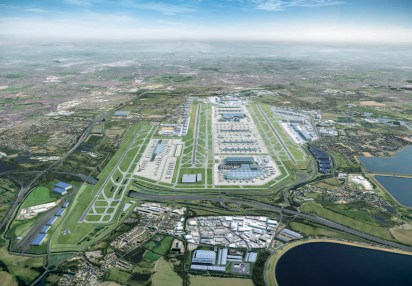
Heathrow Airport expansion plans are drawing industry attention after proposals revealed that a new multi-storey parking complex could rank among the most expensive globally.
Developers have provisionally allocated about £2.6 billion to the consolidated car park facilities within a wider £24 billion Heathrow Airport expansion program aimed at expanding capacity and modernizing surface access infrastructure.
Transport Infrastructure Drives Heathrow Expansion
Heathrow expansion centers on a broader airside and landside transformation. However, transport infrastructure remains a dominant cost component. Plans indicate that airport operators will reconfigure road access, terminals, and parking facilities. Consequently, the car park has emerged as a high-value element within the program.
The proposed structure would support passenger growth linked to a third runway. In addition, it would integrate with revised drop-off systems and internal circulation routes. Developers aim to optimize vehicle flow and reduce landside congestion. Therefore, planners have embedded the facility within a comprehensive ground transport strategy.
Estimates place the car park cost at roughly £2.6 billion. By comparison, standalone parking structures rarely approach that valuation globally. Nevertheless, project engineers cite complexity, phasing constraints, and operational continuity as key cost drivers. They must maintain airport operations throughout construction. As a result, staging and logistics will significantly influence delivery costs.
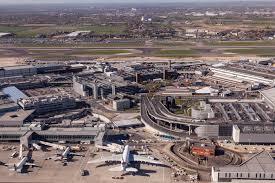
Capacity Expansion and Phased Delivery
Heathrow expansion forms part of a long-term capacity strategy. The airport seeks to increase annual passenger throughput beyond current limits. Accordingly, the master plan includes terminal adaptations and apron works. It also integrates surface access improvements across rail and road networks.
The proposed third runway remains central to the expansion blueprint. However, enabling infrastructure must advance in parallel. Engineers will therefore coordinate runway works with landside upgrades. This integration increases engineering complexity and capital exposure. Furthermore, inflationary pressures in materials and labor continue to shape cost forecasts.
Developers have factored escalation risks into financial modelling. At the same time, procurement strategies aim to manage supply chain volatility. Heathrow expansion also requires statutory approvals and environmental compliance. Design teams must address carbon performance and sustainability benchmarks. Consequently, structural solutions may incorporate low-carbon materials and energy-efficient systems. The car park could adopt modular construction techniques. Such methods would accelerate timelines while improving quality control.
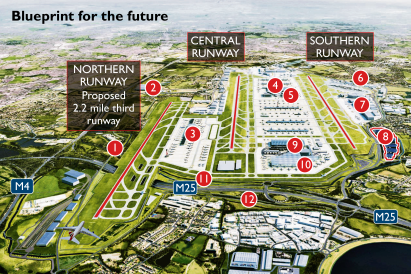
Investment Context and Industry Implications
The wider Heathrow expansion program carries an estimated capital value of £24 billion.
Transport infrastructure alone accounts for a significant share of that allocation. Therefore, stakeholders across aviation construction are closely monitoring developments.
Major contractors, consultants, and infrastructure financiers could participate in phased packages. Moreover, the project may stimulate supply chain demand across structural steel, precast systems, and intelligent transport technologies.
Industry analysts view the car park valuation as indicative of integrated infrastructure costing. They argue that airport expansions now require holistic transport ecosystems. Thus, Heathrow expansion reflects a shift toward multi-modal capacity planning.
While timelines remain subject to regulatory processes, preparatory planning continues. Developers are refining scope definitions and cost validations. As feasibility assessments advance, procurement frameworks will likely take shape. Heathrow expansion therefore stands as one of Europe’s most capital-intensive aviation infrastructure programs.
If delivered as outlined, the car park component alone would rank among the most expensive globally. Accordingly, the scheme highlights the scale and financial weight of modern hub airport expansion.
The Heathrow Airport expansion proposal aligns with the UK Government approval of the £2.2 billion second runway project at Gatwick Airport, designed to significantly increase airfield capacity and passenger throughput. Like Heathrow’s plans, the Gatwick expansion focuses on enhancing operational performance and surface access as part of long‑term infrastructure growth strategies.
Project Fact Sheet: Heathrow Expansion (Including Parkway Car Parks)
- Project Name: Heathrow Airport Expansion Program
- Location: London Heathrow Airport, United Kingdom
- Major Components: Third runway, new terminal capacity, expanded transport infrastructure, parkway car parks.
- Parkway Parking Estimate: £2.6 billion total transport infrastructure cost; £1.3bn for parking structures.
- Parking Capacity: Approx. 36,000 spaces across northern and southern parkways.
- Estimated Per Space Cost: £72,000 (implied).
- Total Expansion Investment: Up to £49 billion across all components.
- Funding Model: Private investment by Heathrow Airport Limited and partners.
- Status: Planning and consultation, regulatory review in progress.
Project Team — Heathrow Expansion
- Project Sponsor: Heathrow Airport Limited
- Lead Delivery Authority: Heathrow Expansion Delivery Board
- Government Oversight: UK Department for Transport and relevant planning bodies
- Consultants & Advisors: Infrastructure design, engineering, transport planning firms (specific appointments pending regulatory approvals)
- Finance Partners: Airport shareholders and private lenders under project finance arrangements
Leave a Reply