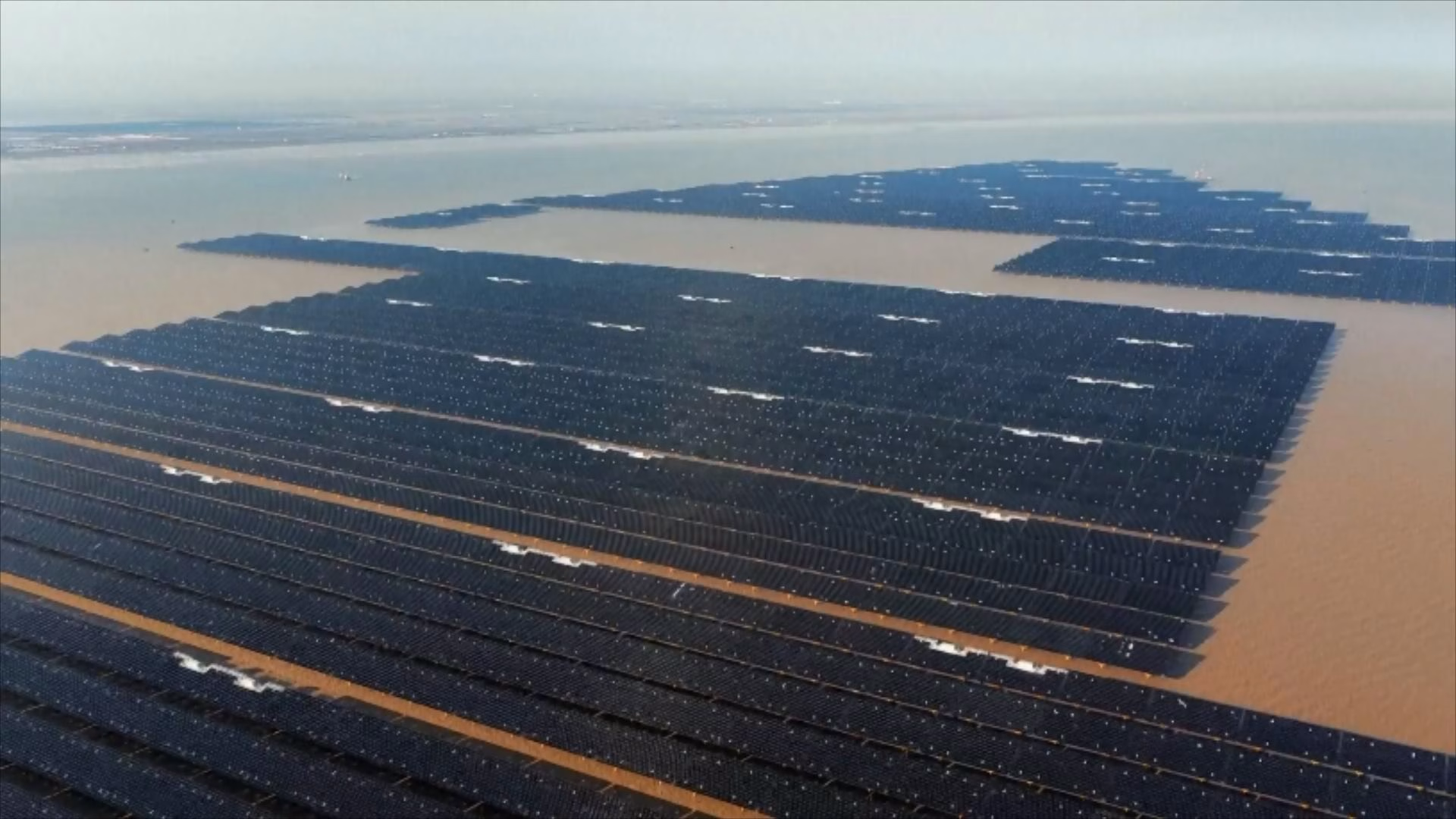
China has brought its first gigawatt-scale fixed-pile offshore solar power plant fully into operation, marking a major step in the country’s offshore renewable energy ambitions. The 1 GW HG14 offshore photovoltaic (PV) project, developed by Guohua Investment, a subsidiary of China Energy Investment Corporation (CHN Energy), is located off the coast of Dongying in Shandong province.
The project achieved full-capacity grid connection in December 2025. It is situated about eight kilometres offshore in shallow waters ranging from one to four metres deep, covering an area of approximately 1,223 hectares.
First of its kind under national sea-use framework
HG14 is notable as China’s first gigawatt-level offshore solar facility built using a fixed-pile foundation system. China has also hosts the largest solar farm in the world that is located in Xinjiang Province, China and has a total capacity of 3.5 GW signalling China’s dominance in the renewable energy generation sector.
It is also the first offshore PV project approved under China’s national three-dimensional sea-use rights policy, which allows integrated use of marine space for energy, aquaculture, and other activities. The total investment in the project is estimated at CNY 8.1 billion (around USD 1.2 billion).
Engineering design for harsh marine conditions
The solar plant consists of 2,934 steel PV platforms, each measuring roughly 60 metres by 35 metres. These platforms are supported by a total of 11,736 steel piles driven into the seabed. The fixed-pile structure has been designed to withstand strong winds, waves, tidal forces, and seasonal sea ice, overcoming challenges that have historically limited offshore solar development in northern China.
High-efficiency modules and offshore performance gains
More than 2.3 million high-power 710-watt n-type bifacial solar modules are installed at a tilt angle of 15 degrees. According to project data, the offshore environment improves power generation efficiency by between 5% and 15% compared with similar onshore installations. Lower ambient temperatures and the reflective effect of the sea surface both contribute to higher output.
Grid connection and energy storage integration
Electricity generated by the plant is transmitted to shore through a 66 kV subsea cable network, linked to onshore lines and a 220 kV substation. The project also includes a 100 MW / 200 MWh energy storage system, which helps stabilise output and improves dispatch flexibility. CHN Energy reports that the combined transmission approach increases capacity by about 20% while cutting unit transmission costs by roughly 15%.
Environmental and economic benefits
Once fully operational, HG14 is expected to produce around 1.78 terawatt-hours of electricity each year. This output is sufficient to meet about 60% of the annual power demand of Dongying’s Kenli district. The project is projected to reduce carbon dioxide emissions by approximately 1.34 million tonnes annually and save more than 500,000 tonnes of coal.
In addition, the plant adopts a “PV-above, aquaculture-below” model, allowing fish and shellfish farming beneath the solar platforms. This dual-use approach improves marine space efficiency and provides additional income streams for local communities.
Project Factsheet: HG14 Offshore Solar PV Project
- Project name: HG14 Offshore Photovoltaic Project
- Capacity: 1 GW
- Developer: Guohua Investment (CHN Energy)
- Location: Offshore Dongying, Shandong province, China
- Distance from shore: ~8 km
- Water depth: 1–4 metres
- Area covered: ~1,223 hectares
- Foundation type: Fixed-pile steel structures
- Solar modules: ~2.3 million bifacial n-type modules (710 W each)
- Annual generation: ~1.78 TWh
- Grid connection: 66 kV subsea cables to 220 kV onshore substation
- Energy storage: 100 MW / 200 MWh
- Estimated investment: CNY 8.1 billion (USD ~1.2 billion)
- CO₂ reduction: ~1.34 million tonnes per year
- Special feature: Integrated offshore aquaculture model
This project sets a new benchmark for large-scale offshore solar development and signals China’s intent to expand renewable energy deployment beyond land-based constraints.
Leave a Reply