
The Hudson Tunnel Project has reached a major milestone with the Gateway Development Commission (GDC) officially awarding the $1.29 billion “Package 1C” contract to a joint venture of Traylor, Walsh, and Skanska. This critical phase involves boring the twin tunnel tubes beneath the Hudson River, connecting New Jersey to Manhattan’s West Side, and follows the recent restoration of federal funding that briefly paused construction earlier this year. Parallel to this heavy civil engineering work, New York’s broader transit modernization is being driven by technology; specifically, the $390 million Siemens Mobility contract to overhaul the Fulton-Liberty subway lines with advanced CBTC signaling.
Additionally, Gateway Hudson Tunnel project reached a critical technical milestone with the assembly of two massive tunnel boring machines (TBMs) at the “Launchbox” site in North Bergen, New Jersey. These 28-foot-wide machines are designed to navigate challenging hard rock conditions, moving at a rate of approximately 30 feet per day while simultaneously excavating and installing pre-made concrete tunnel walls. The current phase involves a one-mile subterranean stretch that will reach depths of up to 280 feet near the Weehawken and Hoboken border before a separate set of machines begins the river crossing to Manhattan. Despite previous funding interruptions, the project has regained momentum and remains on schedule for a projected 2035 opening, utilizing conveyor systems and 59 specialized cutting blades to manage the high-pressure excavation process.
While the Hudson Tunnel focuses on expanding physical capacity between states, the Siemens project serves as the digital counterpart, replacing century-old infrastructure with the same caliber of high-frequency tech required to manage the increased passenger flow that the new river tunnels will eventually deliver to Penn Station.
January 10, 2023
Gateway Development Commission(GDC) is working towards building the Manhattan side of the Hudson River rail tunnel project in New York. A $292 million federal grant will fund the construction of the concrete casing for the box tunnel. This box tunnel is the first major construction step for the project.
Gateway Development Commission(GDC) is working towards building the Manhattan side of the Hudson River rail tunnel project in New York. A $292 million federal grant will fund the construction of the concrete casing for the box tunnel. However, this amount is just half of the entire $600 million cost for the new tunnel.
Leaders at GDC include representatives from New York, New Jersey, and the Amtrak company, which owns the tunnel and rail line. The non-profit entity intends to build a new tunnel that will carry trains in and out of Penn Station beneath Hudson Yards. In addition to this, the Hudson River rail tunnels will also serve as a critical component of the Gateway Tunnel project.
Overall, the Gateway project will cost about $30 billion in total and GDC expects it to wrap up by 2030. Upon completion, the project will make four tracks available for trains running between Newark and New York. The development will add several new tracks and bridges will be available west of Secaucus. Additionally, the Gateway project will involve renovating two older tracks which were first built in 1910.
Development plans for the Hudson River rail tunnel
Sen. Chuck Schumer said the Hudson River rail tunnel project would commence in the coming months. The project is one major component of the Gateway Program which consists of three main elements. It will involve construction on the Hudson Yards right-of-way preservation project, and a new Hudson Tunnel.
Lastly, the project also covers the rehabilitation and modernization of the existing North River tunnel. The tunnel will have a new two-track rail along the Northeast Corridor from the Bergen Palisades in New Jersey to Manhattan.
The first major construction step for the Hudson River tunnel component involves building the concrete box tunnel. According to Gateway Program’s spokesman, Stephen Sigmund, the westbound concrete tunnel casing from Penn Station to Tenth Avenue is now complete. Therefore, Sigmund said the federal funding will help extend the concrete tunnel casing from Tenth Ave. to the west of Eleventh Ave.
Project Overview
The Hudson Tunnel project seeks to rehabilitate the existing tunnel under the Hudson River. The tunnel carries Amtrak and NJ TRANSIT Northeast Corridor passenger trains between New Jersey and New York.
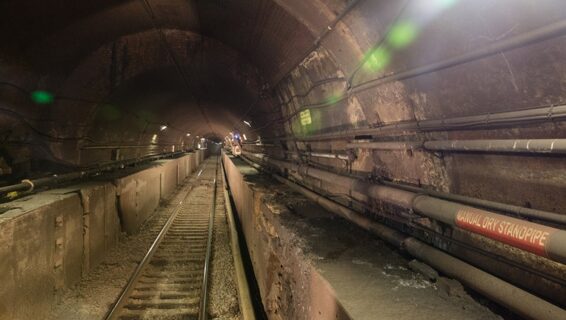
As part of the project, a new tunnel and associated railroad infrastructure to carry passenger rail trains will be constructed while the existing tunnel will be rehabilitated. The existing tunnel is more than 110 years old and prone to problems and delays due to aging signals, crumbling walls, and old wiring.
Saltwater intrusion from Superstorm Sandy in 2012 accelerated the tunnel’s deterioration. This led Amtrak, the company that owns the tunnel to begin costly repairs for the tunnel to continue being used.
A plan to add tracks in New York’s Penn Station to accommodate even more trains when both tunnels are in service is in the early stages of development.
Reported in August 2021
New Hudson River tunnel gets federal approval for construction
An US$11 billion rail tunnel in New York has received federal environmental approval. The Department of Transportation announced that the new Hudson River tunnel can now be constructed to connect New York and New Jersey and design and engineering work can go as planned.
Following approval, federal grants for the project are also now expected to be distributed smoothly once construction begins. According to Senate Majority Leader Chuck Schumer, there are enough funds in President Biden’s US$2.3 trillion infrastructure plan that could fund the project.
It would direct US$85 billion to update and replace subway cars and repair aging tracks and stations and US$25 of those funds would also go to expanding bus routes and rail lines.
“This is a big step for the Northeast, and for the entire country, as these tunnels connect so many people, jobs, and businesses,” Transportation Secretary Pete Buttigieg.



Leave a Reply