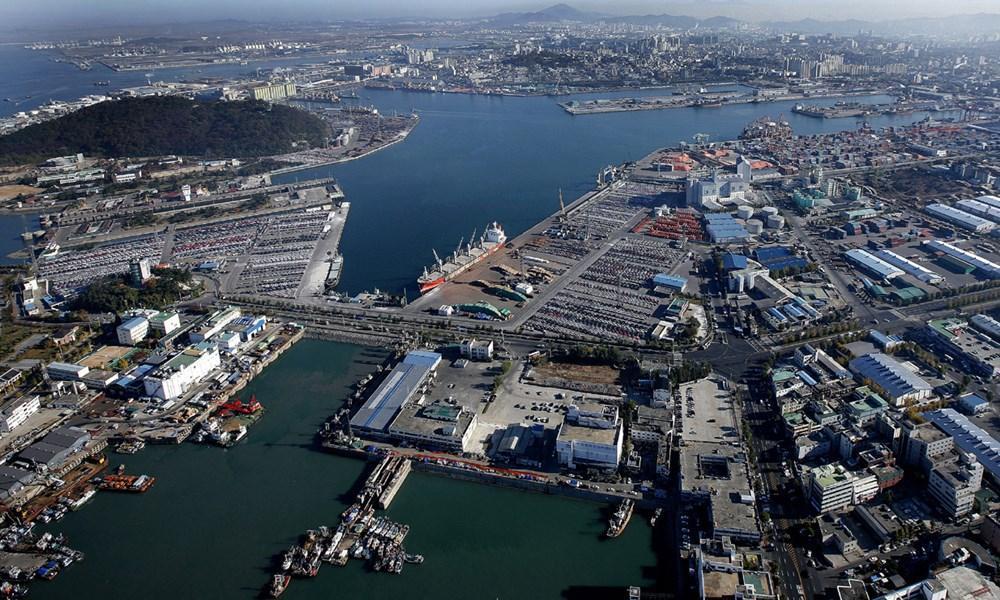
The Incheon Port Authority (IPA) has announced the commencement of superstructure construction at the Incheon New Port Phase 1-2 container terminal — marking the transition from five years of complex substructure works into the above-ground phase of a project that will deliver South Korea’s second fully automated port terminal and Incheon’s first. The ₩672.7 billion (approximately US$490 million) development, located in the 10th zone of Songdo International Business District within the Incheon Free Economic Zone, will feature three berths capable of handling vessels of up to 30,000 TEU capacity — larger than any currently in service — with an annual throughput of 1.38 million TEUs. The superstructure construction phase runs for 27 months, with the terminal slated to open in the second half of 2028 and the port’s total container handling capacity rising to 4.08 million TEUs upon commissioning.
Five Years Underground: What the Substructure Works Achieved
The substructure construction programme that began in May 2021 addressed one of the most demanding challenges any port infrastructure project faces: preparing the seabed and reclaimed land of Incheon’s coastal zone to bear the concentrated dynamic loads that advanced automated port equipment — automated stacking cranes, automated guided vehicles, and heavy container handling machinery — will impose 24 hours a day for decades. Songdo’s reclaimed land carries inherent soft ground risk, and the substructure works were specifically engineered to minimise differential settlement and ground subsidence that would compromise the precision positioning tolerances required for automated crane systems. The programme encompassed inner wall construction, dredging and deep reclamation works, and extensive ground improvement across the terminal footprint, and has now reached 99 per cent completion, with the final works scheduled to conclude by April 2026.
Project Fact Sheet: Incheon New Port Phase 1-2 Container Terminal
Project Name: Incheon New Port Phase 1-2 Container Terminal (Incheon Global Container Terminal)
Location: 10th Zone, Songdo International Business District, Incheon Free Economic Zone, Incheon, South Korea
Total Investment: ₩672.7 billion (~US$490 million)
Berths: 3 berths for vessels up to 30,000 TEU capacity (1 additional berth planned)
Annual Throughput Capacity: 1.38 million TEUs
Port Capacity After Opening: 4.08 million TEUs total for Incheon Port
Automation Type: Fully automated — automated stacking cranes (ASC/ARMG), automated guided vehicles (AGV), remote unmanned operations
Innovation: First U-shaped container yard passage in South Korea
Substructure Construction Start: May 2021
Substructure Completion: April 2026 (99% complete as of March 2026)
Superstructure Construction Start: March 2026
Superstructure Construction Duration: 27 months
Planned Terminal Opening: Second half of 2028
Significance: First fully automated terminal in Incheon; second in South Korea (after Busan New Port Phase 2-4, 2022)
Economic Impact: ₩269.9B value added; ₩621.7B production induced; ~6,000 jobs
Project Team: Incheon New Port Phase 1-2 Container Terminal
Port Authority / Developer: Incheon Port Authority (IPA)
IPA President: Lee Kyung-kyu
Terminal Operator (Concessionaire): Incheon Global Container Terminal Co., Ltd. (IGCT) — Implementation agreement signed November 2024
Consortium Members:
HMM (South Korea’s flagship container carrier)
KMTC Line (Korea Marine Transport Company — intra-Asia carrier)
Hanjin Transportation (logistics and port operations)
E1 Corporation (LPG trading and logistics)
Sun Kwang (port terminal operator — existing SNCT at Phase 1)
Main Construction Contractor(s): To be confirmed (superstructure phase)
Regulator / Zone Authority: Ministry of Oceans and Fisheries; Incheon Free Economic Zone Authority (IFEZA)
Port Throughput Targets: 5.0 million TEUs by 2030; 5.5 million TEUs by 2035
This extended substructure phase — lasting nearly five years against an original target of completion in the first half of 2025 — reflects both the geotechnical complexity of the site and the rigorous preparation standards that IPA has imposed to ensure the automated systems can operate reliably once the terminal opens. The 27-month superstructure phase now underway will deliver the physical infrastructure that hosts the automation: rail installation for automated stacking cranes, on-dock container yard paving to the surface tolerances required for automated guided vehicle operations, electrical and data communications systems throughout the terminal, and the operator building and control facilities from which the terminal will be remotely managed. The U-shaped container yard passage, introduced in a South Korean port terminal for the first time at this facility, will also be built during this phase — a layout innovation designed to optimise container movement efficiency within the yard and reduce the horizontal distances that automated vehicles must travel between ship-side quay cranes and the storage stacks.
The Operator Consortium and the Automation Technology Stack
In November 2024, IPA signed an implementation agreement with the provisional operator consortium, formally named Incheon Global Container Terminal Co., Ltd. (IGCT), following a competitive bidding process in which IGCT was selected as preferred operator in May 2024. The consortium brings together five South Korean shipping and port companies in a structure that aligns commercial incentives with operational accountability across the terminal’s entire logistics chain. HMM — South Korea’s flagship container carrier, which had previously operated automated terminals in Busan but not Incheon — leads the commercial side and brings international deep-sea shipping volumes. KMTC Line, a major South Korean intra-Asia carrier, contributes regional feeder traffic. Hanjin Transportation, the logistics and port handling group, provides operational expertise. E1 Corporation, an LPG trading and logistics conglomerate, contributes investment capacity. Sun Kwang, the established Incheon port terminal operator already running the existing Seokwang New Container Terminal (SNCT) at New Port Phase 1, provides the on-the-ground port operations knowledge that ties the consortium together.
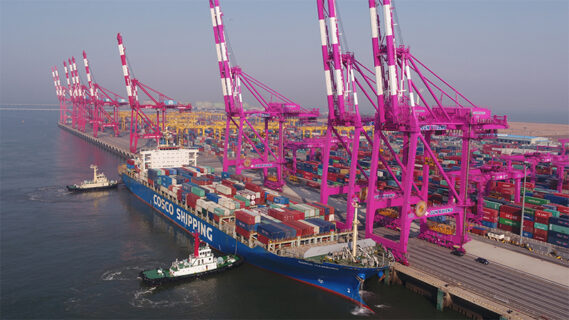
The automation technology deployed at Phase 1-2 will place the terminal in a peer group that globally numbers fewer than 20 fully automated container facilities, including APM Terminals Maasvlakte II in Rotterdam, the Qingdao New Qianwan terminal in China, and the Yang Shan Phase 4 terminal in Shanghai. In the Korean domestic context, the Phase 1-2 terminal follows Busan New Port’s Hanjin Container Terminal (Phase 2-4, opened 2022) as only the second fully automated terminal in the country. All container handling operations — quayside unloading and loading, horizontal transport within the terminal, and stacking and retrieval in the yard — will be performed by unmanned automated systems supervised remotely, eliminating the safety risk of human-machine interface in the most hazardous areas of port operations. IPA President Lee Kyung-kyu has framed the terminal’s AI-based automation as the centrepiece of his ambition to position Incheon as a global top-tier smart port, with the goal of achieving 5.5 million TEUs of total annual container throughput at Incheon Port by 2035.
What the Terminal Unlocks for Incheon Port and South Korea’s Trade
The opening of the Phase 1-2 terminal in the second half of 2028 will lift Incheon Port’s total container handling capacity from approximately 2.7 million TEUs to 4.08 million TEUs — a roughly 50 per cent step-change in capacity that gives the port the headroom to pursue its 5 million TEU annual throughput goal by 2030 and its 5.5 million TEU target by 2035. Incheon recorded 3.45 million TEUs in container traffic in 2023 — a record high at the time — and volumes have continued on an upward trajectory, driven by growing e-commerce trade flows between South Korea and China, rising South Korean seafood exports, the expansion of K-industry supply chains in batteries, bio-pharma, and semiconductors, and Incheon’s extraordinary position as the dominant gateway for South Korea’s used car export industry, through which approximately 500,000 vehicles pass annually, 80 per cent in containers. The port’s container route network has also expanded rapidly, reaching 72 regular services by early 2026.
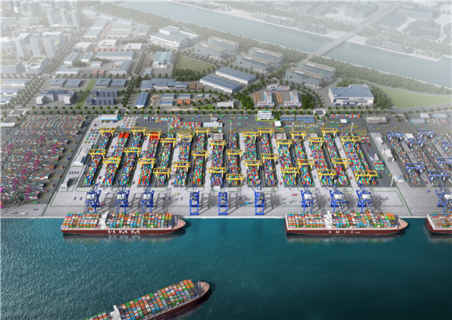
The Phase 1-2 terminal’s ability to handle vessels of up to 30,000 TEU capacity — exceeding the 24,000 TEU maximum of the world’s current largest container ships, and therefore future-proofing the berths against the next generation of ultra-large vessels — is a deliberate strategic choice. As global shipping networks have consolidated onto ever-larger mainline vessels calling fewer but deeper ports, Incheon’s previous Phase 1 terminals have been constrained in their ability to attract the largest strings from the Asia–North America and Asia–Europe trades. The new berths remove that constraint entirely, opening the port to the kind of ultra-large vessel calls that currently bypass Incheon in favour of Busan — and in doing so, strengthening the case for Incheon as a primary port of call rather than a transshipment feeder in the evolving Northeast Asian port hierarchy.
Incheon New Port in Northeast Asia’s Port Automation Race
The timing of Incheon’s Phase 1-2 automation investment reflects a regional competitive dynamic in which South Korean ports are acutely aware of the technology gap that has emerged between their existing infrastructure and the automated terminals that have proliferated across Chinese ports in the past decade. China’s Qingdao New Qianwan, Shanghai Yang Shan Phase 4, and Tianjin Xiagang automated terminals collectively handle tens of millions of TEUs annually with labour efficiencies that conventional ports cannot match, and they are serving as the benchmark against which port authorities across Japan, South Korea, Vietnam, and the Philippines are now measuring their own digitisation and automation ambitions. South Korea’s Ministry of Oceans and Fisheries has embedded port automation as a central pillar of the national maritime logistics strategy, supported by a multi-trillion-won capital investment framework that funds both the physical infrastructure and the domestic development of port automation technology — sensors, cranes, automated guided vehicles, and terminal operating systems — as a policy goal in its own right. Indonesia is pursuing a parallel track of port capacity expansion with a different emphasis — on new greenfield terminal development to serve fast-growing industrial hinterlands — as illustrated by the ICTSI East Java Terminal Project at Lamongan, a new breakbulk and container terminal featuring a 300-metre quay, post-Panamax cranes, and a super heavy lift deck designed to serve the oil, gas, and industrial sectors of East and Central Java.
For IPA and the IGCT consortium, the Phase 1-2 opening in 2028 will be more than a capacity addition — it will be the operational demonstration that South Korea can build and run a world-class automated port terminal end-to-end, using domestic expertise across engineering, equipment manufacture, systems integration, and operations management. The terminal’s economic impact has been quantified at ₩269.9 billion in value added, ₩621.7 billion in induced production, and approximately 6,000 jobs across the construction and operational lifecycle. In a region where the competition for container volumes, shipping line alliances, and logistics investment is intensifying year by year, that combination of capacity, capability, and credibility is precisely what Incheon Port needs as it builds toward its 2030 ambitions.
Leave a Reply