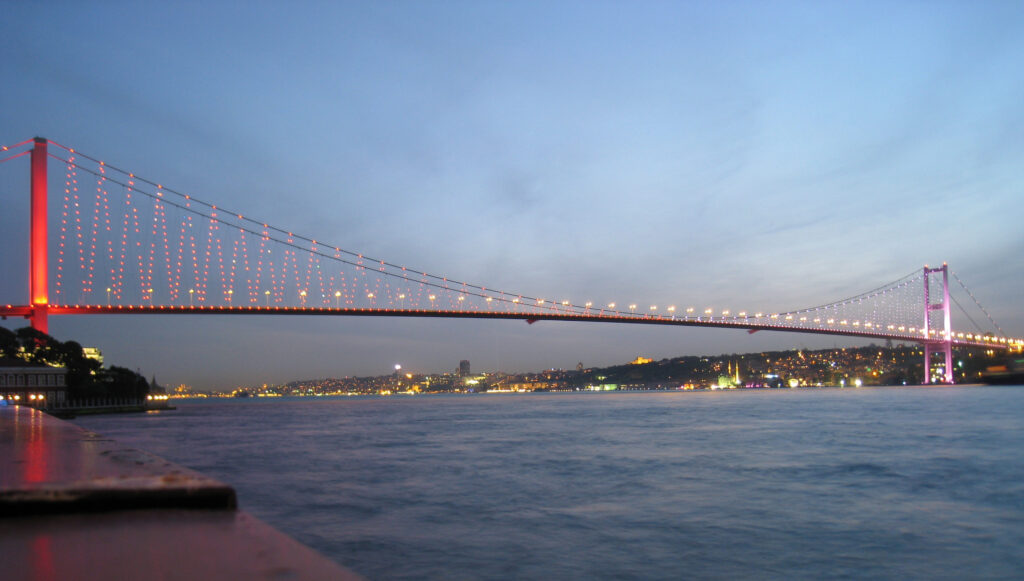
The World Bank has approved a $2 billion loan for the Istanbul North Rail Crossing Project, known as INRAIL , in Türkiye, in what is the anchor financing for a broader $6.75 billion coordinated package assembled by six multilateral development banks. With a total estimated project cost of approximately $8.3 billion, INRAIL is one of the largest transport infrastructure investments in Türkiye’s history and one of the most consequential rail projects currently underway anywhere in the world. The announcement, made on March 31, 2026, marks the culmination of years of planning to resolve one of Eurasia’s most strategically critical infrastructure bottlenecks: the rail crossing of the Istanbul Strait.
A Chokepoint That Has Held Back a Continent
Türkiye’s major rail corridors passing through Istanbul — including the Transcaspian Transport Corridor, the Iraq Development Road, and the Türkiye-EU corridor — are essential for trade and economic growth but currently face a critical bottleneck at the Bosphorus. The Istanbul Strait, which divides Europe from Asia, is one of the world’s most trafficked waterways and sits at the geographic heart of Eurasian trade. Yet for all its strategic significance, its rail infrastructure has remained a severe constraint: rail freight capacity across the Bosphorus currently stands at around 3 million tons per year. For a corridor that links European markets to Central Asia, the Gulf, and beyond, that figure is strikingly modest — a relic of infrastructure that has not kept pace with the geopolitical and commercial importance of the route.
Project Fact Sheet
Project Name: Istanbul North Rail Crossing Project (INRAIL)
Location: Istanbul, Türkiye — crossing the Istanbul Strait (Bosphorus)
Total Estimated Cost: Approximately USD $8.3 billion
World Bank Loan: USD $2 billion (approved March 31, 2026)
Total MDB Financing Package: USD $6.75 billion
Scope: 127-kilometre electrified, high-capacity railway line using the Yavuz Sultan Selim Bridge; approximately 50% of alignment in tunnels
Freight Capacity Uplift: 3 million tons/year → up to 50 million tons/year
Key Features: New Bosphorus rail crossing; airport-to-airport connectivity; integration with national and international rail corridors
International Corridors Served: Trans-Caspian (Middle Corridor); Türkiye-EU Corridor; Iraq Development Road
Job Creation: Up to 414,000 better-paying jobs; up to 99,000 new jobs
Project Team
Lead Financier & Coordinator: World Bank (World Bank Country Director: Humberto Lopez; Task Team Leader: Daniel Pulido)
Co-Financiers: Asian Development Bank (ADB); Asian Infrastructure Investment Bank (AIIB); European Bank for Reconstruction and Development (EBRD); Islamic Development Bank (IsDB); OPEC Fund for International Development
Borrower / Counterpart: Government of Türkiye
Engineering & Construction Contractors: To be confirmed through unified procurement process

INRAIL will finance the construction of a 127-kilometre, electrified, high-capacity railway line that will provide a new overland rail crossing of the Istanbul Strait. Using the rail-ready Yavuz Sultan Selim Bridge and bypassing the Istanbul metropolitan area, the project will significantly increase freight and passenger rail capacity, reduce logistics costs, connect Istanbul’s two airports to each other and to the national rail network, and improve the reliability of critical national and intercontinental transport corridors. About half of the alignment will run through tunnels, reducing exposure to extreme heat, flooding, strong winds, and wildfires — a design consideration that reflects the growing role of climate resilience in major infrastructure planning.
From Fifteen to Fifty: The Numbers Behind the Transformation
The capacity uplift that INRAIL is designed to deliver is extraordinary in scale. Once operational, rail freight capacity across the Bosphorus is expected to rise from around 3 million tons per year to up to 50 million tons — a more than fifteen-fold increase that will significantly improve travel times, reliability, and predictability for freight operators. To put that in context, 50 million tons of annual rail freight would place the Istanbul corridor among the highest-capacity rail freight routes in Europe, broadly comparable to major cross-Alpine corridors in Switzerland and Austria that have taken decades and billions of euros to develop.
Beyond freight, the project addresses a significant gap in passenger connectivity. Linking Istanbul’s two major airports — Istanbul Airport on the European side and Sabiha Gökçen on the Asian side — through a direct rail connection would be transformative for a city of 16 million people where inter-continental travel currently depends almost entirely on road crossings. INRAIL is expected to generate up to 414,000 better-paying jobs — including up to 99,000 new jobs — across communities along Türkiye’s national and international rail corridors, and will positively impact manufacturing, agriculture, and services sectors. It will also expand opportunities for women in the transport sector through an internship programme for female university students.
Six Banks, One Vision: An Unprecedented Financing Coalition
The financing structure behind INRAIL is as notable as the project itself. The World Bank is leading project preparation and financing, working closely with the Asian Development Bank, the Asian Infrastructure Investment Bank, the European Bank for Reconstruction and Development, the Islamic Development Bank, and the OPEC Fund for International Development, which together are expected to provide approximately $6.75 billion to complement counterpart funding from the Government of Türkiye. This coalition of six multilateral development banks represents a degree of multilateral coordination rarely seen in a single infrastructure project, reflecting both the scale of INRAIL’s ambition and the recognition among international financiers that its benefits extend far beyond Türkiye’s borders.
As lead International Financial Institution, the World Bank is mobilising development finance, coordinating co-financing arrangements, and applying a single, streamlined procurement approach to simplify implementation. That last element — a unified procurement framework — is particularly significant. Multi-lender infrastructure projects are often slowed by the complexity of navigating different institutional procurement standards simultaneously. By agreeing to a single approach, the six co-financiers have reduced a common source of delay and cost overrun, signalling a maturation in how development banks collaborate on complex, high-value projects.
World Bank Country Director for Türkiye, Humberto Lopez, captured the project’s wider significance succinctly, stating that INRAIL is “more than building a bridge — it is about bridging continents,” adding that it will accelerate growth, contribute to job creation, and promote more sustainable transport while connecting international corridors that allow merchandise to move between Europe, Central Asia, and the Gulf.
The Bigger Picture: Türkiye as Eurasia’s Rail Hub
INRAIL arrives at a moment when overland freight corridors between Europe and Asia are attracting renewed strategic attention. The Trans-Caspian International Transport Route — also known as the Middle Corridor — has gained significant commercial momentum in recent years as an alternative to both the northern route through Russia and traditional maritime shipping via the Suez Canal. Crossing from China through Kazakhstan, the Caspian Sea, Azerbaijan, Georgia, and into Türkiye, the Middle Corridor depends on Istanbul as its European gateway. A rail crossing capable of handling 50 million tons annually would transform what is today a promising but capacity-constrained alternative route into a genuinely competitive Eurasian freight artery. This push to solidify Istanbul’s role as a premier transit hub is further supported by the expansion of its local transport network, as seen with the Istanbul metro construction project, a financial boost aimed at accelerating the development of the city’s critical urban rail infrastructure.
Similarly, the Iraq Development Road — an ambitious infrastructure programme that envisions a multimodal transport corridor linking the Iraqi port of Al-Faw on the Persian Gulf to the Turkish border and onward to European markets — relies on Türkiye’s internal rail network for its northern leg. INRAIL’s resolution of the Bosphorus bottleneck is therefore not merely a domestic transport upgrade but a prerequisite for the viability of multiple international corridor projects that represent billions of dollars in complementary investment. For a country that has long positioned itself as the bridge between East and West, this project is perhaps the most literal expression of that ambition yet.
Leave a Reply