
At the end of 2025, a sweeping proposal has surfaced in rural southwestern Minnesota, where Bloomington-based Geronimo Power is pursuing plans for a massive $4 billion data center campus near the small towns of Brewster and Reading in Nobles County. The development, if realized, would be paired with an extensive buildout of new wind, solar and battery-storage facilities designed to power the site and attract a major technology buyer.
A Data Center powered by Local Renewable Energy
Geronimo Power’s concept centers on bundling the data center campus with what it calls an “armada” of renewable-energy projects. These include:
Three new wind-and-battery projects
One solar-and-battery installation
The use of existing surplus wind generation already present in the region
The company says the strategy is meant to appeal to a large U.S. tech firm—such as Google, Amazon or Apple—that increasingly demands carbon-free power for its operations. If successful, the project could later expand by an additional $6 billion in future phases.
At full build-out, the data center could consume as much electricity as one million homes, making the co-development of large-scale clean-energy resources a core part of the plan.
Large-scale energy projects such as Xcel Energy’s planned battery storage system at the Sherco Energy Hub demonstrate Minnesota’s increasing capacity to host power-intensive facilities, like the proposed $4 billion data center in southwestern Minnesota

Economic Impact and Job Creation
Geronimo estimates the initial phase would create approximately 1,000 construction jobs and about 180 full-time operational positions once the campus is active. Local officials and power providers, including Nobles Cooperative Electric, say the project could bring significant long-term economic benefits to a region facing population decline and limited new investment.
Status: An Ambitious but Uncertain Proposal
Despite its scale, the project remains speculative. Geronimo Power has not yet secured an anchor tenant—the key step required for construction to move forward. Without a committed operator, the proposal is still years away from becoming a reality.
Company representatives acknowledge that obtaining a buyer is the central hurdle. The data-center market is competitive, and large tech companies examine location, energy resources, water availability, permitting timelines and community support before committing to a site.
Local Concerns and Questions
Reaction within Nobles County has been mixed. While some residents welcome the possibility of new jobs and revenue, others are raising concerns:
Local residents and community groups have raised concerns about the proposed $4 billion data center project in southwestern Minnesota, citing potential impacts on rural land use, local infrastructure, and the environment. Questions have been raised about increased energy demand, strain on regional power grids, changes to agricultural land, and long-term effects on the character of small towns like Brewster and Reading. While the project promises economic benefits, including construction jobs and tax revenue, residents are seeking clarity on how the development will balance technological growth with preservation of local resources and community identity.
Land Use and Landscape Changes
The renewable-energy projects would require large tracts of land, converting parts of a region dominated by corn and soybean farming into industrial-scale wind and solar sites.
Environmental Footprint
Even with Geronimo’s plans to rely mostly on clean power and use minimal water for cooling, data centers still require substantial resources. Residents have questions about long-term electricity demand, noise, and the site’s broader environmental impact.
Rural Infrastructure Limitations
Experts note that hosting a multibillion-dollar data-center campus in a rural area presents challenges. The region may lack sufficient infrastructure and available housing to support both construction crews and long-term staff unless significant upgrades are made.
What Comes Next
Geronimo Power and local utility leaders emphasize that the proposal is still in early stages and will require extensive environmental review, land-use planning and community engagement before any construction begins. They argue that the project could provide a transformative economic boost, turning renewable-energy generation into a foundation for new technology operations.
For now, the plan remains an ambitious pitch: a massive data-center campus rooted in rural farmland, powered by newly built clean-energy projects, and awaiting a major tech partner to bring it to life.
Across the U.S., large-scale energy projects are expanding to meet the needs of high-demand facilities. The 1,450‑MW River Run Energy Center in North Dakota, developed by NextEra and Basin Electric, demonstrates how major power infrastructure can support advanced technology operations.
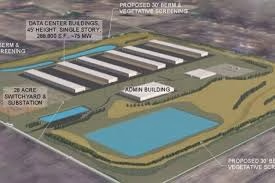
Factsheet: Proposed $4B Data Center Campus in Rural Southwestern Minnesota
Overview
Geronimo Power plans a $4B data center campus in Nobles County, MN (near Brewster & Reading).
Bundled with wind, solar, and battery projects to attract a major tech buyer.
Project is speculative; no buyer yet.
Key Facts
Jobs: 1,000 construction, 180 permanent.
Investment: $4B initial, potential $6B expansion.
Energy: 3 wind + battery projects, 1 solar + battery project.
Water Use: Minimal; like light-industrial facilities.
Backup Power: Diesel generators on-site.
Economic Impact
Generates millions in taxes.
Land lease income for local landowners.
Community fund for local benefits.
Challenges
Depends on securing a major tech buyer.
Land-use concerns: farmland converted to energy infrastructure.
Rural logistics: infrastructure, housing, workforce.
Regulatory hurdles: permits, backup-generator rules.
Leave a Reply