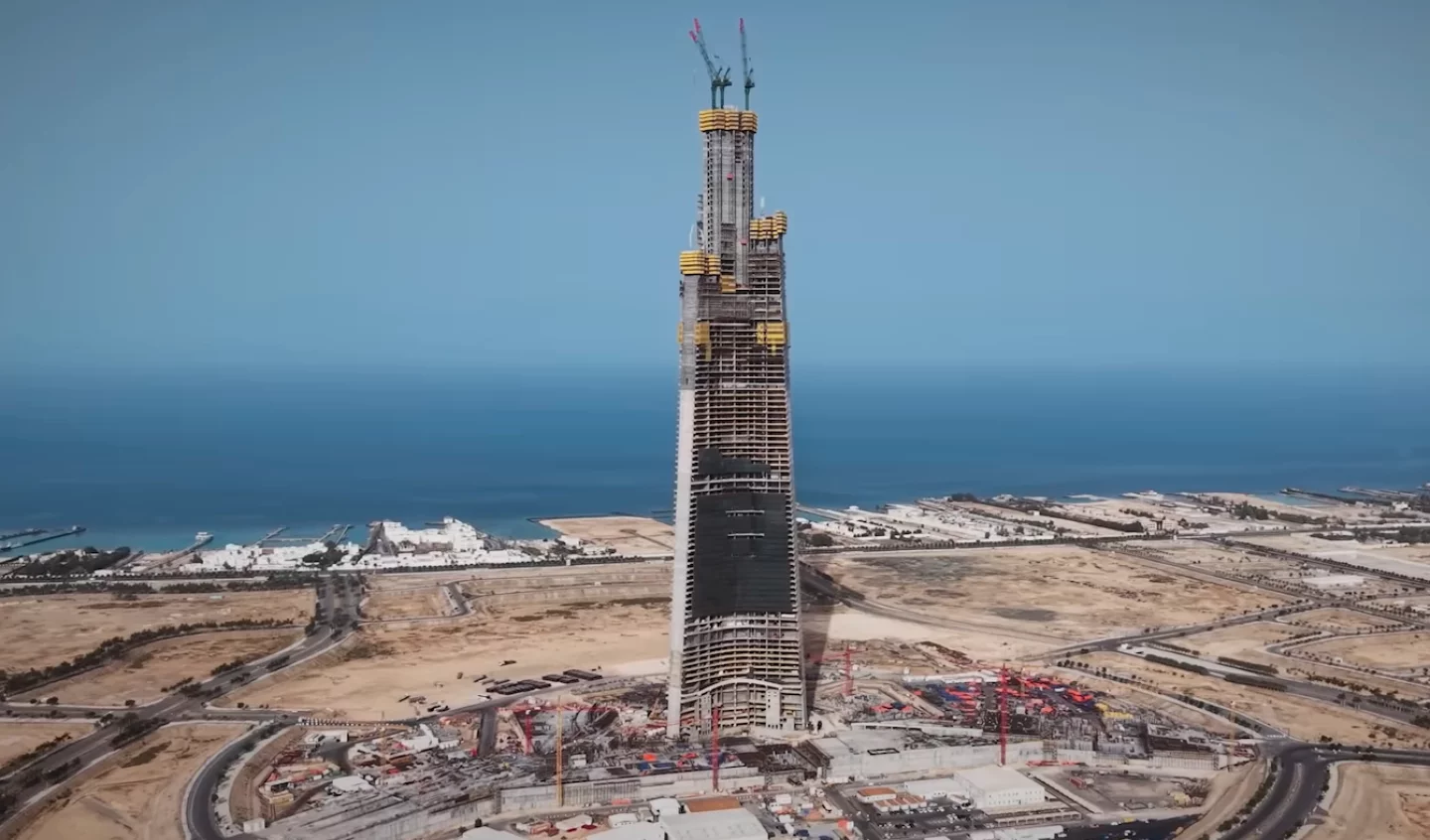
The Jeddah Tower project in Saudi Arabia has reached a major construction milestone as it advances toward becoming the world’s tallest building. The $1.2 billion mega tall development in Jeddah Economic City has now surpassed 102 floors, with rapid vertical progress recorded in 2026. Furthermore, the structure continues climbing toward its final planned height of more than 1,000 meters. Meanwhile, construction teams maintain steady momentum across core and superstructure works. Consequently, the project is once again positioning itself at the center of global skyscraper engineering attention.
Jeddah Tower Project construction hits 102 floors milestone
The Jeddah Tower project has officially passed 102 floors, marking one of its most significant milestones to date. Additionally, the tower is now progressing toward its planned 157 floors. Meanwhile, only a small number of buildings worldwide have crossed the 100-floor mark, placing it in an elite global category.
The development is led by Jeddah Economic Company, which oversees execution within Jeddah Economic City. Moreover, the architectural design is handled by Adrian Smith + Gordon Gill Architecture, a firm known for supertall skyscraper expertise. Consequently, the project maintains strong technical direction despite earlier delays.
Engineers rely on a reinforced concrete core system designed for extreme vertical loads. Furthermore, interconnected shear walls improve stability against wind forces. In addition, a 5-meter-thick raft foundation supported by 270 deep piles anchors the structure. Therefore, the building maintains structural integrity at extreme height conditions.
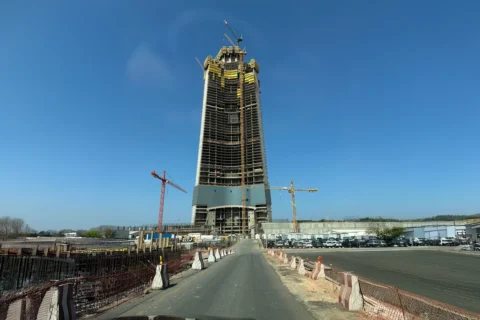
Jeddah Tower Project engineering systems and vertical expansion
The Jeddah Tower project incorporates advanced engineering systems to support its extreme height ambitions. Meanwhile, the tower will feature 59 high-speed elevators serving multiple vertical zones. Additionally, these systems are designed to reduce travel time across the megastructure. Consequently, vertical mobility remains efficient despite the building’s scale.
The project will include approximately 5.7 million square feet of floor space. Furthermore, this space accommodates residential, hotel, office, and observation functions. Meanwhile, the design includes what is expected to become the world’s highest observation deck. Therefore, the tower also targets strong tourism and commercial value.
Architects confirm the structure will reach at least 157 floors. Moreover, zoning strategies separate public, residential, and premium spaces across levels. In addition, mechanical systems are distributed vertically to optimize performance. Consequently, the building maintains operational efficiency across its full height.
Wind engineering remains a critical focus during construction. Furthermore, damping systems are integrated to reduce sway at upper levels. Meanwhile, digital monitoring tracks movement and structural response in real time. Therefore, safety and comfort remain central engineering priorities.
Jeddah Tower Project outlook towards completion in Saudi Arabia
The Jeddah Tower project continues to show strong upward construction momentum in 2026. Meanwhile, sequencing of concrete pours and structural lifts remains tightly coordinated. Additionally, crane systems are adjusted continuously as height increases. Consequently, construction efficiency improves with each new floor cycle.
The project remains a flagship component of Saudi Arabia’s long-term urban transformation strategy. However, unlike several other giga-projects, it is now demonstrating consistent physical progress. Furthermore, stakeholder confidence has strengthened due to visible construction acceleration. Therefore, the tower is once again viewed as a viable global mega tall contender.
Thornton Tomasetti engineers emphasize the simplicity of the structural system. Moreover, the design relies on interconnected walls instead of complex transfer structures. In addition, this approach improves buildability at extreme height. Consequently, the engineering strategy supports both speed and structural resilience.
Ultimately, the Jeddah Tower project is expected to redefine global skyscraper benchmarks once completed. Meanwhile, it strengthens Jeddah’s position as a high-rise construction hub. Furthermore, it reinforces Saudi Arabia’s ambition in megaproject development. Therefore, global attention remains fixed on its next construction phases.
The Jeddah Tower Project is not the only mega tall development reshaping Saudi Arabia’s skyline ambitions. In parallel, a proposed 2-kilometre Riyadh skyscraper designed by Foster + Partners has also gained global attention after winning a major design competition backed by Saudi Arabia’s Public Investment Fund. The scheme, which is expected to surpass the Jeddah Tower Project in theoretical height, reflects the Kingdom’s broader strategy to dominate global supertall construction. Meanwhile, both projects highlight Saudi Arabia’s aggressive push into record-breaking vertical architecture, even as Jeddah Tower continues to advance toward its 1,000-metre milestone. Consequently, the Riyadh concept reinforces the competitive landscape of next-generation megaprojects across the region.
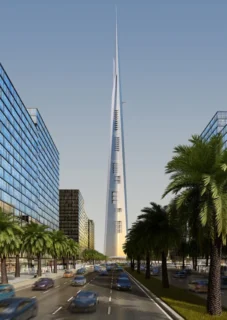
Project Fact Sheet
Project name: Jeddah Tower Project (formerly Kingdom Tower)
Location: Jeddah Economic City, Saudi Arabia
Project value: $1.2 billion
Current height: 102 floors completed (2026 update)
Planned height: Over 1,000 meters (world’s tallest target)
Planned floors: Approximately 157 floors
Floor area: 5.7 million sq ft (530,000 sq m)
Elevator system: 59 elevators planned
Foundation system: 5m raft slab supported by 270 bored piles (up to 105m deep)
Main functions: Residential, hotel, office, observation deck
Project Team
Developer: Jeddah Economic Company
Lead architect: Adrian Smith + Gordon Gill Architecture
Structural engineer: Thornton Tomasetti
Master developer framework: Jeddah Economic City
Construction system: Reinforced concrete core with shear wall configuration
Engineering focus: Wind resistance, vertical transport efficiency, and extreme-height stability

Leave a Reply