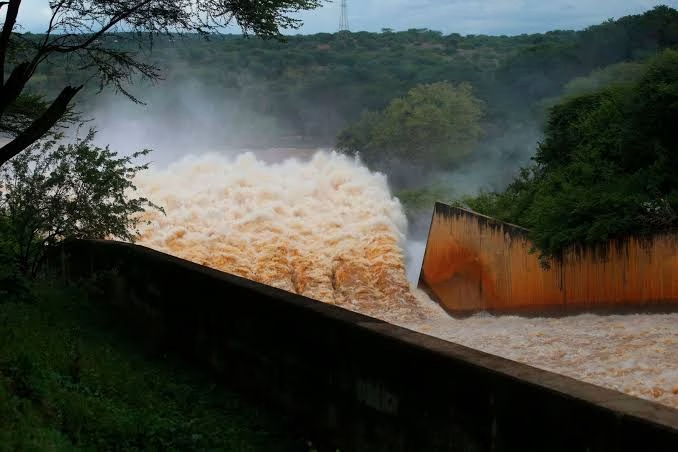
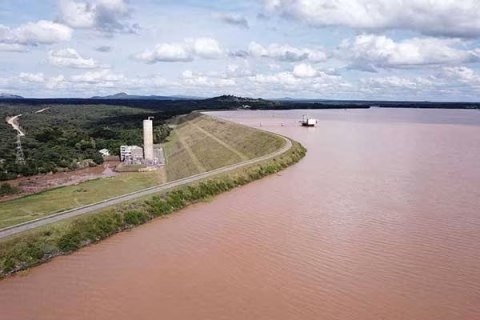
The government has revealed its plans to raise the Masinga dam in an aim to boost the country’s energy capacity. Situated in Embu and Machakos County, Masing Dam is among the seven hydro dams. Furthermore, it is considered the country’s largest reservoir on the Tana River. The dam stands at 60-meters high and 2,200-meters long with a massive storage capacity of about 1.56 billion cubic meters. Moreover, it covers roughly 120 km², a significant feat. Masinga Dam Expansion Project alongside the High Grand Falls will increase the country’s overall power capacity.
Masinga Dam Expansion Plans Unveiled
Additionally, plans for its expansion were revealed by the National Environmental and Management Authority (NEMA). This was noted through a gazette notice this month which received an Environmental Impact Assessment Study Report. The project will involve raising the spillway wall of the dam by 1.5 meters. Also, it entails increasing the volume of water dammed and retained in the reservoir by 173 cubic meters. Furthermore, the project will also involve the installation of a new spillway parallel to the current spillway. Additionally, the main aim is to elevate the efficiency of the discharge capacity of the dam.
Project Factsheet
Project Location
• Facility: Masinga Dam
• River: Tana River
• Counties: Embu and Machakos
• Role: Largest reservoir in Kenya’s Seven Forks hydropower cascade
Existing Infrastructure
• Dam Height: 60 meters
• Dam Length: 2,200 meters
• Reservoir Capacity: ~1.56 billion cubic meters
• Surface Area: ~120 km²
Project Scope
• Raise existing spillway wall by 1.5 meters
• Increase reservoir water volume by ~173 million cubic meters
• Construct a new spillway parallel to the existing structure
• Improve discharge. Also, it enables flood-control efficiency
Implementing authority
• Environmental Oversight: National Environment Management Authority (NEMA)
• Status: Environmental Impact Assessment Study Report received
Objectives
• Boost hydropower generation capacity
• Improve flood regulation downstream along the Tana River
• Enhance operational efficiency of the Seven Forks cascade system
Environmental Considerations
• Identified risks: construction safety, noise and vibration, vegetation disturbance
• Mitigation required: worker safety training and material handling controls. Also, it will imply environmental protection measures.
Strategic Significance
• Strengthens reliability of Kenya’s largest hydropower reservoir
• Supports long-term energy security. Also, it supports water management infrastructure
Impact of the Renovation
Therefore, once raised as planned, the revamp on the Masinga dam shall bring impact in various aspects. The dam will boos the country’s energy capital. Also, it will enhance the flood capacity to regulate flooding downstream in the Tana River. “Masinga Dam is one of the five dams that make up the Seven-Forks cascade of dams. This is due to its location in the upstream of the Seven-Forks cascade and the larger size of its reservoir,” the notice read.
Environmental Laws Compliance During the Renovation
Additionally, as part of environmental compliance, NEMA revealed some anticipated impacts of the project. These include occupational health risks and incidents, health hazards and diseases and increased social disturbance. Also, it entails high levels of noise and vibration, and vegetation degradation. Therefore, the contractors of the project will be required to mitigate these issues and deploy measures such as comprehensive safety training for workers. Workers will also be required to be trained on proper handling and storage of fuels, chemicals, and construction materials. Lastly, the aim of this is to prevent spills onto the soil, among other measures.
Leave a Reply