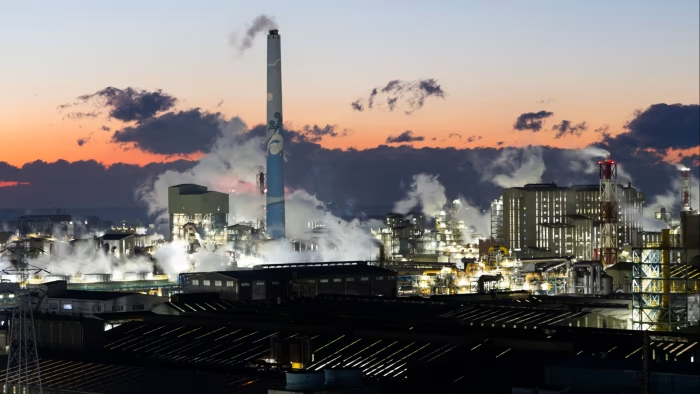
Korea Zinc has noted its plans to build a $7.4 billion smelter project to produce key metals and minerals in the United States. The company also noted that the U.S. government asked them to build the facilities. The aim is to provide response to the expansion of global supply chain risks and increasing demands for non-ferrous metals in the country. Conversely, the smelter plans to produce non-ferrous metals such as zinc, lead and copper. It also aims to produce precious metals such as gold and silver. Strategic minerals that will be produced include antimony, germanium, and gallium.
It will begin commercial operations gradually following construction from 2027 to 2029. In terms of funding, the U.S. Department of War will hold a 40% stake in the venture, while Korea Zinc’s stake will be less than 10%, the company said. It will secure the remaining $5.5 billion for the plant through $4.7 billion in loans from the U.S. government and financial institutions. Moreover, it will consolidate the remaining $210 million in subsidies from the U.S. Commerce Department under the CHIPS and Science Act. The project compliments other mineral projects in the United States such as the Stibnite gold-antimony project in Central Idaho
The Scope of Implementation on the Korea Zinc Smelter Project
The construction of the Korea Zinc smelter project comes as the Trump administration ramps up efforts to secure U.S. supply chains. The U.S. military also revealed plans earlier this month to develop a fleet of small-scale refineries to produce critical minerals. These will be used to make bullets, armor and other types of weaponry. Once complete, the new integrated smelter would produce 540,000 tons per year of major non-ferrous metals. These include 300,000 tons of zinc and 35,000 tons of copper. It also entails 200,000 tons of lead and 5,100 tons of rare earths annually.
The U.S. Commerce Department and the Department of War did not immediately reply to requests for comment. Nyrstar said the sale of its U.S. assets to Korea Zinc is expected to close in the first half of 2026. Critical minerals has been a critical issue since China’s export ban to the U.S. in 2024. China dominates the world’s supply of critical minerals such as antimony and germanium. These minerals are used in telecommunications equipment, semiconductors and military technology. Beijing banned exports of these minerals to the U.S. on December 3, 2024, following Washington’s crackdown on China’s chip sector. The ban has been suspended since November.
Project Factsheet
Overview
- A $7.4 billion smelter project will be undertaken by a firm called Korea Zinc in America
- Project focused on improving critical minerals and non-ferrous metal supply chains in the USA
Key Details
- Total Investment: $7.4 billion
- Project Type: Smelter of non-ferrous metals and critical minerals
- Commercial Operations: Roll out in phases from 2027 to 2029
Ownership & Financing
- US government holding: 40%
- Stake in Korea Zinc: Less than 10%
Remaining funding:
- $4.7B in lending from US govt & financial institutions
- $210M in subsidies in relation to the CHIPS and Science Act
Production Capacity
- Total output: approximately 540,000 tonnes a year
- Zinc: 300,000 tonnes
- Copper: 35,000 tonnes
- Lead: 200,000 tonnes
- Rare Earth & Strategic Minerals: approximately 5,100 tonnes per year
Materials Produced
- Base metals: Zinc, copper, lead
- Precious metals: Gold, Silver
- Strategic Minerals: Antimony, germanium, gallium
Project Importance
- Reduces America’s reliance on other countries regarding critical mineral supply chains
- Promotes local manufacturing in defense, electronics, and semiconductors
- Reacts to global supply chain disruptions and export controls
Current Status
- Project planning in progress
- Project construction timeline consistent with operational objective of 2027 and 2029
Leave a Reply