
The Neoen France Storage Development initiative marks a seismic shift in the European energy landscape as the nation accelerates its transition toward a fully decarbonized, high-resilience power grid. As of April 2, 2026, the official launch of France’s largest battery storage facility signals a departure from the traditional reliance on rigid baseload power toward a more agile, responsive infrastructure model. This project, strategically located to support the national high-voltage network, is designed to mitigate the intermittency of renewable energy sources while providing essential frequency regulation services to RTE (Réseau de Transport d’Électricité). By deploying large-scale lithium-ion technology, the facility acts as a giant “shock absorber” for the French grid, ensuring that the surge in wind and solar capacity across the continent does not compromise the stability of the synchronous zone. This milestone is not just a victory for Neoen but a blueprint for how independent power producers can collaborate with national regulators to secure energy sovereignty in an era of global price volatility.
Engineering the Vanguard of Electrical Resilience
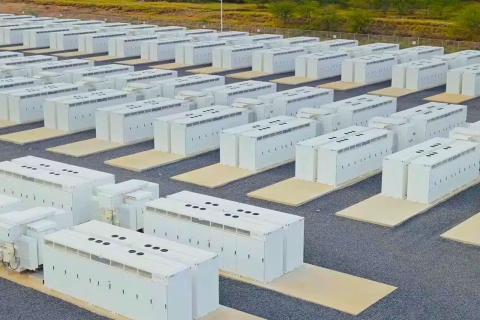
The technical architecture of this storage facility represents the pinnacle of modern electrochemical engineering, utilizing advanced modular units to ensure maximum availability and safety. Unlike previous smaller-scale pilot projects, this 400MW installation is optimized for “deep storage” and rapid-response tasks, capable of shifting large blocks of energy from periods of oversupply to peak demand windows. The site utilizes liquid-cooled lithium-iron-phosphate (LFP) chemistry, a choice driven by the need for thermal stability and a longer lifecycle compared to traditional nickel-manganese-cobalt variants. The project is physically organized into high-density clusters, each integrated with bi-directional inverters that allow for millisecond-speed interaction with the grid. This capability is crucial for the “black start” services and synthetic inertia that are increasingly required as older thermal plants are decommissioned. By recycling the site’s footprint for high-tech storage, Neoen is effectively future-proofing the local industrial landscape and creating a long-term hub for green energy innovation.
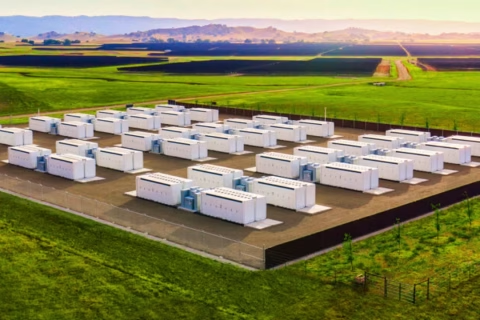
Project Fact Sheet
Project Name: Neoen Is-sur-Tille / Grand Est Battery Storage.
Total Capacity: 400 MW / 800 MWh (Two-hour duration).
Total Investment Value: Estimated at €165 million.
Technology Type: Lithium-Iron-Phosphate (LFP) high-density modular storage.
Grid Connection: Direct link to the 400kV RTE transmission network.
Operational Goal: Providing Frequency Containment Reserve (FCR) and automated Frequency Restoration Reserve (aFRR).
Commissioning Date: Full commercial operations commenced April 2026.
Strategic Role: Managing the “AOLT” (Appel d’Offres Long Terme) capacity mechanism in France.
Project Team
Neoen SA: Lead developer, owner, and long-term operator of the facility.
Tesla Energy: Primary technology provider, supplying the Megapack 3XL modular units.
RTE (Réseau de Transport d’Électricité): National transmission system operator providing grid access and regulatory oversight.
NHOA Energy: Engineering, Procurement, and Construction (EPC) partner for balance-of-plant works.
Eiffage Énergie Systèmes: Principal contractor for electrical infrastructure and high-voltage substation assembly.
Xavier Barbaro: Chairman and CEO of Neoen, overseeing the strategic rollout of the storage portfolio.
The Strategic Evolution of Continental Power Markets
The true value of the Neoen project lies in its role within the broader European “Energy Union” and the specific market dynamics of 2026. While the links provided highlight the scale, the facility’s participation in the European “Picasso” platform—an international exchange for frequency restoration—adds a layer of complexity not seen in earlier French projects. By bidding into a cross-border market, the battery can stabilize grids as far as Germany or Spain, maximizing its revenue streams while lowering overall costs for French consumers. Additionally, this project leverages the “Capacity Market” mechanism, where it receives fixed payments to guarantee availability during winter stress events, effectively replacing the need for carbon-heavy gas peaking plants. This “virtual power plant” approach is a significant upgrade from the 2022-era Bessières battery, as it integrates AI-driven predictive analytics to forecast price spreads and grid strain, ensuring the battery is always charged at the lowest carbon intensity and discharged when the grid is most vulnerable. This investment serves as a definitive signal that the era of massive, centralized storage has arrived in France, bridging the gap between national climate targets and practical grid physics.
This industrial transformation is further exemplified by the now-operational Merbette BESS project in Saint-Avold, a 35MW/44MWh facility that has successfully converted the historic Emile Huchet fossil-fueled power plant site into a high-tech “eco-platform.” Since its commissioning, the 24-container system has been actively providing grid stabilization services to RTE, France’s transmission system operator, effectively meeting the daily electricity demand of approximately 10,000 people. As part of Q Energy’s massive 16 GW European development pipeline, the project serves as a template for the large-scale repurposing of brownfield industrial sites, ensuring that legacy infrastructure is integrated into the highest tiers of the modern green economy.



Leave a Reply