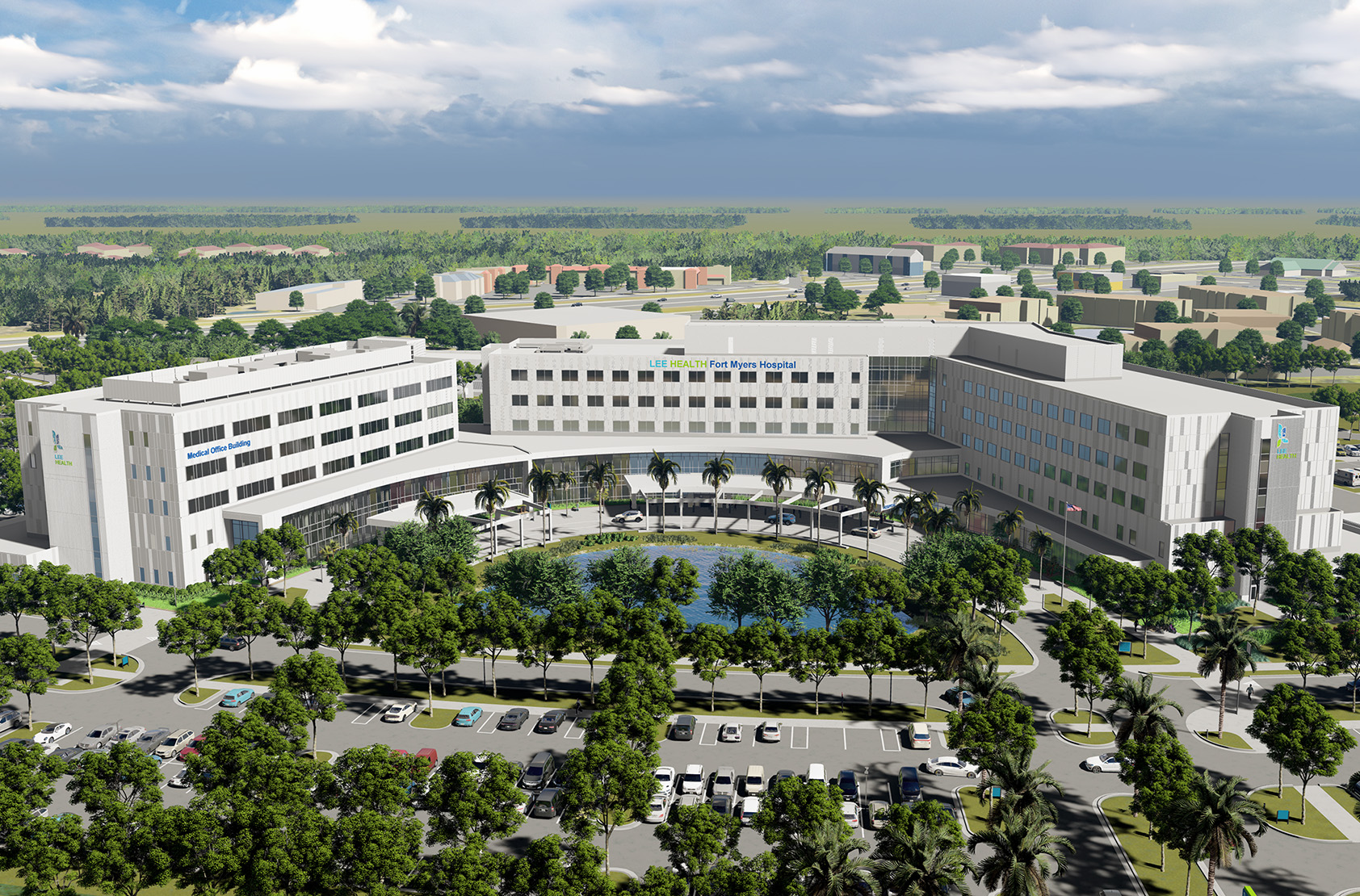
Lee Health has reached a landmark construction milestone at its new Fort Myers campus, holding a topping-out ceremony to mark the placement of the final structural beam on the main hospital tower. The $824 million development at 4453 Challenger Boulevard represents the largest healthcare construction project ever undertaken in Southwest Florida, and the occasion drew together health system leadership, construction teams, and community stakeholders to commemorate a project that has been years in planning and is now unmistakably rising from the ground. With structural completion of the primary building now achieved, the project enters a new phase of interior fit-out and systems installation, keeping the facility on track for a summer 2028 construction completion and a fall 2028 patient opening.
Steel in the Sky: What the Topping-Out Signals
A topping-out ceremony marks the moment a building reaches its full height — when the final beam of the structural frame is lifted into place and the hard physical form of the project is complete from foundation to roof. For a hospital of this scale and complexity, it is a pivotal point that transforms the construction site from a deep earthworks operation into an above-grade structure visible to the surrounding community. The Lee Health Fort Myers campus has been proceeding in phases, with interior framing well advanced in the primary East bed tower at the time of topping-out, while design and foundation work for the West bed tower is scheduled to follow. The structural milestone also coincides with the project’s steady adherence to its original timeline, a notable achievement for a programme of nearly a billion dollars across a campus where multiple building types are being built concurrently.
Project Fact Sheet: Lee Health Fort Myers Hospital
Project Name: Lee Health Fort Myers Hospital Campus
Location: 4453 Challenger Boulevard, Fort Myers, Lee County, Florida, USA
Site Area: 53 acres
Total Gross Floor Area: 535,000 square feet (main hospital); 125,000 sq ft medical office building
Total Project Cost: $824 million
Bed Count: 260 beds at full buildout; 236 private patient rooms at opening
Emergency Department: 44 beds
Operating Rooms: 10 inpatient ORs; 18 ambulatory surgery ORs (medical office building)
ICU Beds: 24
Groundbreaking: January 2025
Topping-Out Ceremony: March 2026
Construction Completion: Summer 2028
Hospital Opening: Fall 2028
Key Campus Components: Main hospital tower, medical office building / Lee Health Musculoskeletal Institute, ambulatory surgery centre, emergency department, child development centre (114-child capacity)
Structural Resilience: Category 5 hurricane rating, 18-foot elevation, full-facility generator, redundant water and electrical systems
Technology: Connected care rooms with integrated digital health and scheduling systems
Purpose: Replacement for Lee Memorial Hospital (Cleveland Avenue, 1916), which will close upon the new campus opening
Significance: Largest healthcare construction project in Southwest Florida history
Project Team: Lee Health Fort Myers Hospital
Owner / Health System: Lee Health (private non-profit)
President and CEO: Dr. Larry Antonucci
VP and Chief Facilities Executive: Dave Kistel
General Contractor: Skanska
Civil and Landscape Engineering: Johnson Engineering
Municipal Authority: City of Fort Myers (Mayor Kevin Anderson)
Key Regulatory Bodies: Florida Department of Transportation (access roads); South Florida Water Management District
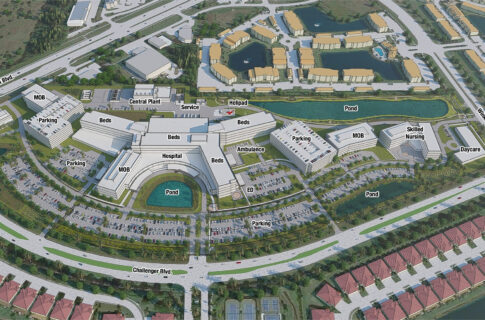
The campus will ultimately span 535,000 square feet across a 53-acre site and deliver 260 beds at full buildout, with 236 private patient rooms operational from opening day. The hospital is being purpose-built for the demands of 21st-century acute care — patient rooms equipped with connected care technology that integrates digital health tools, personalised treatment workflows, and clinical scheduling. Hurricane resilience has been engineered throughout the structure: the campus sits at an 18-foot elevation, carries Category 5 storm rating, and is supported by redundant electrical systems, a full-facility generator, and redundant water and well systems to maintain continuous clinical operations through major weather events. In a region shaped by the memory of Hurricane Ian’s 2022 devastation, that resilience specification is not a formality — it is a community commitment.
The Team Behind Southwest Florida’s Most Ambitious Hospital
Lee Health — the region’s dominant non-profit health system and Lee County’s largest employer, with approximately 17,000 staff and more than 2 million patient interactions annually — is the project owner and driving force behind the Fort Myers campus. Dr. Larry Antonucci, the system’s long-serving president and CEO, has been the public champion of the development since its earliest planning stages, framing it as an essential response to Southwest Florida’s exceptional population growth. Skanska, the global construction and development firm with a strong US healthcare portfolio, is serving as general contractor, bringing the technical depth required for a project that combines acute inpatient care, surgical suites, emergency facilities, ambulatory surgery, and speciality outpatient services on a single integrated campus.
Dave Kistel, Lee Health’s vice president and chief facilities executive, has overseen the project’s execution across its four defined pillars — permitting, design, construction, and building activation — managing each track simultaneously to preserve the 2028 delivery schedule. The development also engaged Johnson Engineering for civil and landscape work on the campus, which required careful coordination with the Florida Department of Transportation for access road permitting, the South Florida Water Management District, and the City of Fort Myers planning process. Fort Myers Mayor Kevin Anderson has been a consistent public supporter of the project, highlighting its broader economic benefits and the potential for a future on-campus hotel to serve families travelling for medical procedures from across the region.
From Cleveland Avenue to Challenger Boulevard: Replacing an Ageing Legacy
The new Fort Myers hospital is not simply an addition to Lee Health’s existing network — it is a direct successor to Lee Memorial Hospital, the system’s flagship facility on Cleveland Avenue, which opened in 1916 and has served the region through more than a century of Southwest Florida’s transformation. Lee Memorial, currently operating with 416 beds, will cease clinical operations when the Challenger Boulevard campus opens in fall 2028. The transition reflects a fundamental shift in how acute care is delivered: while Lee Memorial was built around a high-volume inpatient model, the new hospital prioritises private rooms, advanced outpatient capacity, and specialist centres rather than maximising bed count.
The new campus will anchor the Lee Health Musculoskeletal Institute within a dedicated 125,000-square-foot medical office building — housing an 18-operating-room ambulatory surgery centre, orthopedic, spine, and rheumatology clinics, and eight surgical suites oriented toward outpatient procedures. An 18-bed, technology-equipped emergency department will provide round-the-clock acute access, while a child development centre with capacity for 114 children is integrated into the campus for staff. Lee Health has also been explicit that the project will be delivered primarily using Southwest Florida contractors, seeding the regional construction economy with labour and procurement spend throughout the five-year build. The emphasis on outpatient capacity and surgical throughput places the Lee Health project in the same strategic conversation as Mayo Clinic’s $1.9 billion Phoenix expansion — a programme adding 1.2 million square feet of clinical space and 11 new operating rooms as part of its nationwide effort to dissolve the boundary between inpatient and outpatient care, reflecting a systemic shift in how America’s leading health systems are physically reimagining delivery for the next generation of patients.
Florida’s Hospital Construction Boom and What Lee Health’s Campus Means in Context
The topping-out at Challenger Boulevard arrives at a moment of extraordinary hospital construction activity across Florida — a boom driven by surging population growth, the 2019 repeal of the state’s certificate of need (CON) programme, and a demographic wave of retirees and relocating families arriving far faster than existing capacity can absorb. Across the Gulf Coast corridor alone, a cluster of hospital projects collectively exceeding $1.7 billion in construction value is currently underway, including Turner Construction’s AdventHealth Wesley Chapel expansion and a major new facility in Manatee County. The Lee Health project, at $824 million, is the largest of this cohort and the largest healthcare build in Southwest Florida’s recorded history.
At the national level, the Lee Health campus joins a class of major hospital replacements where ageing urban facilities built in an earlier era of healthcare delivery are giving way to purpose-built campuses engineered for managed care, outpatient volume, and technological integration. As Jeff Wherry of JE Dunn Construction noted in analysis of Florida’s hospital market, health construction activity is strongest where CON restrictions have been lifted and where population growth creates compounding demand — a description that fits Southwest Florida precisely.
With Forbes naming Lee Health among its Top Hospitals for 2026 and The Leapfrog Group awarding consecutive straight-A safety ratings, the system arriving at this topping-out moment is one in strong institutional health, building a campus intended to serve the community it already leads well into the second half of the 21st century. Florida’s construction pipeline is equally active beyond healthcare, with the 280 million Sports Performance Hub now underway in Homestead — a 100-acre complex combining a 10,000-seat stadium, sports academies, a boarding school, and a medical centre that reflects the state’s broader appetite for large-scale, multi-purpose destination infrastructure.
Additionally, the Fort Myers Hospital project is part of a growing wave of large-scale healthcare and biopharmaceutical facility investments across the U.S. CSL recently broke ground on a $1.5 billion biopharmaceutical manufacturing expansion in Kankakee, Illinois, aimed at increasing production of plasma-derived therapies and creating hundreds of new jobs. Together, these projects reflect a broader trend of major construction initiatives that strengthen medical infrastructure while supporting local economies.
Leave a Reply