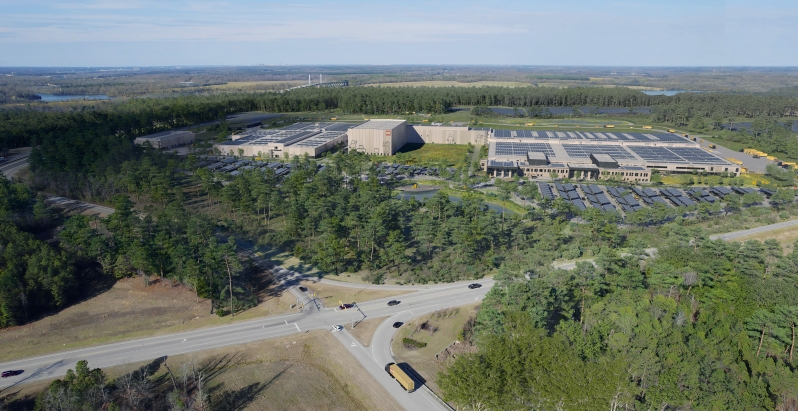
The LEGO Group, a global leader in toy manufacturing headquartered in Billund, Denmark, is advancing its push toward sustainable carbon-neutral operations in the U.S. with a solar project at its new $1.5 billion factory site in Richmond, Virginia. This is part of LEGO’s sustainability commitments to achieve net-zero emissions and operate its global portfolio of facilities with 100% renewable energy. The Virginia factory, first announced in June 2022, is a cornerstone of LEGO’s manufacturing expansion in the West. It will feature on-site solar generation as a primary energy source to meet electricity demand for production, logistics, and ancillary operations.
Project Description
LEGO plans to install approximately 30,700 ground-mounted solar panels across an 80-acre site adjacent to the new factory in Richmond, Virginia. This will form a dedicated solar park to supply renewable electricity directly to the facility. This solar array is designed to serve as a major component of the factory’s energy mix, reducing reliance on grid power and fossil fuels while helping the facility operate on a 100% renewable energy basis once commissioning is complete. The solar installation will also support LEGO’s environmental objective to reduce carbon intensity across its manufacturing footprint.
Project Factsheet for LEGO Manufacturing Factory in Richmond, Virginia
Location: Chesterfield County, near Richmond, Virginia
Developer and Owner: The LEGO Group
Capacity: 30,700 solar panels
Cost: $1.5 billion
Size: 1,700,000 SF; 13-building campus with molding, processing and packing units
Completion Date: 2027
Timeline: Construction planning and solar array rollout expected to be concurrent with factory buildout
Status: Under construction
Jobs: Over 1,700

Contractors and Stakeholders at LEGO Factory in Richmond, Virginia
Construction Partners: Gray Inc and Hourigan Construction
Architect and Design Partner: LS3P Associates Ltd.
Project Engineer: Timmons Group
Earthwork & Site Preparation: George Nice & Sons
Sustainability Design Support: Arkitema A/S
Master Planning and Sustainability Design: Cow i A/S
State Economic Development Support: Virginia Economic Development Partnership (VEDP for incentives and workforce coordination
County Economic Development Lead: Chesterfield County Economic Dev.
Site Selection & Local Facilitation: Greater Richmond Partnership (GRP)
Workforce Training Partner: Virginia Talent Accelerator Program
Interim Operations: 1600 Ruffin Mill Road Packaging Facility
Technical Training Support : Hampton Roads Workforce Council
Finance & Investment at New LEGO Factory in Richmond, Virginia
Financial details beyond the $1.5 billion factory investment have not been made been public yet, but the solar park is part of LEGO’s sustainability capital expenditures for decarbonizing its global operations. Additionally, to improve the factory’s operating profile, the $1.5 billion investment in a solar installation is expected to yield both long-term energy cost savings and emissions reductions credits.
Project Outlook
Additionally, LEGO’s Solar Park at its new $1.5 billion manufacturing factory in Richmond, Virginia complements policy and market trends prioritizing renewable energy in manufacturing and logistics. It also positions LEGO’s Virginia facility as a potential benchmark for green industrial infrastructure in the U.S., especially among global manufacturers establishing U.S. footprint expansions. Furthermore, customer demand for sustainably manufactured products continues to rise, and such energy investments resonate with consumer, regulatory, and investor expectations around environmental responsibility.
Risk and Challenges to Look Out For
Grid and regulatory challenges. Solar integration at utility scale can face complex and lengthy interconnection approval processes and grid interdependency risks.
Land use and permitting. A project of this scale may also encounter permitting challenges related to land zoning, environmental impact assessments, and community engagement.
Supply chain challenges. Global solar panel supply chain disruptions could affect procurement timelines or costs especially with the current global geopolitical wrangles.
Leave a Reply