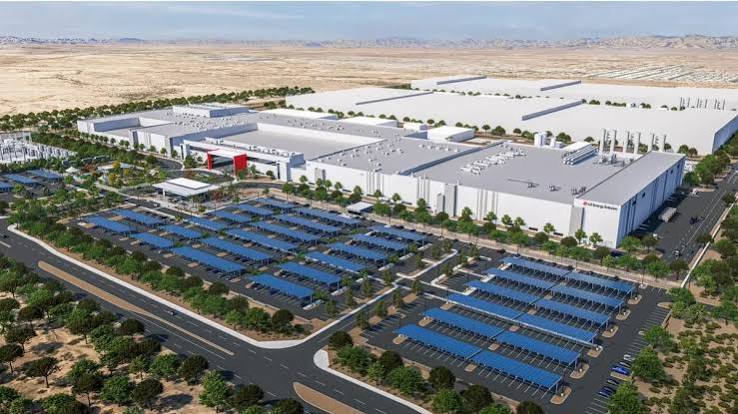
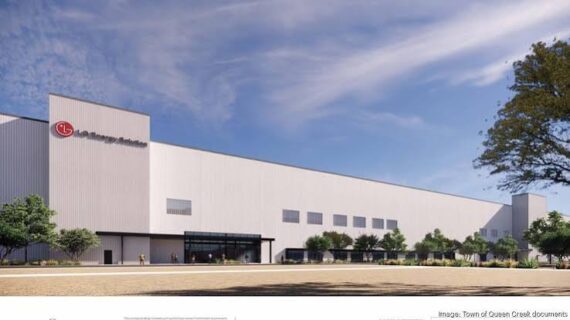
The LG Energy Solution (LGES) Complex in Queen Creek, Arizona, represents a $5.5 billion standalone manufacturing hub, marking one of the largest single investments in an independent battery facility in North America. Spanning a massive 1.3-million-square-foot footprint at Ironwood and Pecos Roads, the site features a dual-facility framework engineered to yield a combined annual capacity of 53 GWh:
- Cylindrical EV Plant (36 GWh): Dedicated to high-density 46-series cylindrical cells (such as 4680 and 4695) to power North American EV automakers like Tesla and Rivian.
- ESS Plant (17 GWh): Dedicated to pouch-type Lithium Iron Phosphate (LFP) cells tailored for localized grid-scale Energy Storage Systems.
Master Timeline & Historical Milestones
Phase 1: Inception & Strategic Recalibration (2022)
- March 2022: LGES initially announces a $1.4 billion investment for an 11 GWh cylindrical EV battery plant.
- Mid-2022: The project is briefly paused as global economic headwinds, skyrocketing inflation, and rising construction costs require a thorough financial review.
Phase 2: The $5.5B Quadrupled Scale-Up (2023)
- March 2023: LGES officially re-commits to Queen Creek with a vastly multiplied investment of $5.5 billion. The capacity is upgraded to 53 GWh by integrating a second standalone facility dedicated exclusively to LFP energy storage system (ESS) batteries.
- November 2023: Heavy machinery moves on-site, kicking off official groundbreaking, mass excavation, and foundational grading.
Phase 3: Structural Development & Market Pacing (2024)
- April 2024: Structural steel framing goes vertical. LGES hosts a massive regional stakeholder meeting to announce that land preparation is complete and structural framing is underway.
- June 2024: Amid a temporary cooling period in global EV growth patterns, LGES strategically pauses construction on the ESS/LFP portion of the site to optimize cash flow, choosing to advance the main cylindrical facility at full momentum.
Phase 4: Factory Fitting, Tech Integrations & Workforce Activation (2025)
- April 2025: The project hits its 50% construction milestone. Concurrently, the State of Arizona and LGES launch the “Future48 Workforce Accelerator” training center in Pinal County to upskill local technicians using simulated cleanrooms and VR technology.
- Late 2025: Plant construction progresses past the 60% mark. LGES contracts Honeywell to deploy its Honeywell Forge IoT platforms, cybersecurity architectures, and advanced automation platforms to run the facility’s internal environmental systems.
Project Status & Upcoming Ramps (2026 and beyond)
- Production Launch Schedule: LGES corporate leadership confirmed during their Q1 2026 financial summaries that internal equipment line integration is meeting strict targets. The facility remains on track to begin initial sample production runs in mid-2026, with commercial mass production of the 46-series cylindrical lines commencing in late 2026.
- The ESS Plant Outlook: Local and corporate officials maintain that the paused ESS framework will resume sequence to capitalize on a rapidly expanding domestic grid storage market, backed by recent massive logistics wins like the company’s 6GWh battery supply pact with DTE Energy.
- Economic Impact: Recruitment campaigns continue to scale up to fulfill a total job creation target of 1,500 advanced manufacturing jobs by 2027 (scaling up to 2,800 at optimal multi-shift capacity), transforming the East Valley into a core anchor of the Southwest’s battery belt.
Workforce development
In addition to construction progress, LGES has been focusing on workforce development. In April 2025, the company helped launch a battery-focused workforce training accelerator in nearby Pinal County. This initiative aims to prepare local workers for the plant’s operations, highlighting LGES’s commitment to supporting the community and ensuring a skilled workforce for the facility.
While construction is advancing on the cylindrical EV battery plant, there has been no new update on the planned Phase-2 energy storage system (ESS) facility. Previously, the ESS plant was put on hold as LGES reallocates resources, with the current focus solely on the cylindrical battery production line.
Read also: New Lithium-ion battery recycling facility to be constructed in Arizona
Production Capacity of LGES Queen Creek Facility
When fully developed, LG Energy Solution’s Queen Creek complex will have an annual production capacity of approximately 53 gigawatt-hours (GWh), with around 36 GWh coming from its cylindrical electric vehicle (EV) battery line and 17 GWh from the planned lithium-iron-phosphate (LFP) energy storage system (ESS) facility. The cylindrical line will produce LG’s 46-Series (4680) batteries, marking a shift from the original 2170 cell design that was expected to yield 27 GWh. That redesign, finalized in late 2023, reflects LG’s effort to boost output and align with the growing demand for next-generation EV batteries.
Economic Impact
Beyond its production capabilities, the Queen Creek plant is positioned to have a wide-reaching economic impact. LG Energy Solution has partnered with local and state entities to launch the Future48 Workforce Accelerator, a training center designed to prepare Arizona residents for careers in battery manufacturing. With approximately $80 million invested in surrounding infrastructure—supported in part by state reimbursement programs—the facility is shaping up to be a cornerstone of Arizona’s clean energy industry. It also qualifies for various state incentive programs, and once fully operational, it is expected to support millions of EVs while generating significant tax revenue and regional supply chain growth.
Additionally, as battery gigafactories like LGES’s Queen Creek complex scale up production, recyclers are moving to secure the raw materials pipeline — Aqua Metals recently advanced site diligence for Headwaters ARC, a planned battery recycling and critical minerals recovery campus positioned near the Midwest’s growing cluster of LFP battery plants.
Read also: T1 Selects Texas for $850M Solar Cell Manufacturing Facility
LG Energy Solution Queen Creek Battery Facility Project Factsheet
Project Overview
Investment: $5.5 billion
Location: Queen Creek, Arizona
Size: 1.3 million square feet
Primary Focus: Cylindrical EV battery production
Targeted Completion: 2026
Current Status: On track to launch commercial production in the second half of 2026
Production Capacity
Total Planned Capacity: 53 GWh annually
Cylindrical EV Battery Line: 36 GWh
Energy Storage System (ESS): 17 GWh (Phase-2, currently on hold)
Battery Type: 46-Series (4680) cylindrical batteries (upgraded from original 2170 design)
Timeline
Sample Production: Expected mid-2026
Full-Scale Production: Expected end of 2026
May 6, 2025: Partnership announced with Honeywell to supply advanced building automation systems for security, monitoring, and safety
April 2025: Launch of battery-focused workforce training accelerator in Pinal County
LGES Battery Facility in Queen Creek, AZ: Economic Impact
Job Creation:
Approximately 1,500 full-time operational roles by 2027
Thousands of temporary construction jobs
Original two-phase project estimated 2,800 jobs (revised due to ESS facility hold)
Infrastructure Investment: Approximately $80 million for surrounding infrastructure
Regional Benefits: Tax revenue generation and supply chain growth
Workforce Development: Partnership with Future48 Workforce Accelerator to prepare local workforce
Updates on LGES Battery Facility in Queen Creek: Current Status
Phase-1 (Cylindrical EV Battery Plant): On schedule for 2026 completion
Phase-2 (ESS Facility): Currently on hold as LGES reallocates resources
Richard Ra, LGES Arizona President, confirms the project remains on track for 2026 production goals
Partners and Stakeholders
LG Energy Solution: Primary investor and operator
Honeywell: Building automation systems provider
State and Local Entities: Supporting workforce development through Future48 initiative
Read also: Natron Energy to Build $1.4B Sodium-Ion Battery Manufacturing Facility in North Carolina