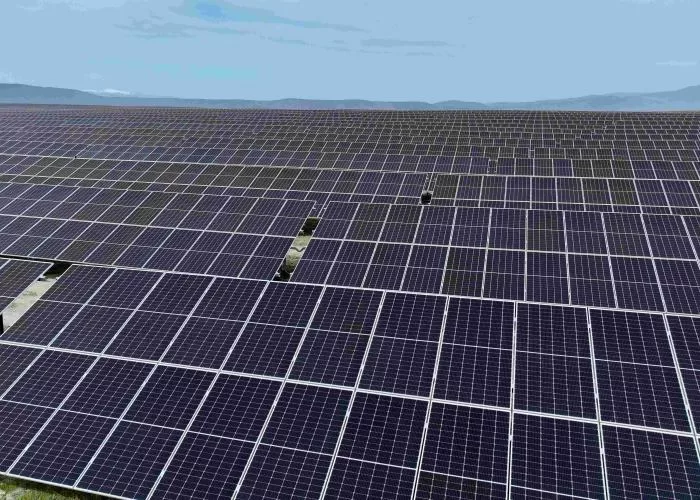
The Mammoth Solar project, developed by Doral Renewables, is a landmark utility-scale initiative in northwestern Indiana that, upon full completion, will stand as one of the largest solar farms in the United States. Spanning approximately 13,000 acres across Starke and Pulaski Counties, the project is designed to generate up to 1.6 GW of clean energy. This energy will be enough to power roughly 275,000 homes. Its first phase, Mammoth North, officially began operations in late 2024, marking a massive shift in Indiana’s energy profile from coal toward renewables.
Together with the Riverstart Solar IV project in Randolph County, which is a 150 MW facility that reached commercial operation in January 2026, Mammoth Solar cements Indiana’s new status as a top-tier national leader in solar capacity additions. While Mammoth Solar represents the state’s push for massive, gigawatt-scale hubs, Riverstart Solar IV illustrates the successful “clustering” of renewable energy in Indiana’s eastern agricultural corridors. Both projects utilize the PJM Interconnection grid to stabilize regional power supplies and demonstrate a growing “agrivoltaic” trend in the state, where solar infrastructure coexists with traditional farming and livestock grazing to maximize land productivity.
May 17, 2025
Doral Renewables LLC has announced the financial close of $1.5 billion in project financing to advance construction of three major photovoltaic power plants—Mammoth South, Mammoth Central I, and Mammoth Central II—located in Pulaski County, Indiana. Each plant will have a generation capacity of 300 megawatts (MWac), representing a combined 900 MWac of the 1.3 gigawatt (GWac) Mammoth Solar project Indiana.
Once fully operational, the facilities are expected to supply clean electricity to approximately 275,000 households annually, boosting Indiana’s total solar capacity by over 20%.
Engineering and construction firm Bechtel has also announced that they have been selected by Doral Renewables to deliver the three core phases of the Mammoth Solar project Indiana. Following early preparatory works, Bechtel has now received Full Notice to Proceed (FNTP), allowing it to begin full-scale construction including panel installation, cable laying, and substation development. The Mammoth Solar project Indiana is one of the largest of its kind in the United States and is seen as a critical contributor to the nation’s clean energy transition.
Phase 1: Operational
The initial phase of the Mammoth Solar project Indiana is already complete and operational. Doral Renewables began this effort in 2019 as a grassroots initiative among local farmers. Today, over 65 families lease their land to support the solar project. Upon decommissioning, the land will revert to the original owners.
Phase 2: Mammoth South Under Construction
Mammoth South, the second phase, is now under construction in Pulaski County. The 300 MW facility is expected to produce enough clean electricity to power approximately 65,000 households. A long-term Power Purchase Agreement (PPA) for the generated electricity has been executed with AEP Energy, a subsidiary of American Electric Power.
The Mammoth South project officially launched in November 2022, marked by a ceremony that brought together local stakeholders, community members, and dignitaries from Indiana and Israel.

Latest Updates on Mammoth Solar Project in Indiana. USA’s largest solar project
Phase 3: Mammoth Central Set for Launch
Mammoth Central, the third and largest phase of the project, will deliver 600 MW of solar energy and is scheduled to begin construction in 2025, with commercial operations expected by 2027. Due to its scale, Mammoth Central will be built in two segments.
Doral Renewables has secured full offtake for the 600 MW capacity. Half of the output—300 MW—will be supplied to AEP Energy, while the remaining 300 MW will be sold to Bank of America, PNC Bank, CVS Health, and Dietz & Watson through Constellation Energy.
Mammoth Central will also integrate significant agrivoltaics elements, including livestock grazing for vegetation management, pollinator habitats, and crop production. These initiatives will be managed by local farmers, blending renewable energy production with sustainable land use and heritage agricultural practices.
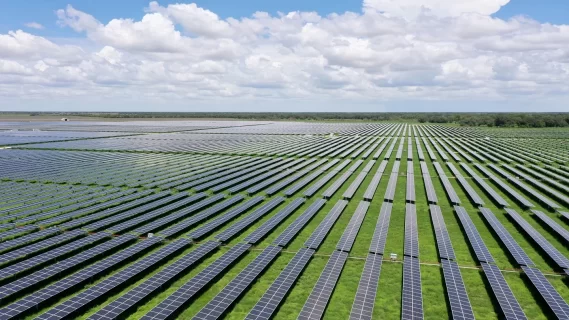
Averon Energy begins construction of 288 MW Posey Solar plant, Indiana
Mammoth Solar Project Indiana Factsheet
Project Name:
Mammoth Solar
Developer:
Doral Renewables LLC
EPC Contractor:
Bechtel Corporation
Location:
Pulaski and Starke Counties, Indiana, USA
Total Planned Capacity:
1.3 gigawatts (GWac)
Project Phases & Capacity:
- Phase 1 – Mammoth North: 300 MW (Operational)
- Phase 2 – Mammoth South: 300 MW (Under Construction)
- Phase 3 – Mammoth Central I & II: 600 MW (Planned, Construction begins 2025)
Land Area:
13,000 acres
Households Powered Annually:
~275,000 homes
Power Purchase Agreements:
- AEP Energy (Phase 2 & 3 – 600 MW total)
- Constellation Energy (Phase 3 – 300 MW for Bank of America, PNC Bank, CVS Health, Dietz & Watson)
Estimated Completion Dates:
- Mammoth South: Under construction
- Mammoth Central: Operational by 2027
Community Engagement:
- Over 65 local families leasing land
- Land returned to owners post-decommissioning
Sustainability Features:
- Agrivoltaics: Livestock grazing, pollinator habitats, and crop production integrated with solar use
- Led by local farmers to maintain agricultural heritage and diversify revenue
Notable Facts:
- One of the largest solar projects in the U.S.
- Named “Mammoth” due to ancient mammoth bones discovered on-site
- Expected to increase Indiana’s total solar capacity by 20%
Leave a Reply