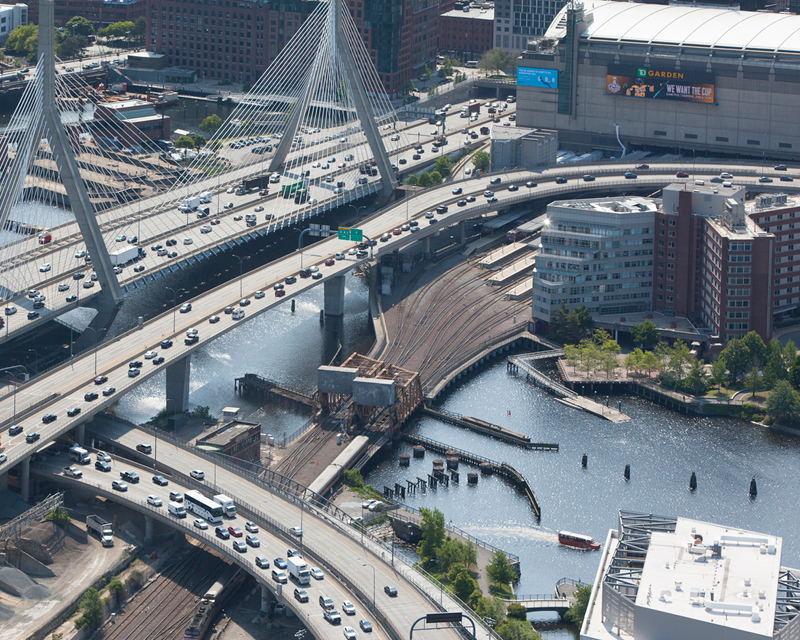
The MBTA North Station Draw One Bridge Replacement is now under way, with the Massachusetts Bay Transportation Authority having issued its Notice to Proceed on 4 May 2026 for the $1.286 billion project. Skanska holds the roughly $1 billion (about SEK 9.3 billion) design-build contract to replace the century-old drawbridge over the Charles River and deliver associated track and signal upgrades across Boston, Cambridge and Somerville. As of the third quarter of 2026, work is in its early stages, with geotechnical soil-boring investigations in the Charles River and on the north shore running from mid-August through September 2026 to inform the new bridge’s design ahead of major structural work. Completion is targeted for fall 2032, with train service maintained throughout.
The design-build project scope includes replacing the existing 1930-era bascule bridges with new vertical lift spans, upgrading approach trestles, constructing a new Tower A control facility and supporting the addition of a new Platform F at North Station. The project proposes to replace the current four-track, two-span movable drawbridge with a six-track, three-span drawbridge to improve commuter rail transit service, with improvements to bridge substructures, track alignments, signalling and communications systems, and passenger infrastructure. The work also encompasses integrated track, signal and Positive Train Control (PTC) upgrades to enhance resiliency and maintain uninterrupted commuter rail and Amtrak service throughout construction. Track improvements will extend approximately 1.5 miles from North Station, with the bridge constructed in six phases. In a clarification provided to Construction Review Online, VHB confirmed that it is the designer for the current design-build delivery phase, with a scope covering the movable spans, a replacement signal tower, a new pedestrian walkway, associated track and signal upgrades and the addition of two new platform tracks at North Station. VHB noted that STV supported the earlier and full engineering design leading up to procurement but is not involved in the current delivery phase. The total project budget is $1.286 billion, forming part of the MBTA’s $9.6 billion, five-year capital investment plan.
Project Fact Sheet
- Project Name: North Station Draw One Bridge Replacement
- Owner/Client: Massachusetts Bay Transportation Authority (MBTA)
- Design-Build Contractor: Skanska USA Civil Inc.
- Designer (delivery phase): VHB
- Early/full engineering design (pre-procurement): STV Group (STV Inc.)
- Visualisation Partner: RDV Systems (3D modelling and stakeholder engagement)
- Contract Type: Design-Build
- Contract Value (Skanska): USD $1 billion (approximately SEK 9.3 billion; booked in Skanska’s US order bookings for Q2 2026)
- Total Project Budget: $1.286 billion
- Federal Funding: $472 million federal grant (US Department of Transportation)
- Notice to Proceed: 4 May 2026
- Location: Charles River, between North Station (Boston) and communities to the north, spanning Cambridge and Somerville
- Lines Served: Haverhill, Lowell, Newburyport/Rockport and Fitchburg MBTA Commuter Rail lines; Amtrak
- Existing Structure: Two rolling lift bascule bridges, built 1931; four tracks; designed by Keller and Harrington of Chicago; built by Phoenix Bridge Company of Phoenixville, Pennsylvania
- Replacement Structure: Three vertical lift drawbridges; six tracks; three spans
- Track Capacity Increase: Four tracks to six tracks across the Charles River
- New Infrastructure Added: Platform F at North Station; Tower A replacement control facility; pedestrian walkway; PTC and signal upgrades; trestle and fender system replacements
- Track Upgrade Extent: approximately 1.5 miles from North Station
- Construction Phasing: six phases, maintaining live commuter and Amtrak operations throughout
- Current Phase (Q3 2026): Geotechnical soil-boring investigation in the Charles River and north shore (mid-August–September 2026)
- Construction Start (Notice to Proceed): May 2026
- Completion Target: fall 2032
- Daily Ridership Affected: more than 100,000 riders on the north-side network
- Programme Context: Part of the MBTA’s $9.6 billion five-year capital investment plan
- Environmental Assessment: FTA Environmental Assessment completed January 16, 2025; Finding of No Significant Impact issued January 16, 2025
Project Team
- Owner/Client: Massachusetts Bay Transportation Authority (MBTA) — the public agency responsible for Greater Boston’s transit network, including subway, commuter rail, bus, and ferry services; operating the North Station hub for all north-side commuter rail and intercity Amtrak services
- Design-Build Contractor: Skanska USA Civil Inc. — the US civil operations division of Skanska AB (Stockholm: SKAb), a Swedish multinational construction company with 2025 global revenue of $18.3 billion and US operations generating $8.7 billion; simultaneously delivering the Hudson Tunnel Project Package 1C in New York
- Designer (current delivery phase): VHB — Watertown, Massachusetts-based engineering and design consultancy serving as designer for the design-build delivery phase, covering the movable spans, replacement signal tower, pedestrian walkway, track and signal upgrades and expanded platform works
- Early Engineering Design (pre-procurement): STV Group (STV Inc.) — supported the early and full engineering design phases leading up to procurement under a separate earlier MBTA engagement; not involved in the current delivery phase
- 3D Modelling and Visualisation: RDV Systems — provided interactive 3D modelling for stakeholder engagement, environmental documentation and public communications throughout the design phase
- State Government: Governor Maura Healey and Lieutenant Governor Kim Driscoll (Healey-Driscoll Administration) — advanced the project announcement in March 2026 and positioned the Draw One replacement as a cornerstone of the administration’s commitment to MBTA capital reinvestment and job creation
- Federal Environmental Authority: Federal Transit Administration (FTA) — completed the Environmental Assessment and issued the Finding of No Significant Impact on January 16, 2025, clearing the project for procurement
- Waterway Authority: US Army Corps of Engineers — manages waterway traffic and flood control on the Charles River; concurred with the project’s environmental and navigational approach
- Regulatory Authority: US Coast Guard — reviewing navigational impact and tentatively determined no significant environmental impact for NEPA purposes; Massachusetts Department of Environmental Protection (MassDEP) providing water quality certification under Section 401 of the Clean Water Act
MBTA board approves US $159m contract for South Coast Rail project in Massachusetts, US
Although rail bridges across the Charles River near the present location of North Station have existed since the Boston and Lowell Railroad opened in 1835, the current bridges date from 1931, when the navigable channel of the Charles River was shifted 300 feet to the north of its former route to allow the platforms at North Station to be extended northwards. Nearly a century of service later, the Draw One Bridge is not merely aging — it is classified as beyond repair, operating as a critical bottleneck that constrains the throughput of the entire north-side commuter rail network. The existing bridge is a critical bottleneck for commuter rail operations, limiting platform availability and overall system flexibility. The expansion from four to six tracks is the structural heart of what this project is actually trying to achieve, because it is the track count at the Charles River crossing, not platform capacity elsewhere, that has historically limited the number of simultaneous movements the north side network can execute during peak periods. Greater Boston’s commuter rail network is carrying growing demand across the Haverhill, Lowell, Newburyport/Rockport and Fitchburg lines that all pass over Draw One, and the inability to operate more than four tracks across the river has cascaded into timetable inflexibility, reduced resilience to delays and constrained the MBTA’s ability to expand service frequency without infrastructure relief. This capacity constraint is becoming more urgent as the MBTA expands its regional rail footprint — most notably with the opening of Phase 1 of the $1.1 billion South Coast Rail project in March 2025, restoring commuter rail service to Fall River and New Bedford for the first time in decades and adding further systemwide pressure for more reliable, higher-frequency operations.
The comparable challenge on the south side of the network, where South Station’s own capacity constraints are the subject of a separate long-range planning process, illustrates just how structurally dependent Greater Boston’s rail system is on a handful of critical chokepoints. Draw One is the north side’s equivalent of that problem. Skanska’s appointment to this contract, following its concurrent award on the Hudson Tunnel Project Package 1C in New York, signals that the Swedish contractor is rapidly consolidating its position as the dominant international civil infrastructure builder in the northeastern United States, with two of the region’s most complex rail infrastructure programmes now simultaneously on its books. This momentum is also reflected in major rail investments further south, including the recently awarded US$1 billion Long Bridge North rail contract, where Skanska’s joint venture is advancing another critical corridor upgrade designed to relieve long-standing bottlenecks in the Washington, D.C. region.
Structural Configuration, Construction Phasing and Rail Upgrades
- Existing structure: two adjacent two-track rolling lift bascule bridges, built 1931, each carrying two railroad tracks across the Charles River; the existing bridge is beyond repair and presents an ongoing maintenance challenge
- Replacement structure: three side-by-side vertical lift drawbridges, each carrying two tracks, providing six tracks total across the Charles River
- Track capacity expansion: four tracks to six tracks across the river
- Scope includes replacement of the north and south trestles and fender system; staged demolition of the existing draw bridges, approach spans, fendering and Tower A
- New Tower A control facility: replacing the temporary control tower built in 2018 following deterioration of the original Signal Tower A
- New Platform F at North Station: additional platform increasing operational flexibility on the north-side network
- New pedestrian walkway incorporated into the replacement bridge structure
- Track, signal and PTC (Positive Train Control) upgrades extending approximately 1.5 miles from North Station
- Construction phased in six stages to maintain uninterrupted commuter rail and Amtrak service throughout the programme
- Alternative Technical Concepts (ATCs) employed to reduce in-water work, simplify staging and improve safety
- Over 100,000 daily riders rely on the MBTA’s north-side network, which the project is designed to protect throughout construction
- Navigation clearance for vessels on the Charles River to be maintained throughout and after construction
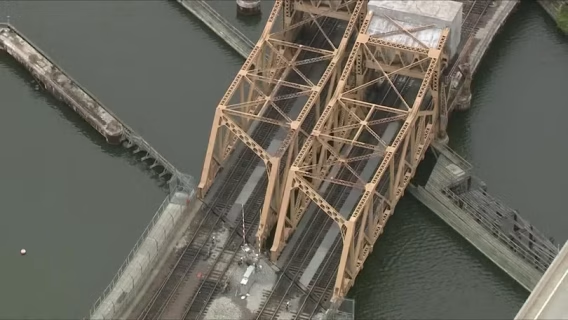
MBTA North Station Draw One Bridge Replacement


Leave a Reply