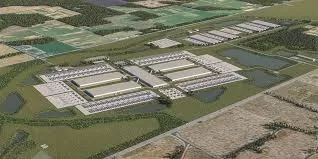
What began in late 2024 as a $10 billion data-center announcement for rural northeast Louisiana has grown into one of the largest privately financed digital infrastructure projects in the United States. As the project expands in size, financing and electrical requirements, its presence is becoming increasingly visible across Richland Parish—both in the economic activity it brings and in the pressures local communities are working to manage.
The facility, known internally as the Hyperion campus, is designed as a multi-gigawatt hub for Meta’s future AI systems. The company continues to describe the site as one of its most important long-term infrastructure investments. Yet for residents, parish officials and local institutions, the transformative effect of the project is rooted not only in its scale but in the pace at which its demands are intersecting with everyday life.
From a $10B announcement to a nearly $30B financing structure
When the project was unveiled in December 2024, the state and Meta announced a $10 billion development—the largest single corporate investment Richland Parish had ever seen. But as planning advanced, the structure evolved into a far larger financing model supported by private-equity and bond investors, almost being mimicked by Google-backed River Bend data center in Southeast Louisiana.
By October 2025, financial documents and reporting showed a financing package approaching $27–30 billion, with Meta retaining about 20% ownership. The majority of the investment is backed by Blue Owl Capital, a private-equity fund that manages the bulk of the stake, while PIMCO serves as the anchor bond investor, providing long-term debt financing for the project. For local leaders, the shift did not change the physical size of the development, but it clarified that the project is now supported by global institutional investors with long-term expectations for returns tied to the growth of AI computing.
For local leaders, the shift did not change the physical size of the development, but it clarified that the project is now backed by global institutional investors with long-term expectations for returns tied to the growth of AI computing.
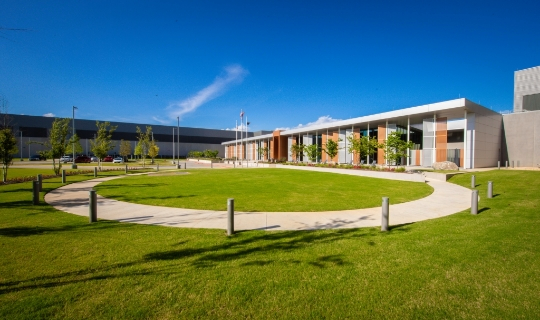
A massive physical footprint in a rural landscape
The project covers approximately 2,250 acres, with construction planned through the late 2020s. Plans call for over 4 million square feet of data-center facilities, along with supporting substations, cooling infrastructure, internal roads and security perimeters.
At peak construction, state officials anticipate up to 5,000 workers on-site, followed by about 500 permanent jobs once the campus is operational. An additional 1,000+ indirect jobs are projected to arise in logistics, services and maintenance.
Local officials have emphasized that these numbers come from state economic-development estimates and should be treated as projections rather than guaranteed outcomes.
Power demand and regulatory decisions
The campus is being engineered for more than 2 gigawatts (GW) of compute-capacity operations, with long-term designs allowing for the possibility of scaling toward 5 GW. That level of demand has required major action from regulators.
The Louisiana Public Service Commission approved Entergy Louisiana’s plan to build two new natural-gas generation and additional transmission infrastructure specifically to serve the data center. The approval followed negotiations with consumer groups, clean-energy advocates, and large commercial customers.
Supporters of the project argue that the new infrastructure will strengthen grid reliability and attract further investment to the region. Critics have raised questions about ratepayer exposure, environmental impacts, and whether long-term gas-fired generation is the right fit for a region seeking industrial growth.
Meta has pledged to match its energy usage with 100% renewable procurement and to work with Entergy to bring 1,500 MW of new renewable energy onto the grid. Those commitments, however, relate to renewable purchases and not necessarily to the physical power Mix that flows directly to Richland Parish.
Changes residents are seeing day-to-day
While company officials highlight economic benefits, residents across the parish have experienced a more immediate set of changes driven by the construction phase.
Roads and traffic
Rural roads originally designed for farm vehicles now carry steady flows of heavy equipment, concrete trucks and delivery convoys. Parish officials report:
accelerated road wear
safety concerns at narrow intersections
increased demand on local emergency responders
Maintenance schedules have been updated to keep pace with traffic volume that many local residents say they have never seen before.
Housing pressure
Temporary workforce housing needs have raised rental prices in nearby towns. Property managers in Rayville, Delhi and surrounding areas have reported unusually high short-term occupancy levels, leaving fewer options for long-time residents and new local workers.
Water and well concerns
Residents in areas near the construction zone have reported:
sediment in well water after major earth-moving periods
localized drops in water pressure
concerns about long-term groundwater draw once cooling systems begin operation
These reports have prompted local officials to request expanded monitoring, though formal, parish-wide assessments are still developing.
Community services
Local schools, clinics and emergency services have been preparing for temporary population increases tied to construction cycles. For small towns, even modest fluctuations can affect staffing needs and scheduling.
Local institutions adapting to the project
In anticipation of long-term operations jobs, the Louisiana Community and Technical College System committed $250,000 to workforce programs at Delta Community College. New or expanded curricula focus on:
electrical and mechanical systems
data-center operations
industrial maintenance
Parish leaders say they expect these programs to be essential if local residents are to secure a significant share of the permanent roles.
Meta has also committed up to $1 million per year to Entergy’s low-income bill-assistance program and has pledged more than $200 million in local infrastructure improvements, including road upgrades and water-system enhancements.
Community questions that remain unresolved
While many residents welcome the economic activity, several issues continue to be raised at public meetings and in local reporting:
How will long-term ownership work?
With Meta holding only about 20% of the project, some local officials want clarity on future governance, accountability and dispute-resolution mechanisms.
How will costs be allocated?
Residents want clearer assurances that ratepayers will not bear disproportionate costs for new generation assets built for the project.
Will job commitments be met?
Parish leaders have asked for transparent reporting on hiring, including how many roles go to local residents versus external recruits.
What water protections are in place?
Requests for ongoing testing, public reporting and independent monitoring continue.
Will a binding community-benefit agreement be established?
Advocacy groups say this is necessary to ensure enforceability of commitments.
Read also: Tract Secures Approval for $20 Billion Data Center Park in Buckeye
Meta New AI Data Center in Richland Parish – Project Factsheet
Project Overview:
Location: Richland Parish, Northeast Louisiana
Investment: $30 billion
Size: 4 million square feet
Construction Period: Through 2030
Job Creation:
Direct Jobs: 500+
Indirect Jobs: 1,000+
Construction Workers: 5,000 (peak)
Site Area: 2,250 acres
Read also: $2B Central Ohio Data Center Campus: Expected to Cover 1.5 Million Sq. Ft.
Meta’s new $30 billion AI data center in Louisiana: Key Features:
Meta’s largest global data center
Optimized for AI workloads
100% renewable energy commitment
1,500 MW new renewable energy through Geaux Zero program
Economic Impact:
Infrastructure Investment: $200+ million
Local Community Support:
$250,000 workforce development funding
Partnerships with local schools
Up to $1 million annual low-income ratepayer support
Meta New AI Data Center in Richland Parish, Louisiana: Strategic Significance:
Positions Louisiana as an AI and tech innovation hub
Leverages new state tax incentive programs
Supports digital workforce development
Read also: Core Scientific to Invest $6.1 Billion in Converting Crypto Mine in Denton into AI Data Center
Leave a Reply