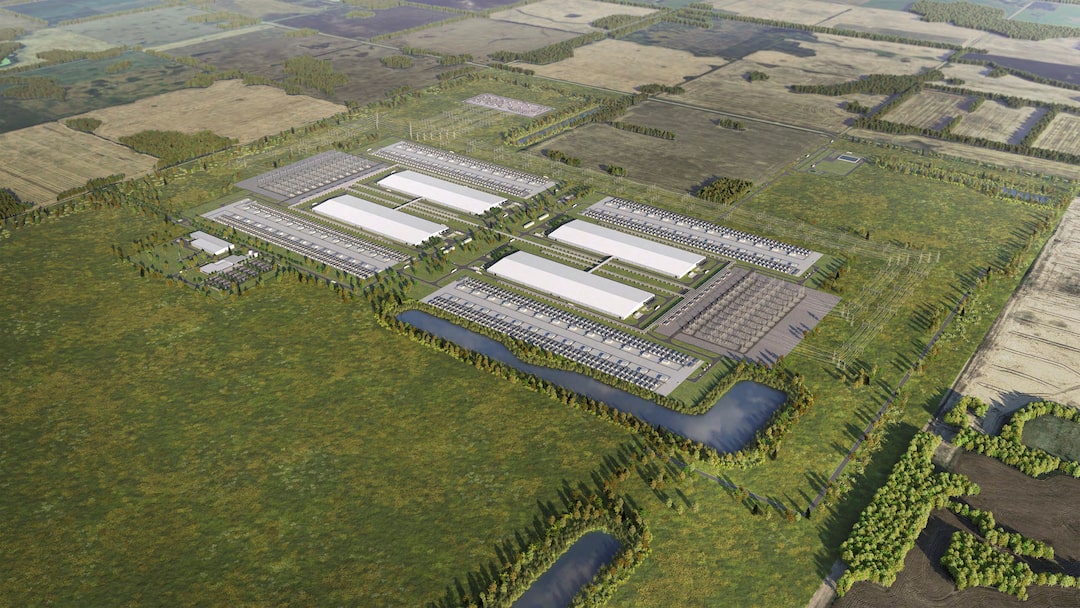
Tech giant Meta announced Wednesday it will construct a massive data center in central Alberta. This data center, known as the Sturgeon Data Centre, will be the company’s first in Canada, as it rapidly builds out computing capacity to support the global AI boom.
Sturgeon Data Centre Capacity
The 1-gigawatt data center will be constructed with the ability to scale up to 1.8 gigawatts. Moreover, it will be located in Sturgeon County. It represents a total investment of C$13 billion, or $9.17 billion, Meta said
Furthermore, Meta has doubled down on AI, pledging hundreds of billions of dollars to build large AI data centers in the U.S. The Alberta announcement represents the company’s 33rd data center globally.
Executives made the announcement in Calgary alongside Premier Danielle Smith and other Alberta government officials. They have spent several years courting Silicon Valley tech giants with the aim of spurring a large-scale investment in the oil-and-gas province.
Other Data Center Proposals for Alberta
Alberta’s technology minister, Nate Glubish, revealed to reporters that there are currently several other gigawatt-scale data center proposals in various stages of development in the province.
“This is the first of its kind, the first of its size, the first of its scale. Also, it won’t be the last,” Glubish said.
Meta, like other tech giants, is facing rapidly expanding power needs. This is as a result of the growth of AI, and Alberta is rich in natural gas which sells at a significant discount to the U.S. benchmark.
The province’s cold climate also makes cooling the massive super-computers and related data center infrastructure more cost-efficient.
Additionally, 20 existing small- to mid-scale data centers in Alberta already pull from the province’s energy grid, which is 60% powered by natural gas. The provincial government is giving new proponents the option to build their own power sources to avoid limits on power capacity.
Funding of Generation and Grid infrastructure for the Data Center
Also, Meta said on Wednesday it will fully fund new generation and grid infrastructure for its Alberta data center, which will consume about as much electricity as 800,000 homes.
Gary Demasi, Meta’s vice president for data center development, said the company will offset that electricity use by investing in clean and renewable energy.
Closed-loop Liquid Cooling System to Reduce Water Use at the Data Center
He also said the data center will use a closed-loop liquid cooling system, meaning its total water use will be less than that of a typical golf course.
Additionally, the company has partnered with Alberta-based Pembina Pipeline (PPL.TO), opens new tab , which announced last week it will go ahead with its Greenlight Electricity Centre, a new natural gas-fired power-generation facility in Sturgeon County which will be in service in late 2030 and with which Meta has a long-term tolling agreement.
Until that project is operational and for the next decade, Alberta-based power producer Capital Power (CPX.TO), opens new tab will provide 250 megawatts of electricity for the site using its existing natural gas-fired fleet.
Energy Consumption
Also, the project will require approximately 150 million cubic feet per day of natural gas, according to Pembina, helping to create demand for Western Canadian natural gas producers.
Moreover, Canada’s government laid out an AI strategy last month that suggested new data center growth would benefit from the country’s clean electricity grid, which is largely powered by renewables and low-emission power sources.
Why Alberta Emerges as a Leading Data Center Development Hub in Canada
But the vast majority of data centers currently in the planning stages in Canada are located in Alberta, where a reliance on natural gas means the emissions intensity of the province’s electricity grid is almost five times the national average. Also, the region has renewable energy sources that can be utilized to power data centers.
However, environmentalists in Canada were quick to condemn Meta’s plans. Some environmentalists said tech billionaires have no right to the country’s natural resources.
“We need a moratorium on mega-data centers until we have legislated environmental and human rights protections on AI,” said Keith Stewart of Greenpeace.
Sturgeon Data Centre: Project Factsheet
Project Name: Sturgeon Data Centre
Developer/Owner: Meta Platforms, Inc.
Location: Sturgeon County, Alberta, Canada (Located within Alberta’s Industrial Heartland, approximately 35 kilometers northeast of Edmonton)
Status: Groundbreaking announced July 8, 2026
Project Scale: 2.9 million square feet (Meta’s 33rd data center globally, its first in Canada, and its largest facility outside the United States)
Total Capital Investment: Over CA$13 billion (approx. US$9.2 billion)
Power Capacity: 1 Gigawatt (1,000 MW)
Primary Workload: Advanced Artificial Intelligence (AI) infrastructure and global computing workloads
Target Timeline: Construction underway; full power-generation integration targeted for late 2030
Employment: Generates up to 3,000 jobs at peak construction and supports 300+ permanent, high-skilled operational roles (trades, technical, and maintenance).
Project Team
Meta Infrastructure Team: Responsible for site architecture, deploying the advanced AI-optimized hardware, and managing the closed-loop, liquid-cooled technology.
Pembina Pipeline Corporation: Leading energy transportation. Also, it will be the midstream service provider managing resource supply lines.
Kineticor Asset Management: The primary developer and manager of the project. Moreover, it will be the operator of the power generation facility.
Morgan Stanley Infrastructure Partners (MSIP): Global private infrastructure investment platform providing capital and investment oversight.
Capital Power: Executed a long-term Energy Supply Agreement (ESA) to supply 250 MW of backup and baseline capacity from its broader Alberta fleet.
AltaLink: Managing transmission infrastructure and physical grid connections.
Alberta Electric System Operator (AESO): Overseeing regulatory alignment and system reliability to prevent local consumer rate inflation.
PCL Construction & Clark Builders: Leading industrial general contractors tasked with managing the peak workforce of 3,000 tradespeople.
SLB (Schlumberger): Involved in technical infrastructure and civil/energy positioning.
Invest Alberta: Acted as the primary investment attraction agency orchestrating the multi-year deal.
Sturgeon County Council: Municipal authority managing local land zoning (Alberta’s Industrial Heartland) and development permits. Additionally, it will manage the CA$60 million local infrastructure upgrade.
Government of Alberta: Spearheaded by Nate Glubish (Minister of Technology and Innovation) and RJ Sigurdson (Minister of Affordability and Utilities), who established the specific regulatory framework and data center “concierge team” to fast-track the project.



Leave a Reply