
Miami University’s Board of Trustees has unanimously approved construction of a new $242 million multipurpose arena on its Oxford, Ohio campus, with the total project budget authorised at up to $281 million. Slated to replace the ageing Millett Hall and open by the fall 2028 athletic season, the facility marks one of the largest capital investments in the university’s history — and arrives in the midst of one of its most celebrated sporting moments.
From Cook Field to Crown Jewel: What the New Arena Will Deliver
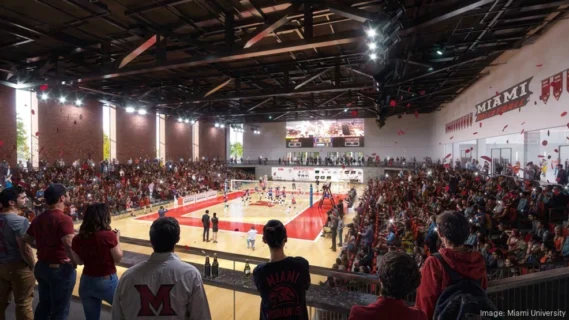
The new facility will be built on the site of Cook Field, located near the State Route 73 eastern entrance to Miami’s main campus — a more accessible location for students than the current Millett Hall. The arena will house a main competition court, a dedicated volleyball arena, and a practice court, with total construction costs for these elements estimated at $242 million. The broader $281 million budget additionally covers parking, site improvements, demolition of Millett Hall, and the relocation of recreational fields.
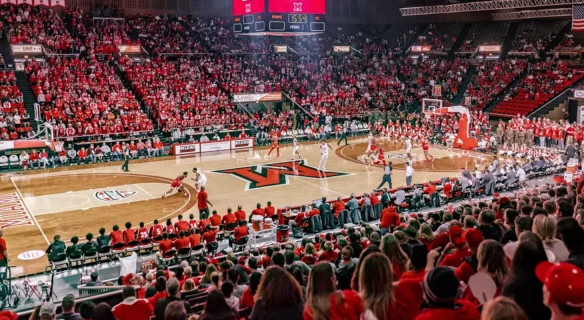
Designed to serve as both an athletic venue and a community hub, the arena will accommodate concerts, graduation ceremonies, career fairs, and arts performances alongside basketball and volleyball competitions. University officials have also outlined plans for a mixed-use development around the site, including a hotel, a high-end restaurant, and a conference centre, which are expected to spur economic activity for the city of Oxford and the broader Southwest Ohio region. Two replacement recreational fields will be constructed near Millett Hall and at the Chestnut Fields campus location, with work beginning in May 2026 and targeted for completion by September — at which point Cook Field will be taken offline for arena construction.
Project Fact Sheet: Miami University Multipurpose Arena
Project Name: Miami University Multipurpose Arena
Location: Cook Field, Oxford, Ohio, USA (Miami University Main Campus)
Construction Cost: ~$242 million (arena, volleyball arena, practice court)
Total Authorised Budget: Up to $281 million (includes demolition, parking, field relocation)
Financing: Tax-exempt revenue bonds, private donations, naming rights, investment income draw (~$10.2M/year)
Key Features: Main competition arena, volleyball arena, practice court; potential hotel, restaurant, and conference centre on adjacent site
Demolition: Millett Hall (current arena)
Replacement Recreation: New fields at Millett Hall site and Chestnut Fields (construction May–Sept 2026)
Construction Start: September 2026 (following Cook Field going offline)
Target Opening: Fall 2028 athletic season
Pending Approval: Ohio Chancellor of Higher Education (additional debt authorisation)
Project Team: Miami University Multipurpose Arena
Owner/Client: Miami University, Oxford, Ohio
Approving Body: Miami University Board of Trustees (approved unanimously, Feb. 27, 2026)
Director of Athletics: David Sayler
Vice President for Strategy and Partnerships: Ande Durojaiye
Academic Adviser (Sport Leadership): Adam Beissel, Associate Professor, Sport Leadership and Management
State Oversight: Ohio Department of Higher Education (pending Chancellor approval)
General Contractor: To be confirmed
Architect/Designer: To be confirmed
The Minds and Mandate Behind the Project
Miami University’s Board of Trustees approved the project through three resolutions at its February 27, 2026 meeting, authorising both the construction itself and the issuance of tax-exempt revenue bonds to fund the majority of the cost. The university will borrow all but $77 million of the total budget, with debt service funded through an increased annual draw on investment income of approximately $10.2 million per year alongside savings from retiring existing debt. No increase in student tuition or fees is proposed. Supplementary revenue is expected from private donations, corporate sponsorships, and naming rights.
Director of Athletics David Sayler has been the project’s most prominent institutional advocate, framing the arena as essential to Miami’s competitive future as a Division I, FBS institution. Associate Professor of Sport Leadership and Management Adam Beissel also endorsed the development, noting that anchoring a multipurpose arena within a mixed-use district creates revenue generation opportunities and an enhanced student experience that extends well beyond sport. Final approval from the Chancellor of the Ohio Department of Higher Education is still pending, though university officials expect it imminently. Design and general contracting teams are yet to be publicly confirmed.
RedHawks Rising — and a Campus Divided
The arena vote did not pass without friction. A coalition of students, faculty, and the Faculty Alliance of Miami organised a public demonstration outside the Marcum Hotel and Conference Center ahead of the trustees’ vote, arguing that the project was advanced without adequate consultation. An independent student survey cited during public comment found more than 80 percent of respondents opposed the development, with critics raising concerns about the loss of Cook Field’s recreational value, falling enrolment, elimination of academic programmes, and the university’s decision to take on substantial debt for an athletic facility.
Proponents, however, point to the deteriorating state of Millett Hall — where renovation costs were originally estimated at $80 million but later revised sharply upward — as making replacement the fiscally sound choice. Student athletes described inadequate training rooms, rehabilitation spaces the size of storage closets, and collaboration areas so limited that NIL meetings were conducted in arena seating. The debate ultimately played out against the backdrop of Miami’s men’s basketball team finishing the regular season at 30-0, ranked No. 21 nationally — a moment that has energised the case for upgraded facilities and raised the programme’s national profile heading into the NCAA Tournament.
Campus Arenas and the New Economy of College Athletics
Miami’s arena investment reflects a rapidly shifting landscape in American collegiate sport. The introduction of Name, Image and Likeness (NIL) rights for student athletes, combined with the ongoing restructuring of conference affiliations and the explosion of media rights revenue, has made facility quality a decisive factor in recruitment, programme reputation, and institutional revenue. Mid-major institutions like Miami — which competes in the Mid-American Conference — are increasingly compelled to invest at levels once associated only with Power Five programmes in order to remain competitive. This dynamic is reshaping stadium economics across the board, from college campuses to the NFL, where the $1.4 billion renovation of EverBank Stadium for the Jaguars — a deal split equally between the team and the city, underscoring how deeply facility investment has become tied to franchise and community identity alike.
Comparable arena projects at mid-major universities have followed a similar logic in recent years. The University of Dayton completed a $72 million renovation of UD Arena in 2022. Ball State University opened a $60 million Student Recreation and Wellness Center in 2020. At $242 million in direct construction cost, Miami’s project is significantly more ambitious than either, signalling a broader institutional bet: that a state-of-the-art multipurpose venue, integrated into a mixed-use development with hospitality and retail components, can function as both an athletic asset and an economic engine. In an era of enrolment pressure and heightened competition for students, the arena is as much a recruitment and marketing tool as it is a sports facility.
Leave a Reply