A number of large tech companies have shown profound interest on the Savannah River Site for nuclear-powered AI-data center. They attended a meeting about building a data center on the Department of Energy’s (DOE) land. The companies attended an industry day focused on soliciting proposals at the Savannah River Site (SRS) in South Carolina, putting South Carolina in the race for data center investment dollars that states are competing for. The DOE is open to proposals for AI data centers and/or energy infrastructure.
Various well-known technological companies across the U.S. were in attendance such as Microsoft, Google, and Meta. Others include CoreWeave, QTS, Oracle, Crusoe, Arus, Pegasus Group, Submer and Pure Storage. On the other hand, Bloom Energy and The Nuclear Company represented the energy side. Oppenheimer Energy, Deep Atomic, Oklo, GE Vernova were also present.
However, hyperscaler Amazon was not in attendance despite the magnitude of interest on the project. Savannah Rive is one of a number of location for the Department of Energy. The DOE has noted it could private AI data centers in these sites. Following Executive Orders from Presidents Biden and Trump, the DOE announced 16 possible sites last April. South Carolina is becoming a hub for data centers as other projects such as Google’s multi-billion-dollar data center expansion project takes shape. Furthermore, the Little Rock data center project is also gaining support from city officials. It is among the few to have state backing based on how officials are opposing data center projects.
Scope of Implementation on the Savannah River Site AI Data Center Project
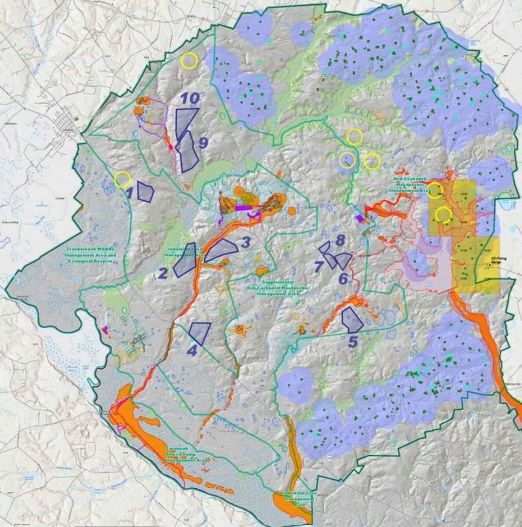
In July, the DOE highlighted four locations as the furthest along, with Savannah River Site among them for an AI data center. At SRS, there are ten tracts of land potentially capable of supporting a data center. Furthermore, it can possibly also support power generation facilities totaling 3,103 acres. Projects “must include new energy generation.” In terms of power, the site currently has access to several 115kV lines and a 20MW DOE-owned biomass combined cycle plant.
Two commercially-owned 75MW solar power generation facilities with BESS are also currently in development. Operations are scheduled to commence in 2029. ” I am tasked to oversee the modern-day Manhattan Project,” NNSA principal deputy administrator Scott Pappano said in opening remarks during the industry day. “Think about the Manhattan Project – a strategic imperative, at the time, to essentially end WWII, right? We are back in that sort of strategic national imperative again today. We are in a global race right now for AI compute power and the energy that’s needed to drive that. That’s the world we face today.” He added. Furthermore, he also noted that the Savvanah River Site will provide AI data centers a good opportunity to combine tech and energy.
Project Factsheet
Savannah River Site AI Data Center
- Project: Savannah River Site (SRS) Nuclear-Powered AI Data Center
- Location: South Carolina, USA
- Land Owner: U.S. Department of Energy (DOE)
- Status: Proposal solicitation stage
- Main Interest From:
Microsoft, Google, Meta, CoreWeave, QTS, Oracle, Crusoe, Pure Storage, Submer, Pegasus Group - Energy Partners Present:
Bloom Energy, The Nuclear Company, Oklo, GE Vernova, Deep Atomic, Oppenheimer Energy - Notably Absent:
Amazon - Site Capacity:
- 10 viable land tracts
- Total area: 3,103 acres
- Projects must include new power generation
- Existing Power:
- Three 115kV transmission lines
- 20MW DOE-owned biomass plant
- Planned Power:
- Two 75MW solar plants with BESS
- Operational target: 2029
- Strategic Positioning:
DOE ranks SRS among the top 4 most advanced sites for AI data center deployment nationwide - National Priority:
Framed by NNSA as a “modern-day Manhattan Project” focused on AI compute and energy dominance - Core Objective:
Combine AI hyperscale computing with nuclear-powered and renewable energy infrastructure
Leave a Reply