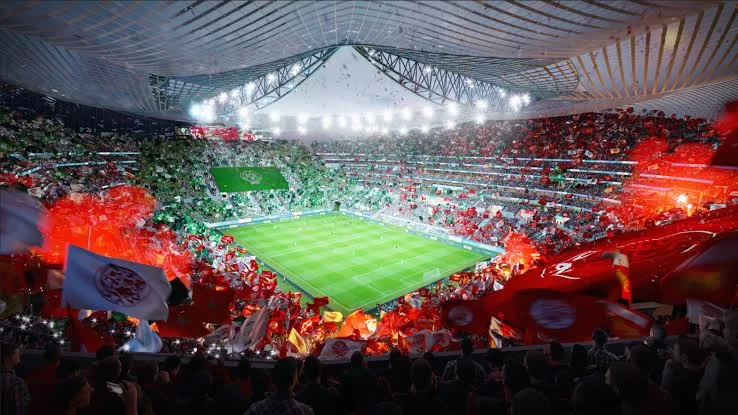
The construction of the Grand Stade Hassan II Stadium in Benslimane province of Morocco is part of ambitious plans to make it the largest stadium in the world. The second phase of the project, with an estimated cost of MAD 3.2 billion ($320 million), follows the nearly completed earthworks phase. As revealed by converging reports, this stage entails major structural elements including masonry, waterproofing, metal framework, coverings, false ceilings, carpentry and painting.
Contacted by Construction Review Online, Oualalou+Choi — the lead architect on Morocco’s Grand Stade Hassan II — confirmed that two elements of the earlier design are no longer foreseen. The raised botanical-garden platforms (28 metres high) once planned at the entrances will not go ahead, and the two large single-tier stands previously shown at each end have also been dropped. The monumental entrances remain, supported by the roof’s ring of 32 stairways, and the stadium keeps its three tiers of seating in the main stands.
The 115,000-seat stadium, set to become the largest in the world upon completion, is being delivered for the 2030 FIFA World Cup, which Morocco will co-host with Spain and Portugal.
Hassan II Stadium Factsheet
Name: Hassan II Stadium, also known as Grand Stade de Casablanca.
Location: Benslimane, near Casablanca, Morocco (approximately 38 km north-east of Casablanca in the Beni Amer forest area of El Mansouria).
Status: Under construction; earthworks are nearing completion, with tenders for construction works to be launched soon.
Planned opening: 2028.
Owner: Royal Moroccan Football Federation.
Operator: SONARGES.
Planned capacity: 115,000 spectators, making it the largest football stadium in the world upon completion, surpassing the Rungrado 1st of May Stadium in Pyongyang, North Korea (114,000).
Architects: Consortium led by Oualalou+Choi, in collaboration with Populous.
Construction cost: Estimated at MAD 5 billion (approximately US$500 million). The second phase of construction is budgeted at MAD 3.2 billion (US$320 million).
Key design features:
- Inspired by traditional Moroccan cultural festivals known as “moussem” and the form of traditional tents.
- Covered by a large, translucent tent-like roof made from a unique aluminum lattice.
- The roof is supported by a ring of 32 stairways, creating monumental entrances.
- Features three tiers of seating in the main stands.
- Includes five levels of hospitality suites along the main stands, including a royal box.
- Incorporates extensive greenery, aiming to create an “oasis of greenery.”
- The designers have ensured full compliance with FIFA standards, enabling the stadium to host the final of the 2030 FIFA World Cup.
- Lastly, part of a larger 100-hectare sports and entertainment complex envisaged to include training fields, a hotel, a conference center, an athletics stadium, a sports hall, a gymnasium, a swimming pool, a play area, two shopping centers and four parking lots. The architect, Oualalou+Choi, clarified that these surrounding facilities are not being built in the current phase, which is focused on the stadium itself.
The National Agency for Public Equipment (ANEP) is supervising the stadium project as the delegated project manager for the National Company for the Implementation and Management of Sports Equipment (SONARGES).
The authorities set the tender submission deadline for June 10 at exactly 10:00 a.m. The contractor must complete the stadium project within 30 months from the date specified in the service order, which the authorities must issue within 30 days after they approve the contract.
Timelines
This timeline aligns with statements from Fouzi Lekjaa, president of the Royal Moroccan Football Federation, who projected completion of the stadium by December 2027, in preparation for the 2030 World Cup that Morocco will co-host with Spain and Portugal.
Also read: $500M Hassan II Stadium Construction Underway Ahead of 2030 World Cup, Morocco
About Oualalou+Choi
The architecture and urban design practice of Oualalou+Choi approaches the architectural project as a means of negotiating complex situations, however foreign or obscure. Founded by Linna Choi and Tarik Oualalou, the office’s work spans a wide range of scales, typologies and contexts, serving as investigations as much about exploring given project constraints as about questioning the limits of the design profession. Its most significant works include the Volubilis Museum, the Cultural Center of Morocco in Paris, the United Nations COP22 Village, the Campus for the World Bank/IMF Annual

Leave a Reply