
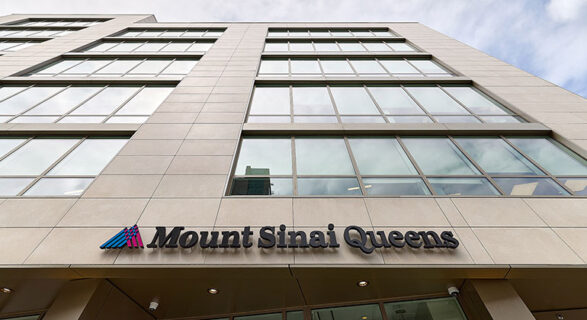
Mount Sinai Health System held a ceremonial groundbreaking on April 30, 2026, for a new, clinically advanced intensive care unit at Mount Sinai Queens, a project that will increase the hospital’s total certified bed count from 228 to 241 beds and add 13 new ICU beds to its current eight. Construction is expected to take approximately 16 months once a certificate of need is granted, and will be funded in part by New York City and New York State as well as through Mount Sinai’s capital resources. The bed breakdown includes seven beds for intermediate care services, serving as an in-between space for general care and the ICU and commonly used to support older adults and patients with complex conditions or severe disabilities. The new ICU will be built on the sixth floor of the hospital’s main campus at 25-10 30th Avenue in Astoria, transforming underutilised space into a modern, high-functioning critical care environment. The unit will include a class 2 procedure room designed to support moderate-risk surgical or interventional procedures, equipped to support fluoroscopy-guided procedures including peripherally inserted central catheter line placements, central venous catheter insertions and dialysis catheter placements. Critical care beds will be fully equipped with telemonitors enabling care teams to manage a large number of ICU patients and exchange information electronically in real time. Public funding for the project totals at least $13 million: State Senate Deputy Leader Michael Gianaris allocated $6 million in state funds, while Queens Borough President Donovan Richards Jr. allocated $7 million toward the future ICU.

The numbers behind this groundbreaking are small compared to the billion-dollar hospital builds that have dominated construction headlines in recent years, but they tell a story that is arguably more important to understand about how urban healthcare infrastructure actually works in New York City. Approximately 120 patients were transferred from Mount Sinai Queens to other facilities in 2023 due to a shortage of available ICU beds. Each one of those transfers represents a failure of the local care system: a family separated from a critically ill relative, an ambulance journey that carries clinical risk, and a cost burden that falls on patients, insurers and the health system simultaneously. Western Queens is a dense, rapidly gentrifying borough with a complex and diverse patient population, and Mount Sinai Queens in Astoria has historically been the primary safety net for residents who cannot easily access Manhattan-based tertiary care. The hospital has undergone significant modernisation since its NK Architects and Davis Brody Bond-designed expansion completed in the mid-2010s, which delivered new emergency department, operating room and outpatient infrastructure, but ICU capacity was not expanded as part of that programme, creating the gap this new project addresses. The contrast with how larger health systems approach ICU capacity is instructive. Across New York, major hospitals have invested heavily in dedicated critical care towers with standalone infrastructure and dedicated mechanical systems, but community hospitals within larger health networks often inherit older floor plates that require creative conversion rather than new construction. Similar adaptive redevelopment strategies are also playing out elsewhere in the city’s healthcare infrastructure pipeline, including the New York Blood Center redevelopment into the new Center East facility, which reflects how institutions are upgrading specialized medical and research spaces within tight urban footprints. The sixth-floor conversion model at Mount Sinai Queens reflects this reality and represents a practical, cost-efficient approach to adding high-acuity capacity within an existing building envelope, something that more community hospitals across the five boroughs will need to pursue as patient acuity continues to rise.
ICU Configuration, Procedure Room Scope and Clinical Staffing Model
- New ICU location: sixth floor, Mount Sinai Queens main campus, 25-10 30th Avenue, Astoria
- Total new bed count: 21 ICU beds (up from existing 8), a near-tripling of capacity
- Bed breakdown: 14 standard ICU beds and 7 intermediate care beds (step-down level, supporting older adults and complex condition patients)
- Class 2 procedure room: supports moderate-risk surgical and interventional procedures
- Fluoroscopy capability: enables PICC line placements, central venous catheter insertions and dialysis catheter placements
- Telemonitor-equipped beds: real-time electronic patient monitoring and information exchange across the full unit
- Clinical team supported: critical care nurses, patient care associates, respiratory therapists, physical therapists, social workers, case managers and specialists
- Construction timeline: approximately 16 months following certificate of need approval
- Impact on ED: expected to reduce Emergency Department congestion by accepting higher-acuity patients from the ED into the ICU more rapidly
- Transfer reduction: designed to eliminate or significantly reduce the approximately 120 annual patient transfers from Mount Sinai Queens to other facilities due to ICU bed shortages
- Hospital bed count impact: total certified beds increase from 228 to 241 upon completion
Project Fact Sheet
- Project Name: Mount Sinai Queens New Intensive Care Unit
- Owner/Operator: Mount Sinai Health System
- Hospital: Mount Sinai Queens
- Location: Sixth Floor, 25-10 30th Avenue, Astoria, Queens, New York
- Groundbreaking Date: April 30, 2026
- Construction Duration: approximately 16 months following certificate of need approval
- Project Type: ICU capacity expansion and fit-out within existing hospital building (sixth floor conversion)
- New ICU Beds: 13 additional beds (total 21, up from 8)
- Intermediate Care Beds (within ICU): 7 of the 21 total beds
- New Procedure Room: Class 2, fluoroscopy-equipped, supporting PICC line, central venous catheter and dialysis catheter placements
- Monitoring Technology: Telemonitors at all critical care beds for real-time patient management and electronic information exchange
- Total Certified Beds (Post-Completion): 241 (up from 228)
- Funding Sources: New York State ($6 million via State Senate Deputy Leader Michael Gianaris); Queens Borough President’s Office ($7 million via Donovan Richards Jr.); Mount Sinai capital resources (remainder)
- Certificate of Need: Pending approval by New York State Department of Health prior to construction commencement
- Transfer Reduction Target: Eliminate or significantly reduce the approximately 120 annual patient transfers due to ICU bed shortages (2023 baseline figure)
- Previous Expansion Reference: Mount Sinai Queens building modernisation (2013 groundbreaking, completed mid-2010s): $175 million, 140,000 sq ft; architect NK Architects with Davis Brody Bond; builder Skanska USA
Project Team
- Owner/Client: Mount Sinai Health System — one of the largest academic medical systems in the United States, comprising eight hospitals, approximately 9,000 primary and specialty care physicians, and multiple outpatient sites across New York City, Westchester, Long Island and Florida; consistently ranked in Newsweek and U.S. News and World Report national and global hospital rankings
- President and Chief Operating Officer, Mount Sinai Queens: Cameron R. Hernandez, MD, FACHE — principal hospital spokesperson for the ICU expansion; described the project as a key investment in long-term community resilience and critical care access
- Director, Intensive Care Unit, Mount Sinai Queens: Nazia Mashriqi, MD, MBA — provided clinical leadership commentary at the groundbreaking, framing the new unit as a meaningful advancement in the hospital’s ability to deliver timely high-acuity interventions and multidisciplinary critical care
- State Funding Authority: State Senate Deputy Leader Michael Gianaris — allocated $6 million in New York State funds toward the ICU build, a commitment originally announced in October 2024 and formalised through the 2026 groundbreaking ceremony
- Borough Funding Authority: Donovan Richards Jr., Queens Borough President — allocated $7 million from the borough president’s capital budget toward the new ICU; co-hosted the groundbreaking and cited community access to local critical care as the primary rationale
- Architect and Contractor: Not publicly confirmed for the current ICU project; the hospital’s prior major expansion (2013 to mid-2010s) was delivered by NK Architects and Davis Brody Bond as architects and Skanska USA as builder



Leave a Reply