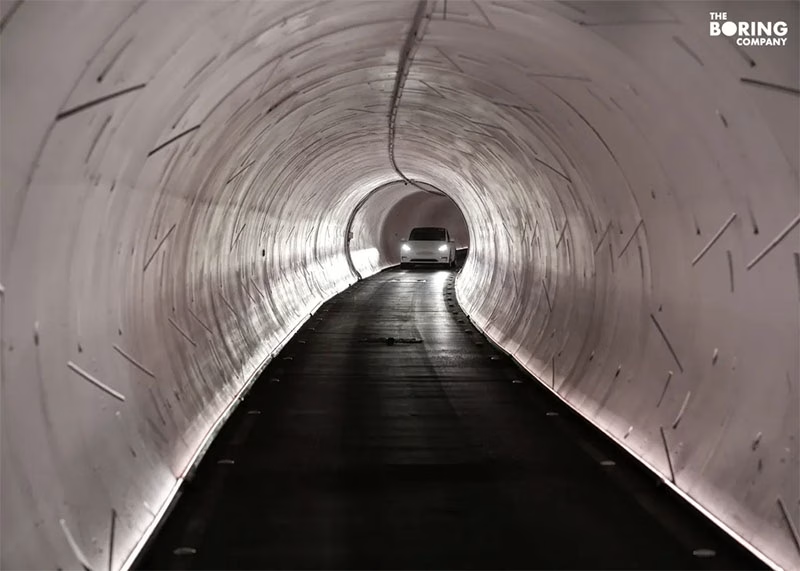
Updated 19th August 2025 – Tennessee Governor Bill Lee has confirmed that The Boring Company will not be required to pay for the use of state land to build its planned 10-mile tunnel system in Nashville, which will run from the airport through Murfreesboro Pike to Lafayette Street, past the Music City Center, under Eighth Avenue, and up to the State Capitol. While final negotiations on the state’s inspection process are still underway, Lee indicated that the company is unlikely to face land-use fees as part of the agreement.
Other than the upgrade on the Nashville international airport through the Nashville Tesla tunnel project, the LAX roadway improvements in Los Angeles also advances hastily.
A joint venture between Skanska and Flatiron has been awarded a new $868 million roadway upgrade contract as the LAX roadway improvements advances. The contract was awarded by the Los Angeles World Airports to advance the Airfield and Terminal Modernization Program (ATMP). The combined contract value stands at $868m, with Skanska’s share accounting for $445m. The company will recognize its portion in its US order bookings for the fourth quarter of 2025.
The scope of implementation covers various aspects of the project. These include upgrading over 6km of roads and also construction and retrofitting bridges. Furthermore, it entails improving traffic signal infrastructure and introducing advanced traffic monitoring systems at LAX. The work aims to adjust existing airport access routes while staying within the current site boundaries. Construction started in July 2025 and is scheduled to finish by the end of 2030.
July 2025
The Boring Company, owned by Elon Musk, plans to construct an underground tunnel connecting Nashville International Airport (BNA) to downtown Nashville. The exact downtown drop-off location has not yet been announced, but the goal is to bypass surface traffic and deliver a faster route for travelers.
When Will It Be Built?
Governor Bill Lee described the project as a public-private partnership, with The Boring Company covering all construction costs. The company says it can build the tunnel in about two years once construction begins. However, no firm construction start date has been given. Officials have indicated the first section of the loop might open by fall 2026, but that timeline depends on when actual work starts.

How Will It Work?
The planned loop would allow Tesla vehicles to transport passengers between the airport and downtown in 8–10 minutes, running beneath existing traffic congestion. At the project’s launch event at BNA, company president Steve Davis said hiring for the build would begin immediately, with plans to offer at least 50 jobs in the first week.
What Challenges Lie Ahead?
While a similar tunnel in Las Vegas demonstrates that the concept can work, Nashville’s underground conditions are far more complex. The city’s Karst topography — a foundation of soluble limestone prone to caves and sinkholes — poses unique tunneling risks. The hard rock formations will make boring more difficult than in the flat desert terrain of Nevada.
Steve Davis acknowledged the tough geology, calling it “way harder than it should be,” but said the engineering challenges are solvable. Still, some experts and local leaders worry about potential safety and cost implications that have yet to be addressed.
Who Supports It — And Who Doesn’t?
Governor Lee, U.S. Transportation Secretary Sean Duffy, and Tennessee’s Republican senators have all endorsed the project, describing it as an innovative private investment that won’t cost taxpayers money. Duffy cited The Boring Company’s high federal safety rating for its Las Vegas tunnel, although that rating relates to operational security, not engineering risks.
However, local officials and Democrats have voiced skepticism. Nashville Mayor Freddie O’Connell has not taken a public position but said his office has “operational questions” about the impact on the city. Other lawmakers criticized the lack of transparency on the agreement’s details and raised concerns about granting long-term underground rights to a private company.
Notably, State Rep. Justin Jones, whose district includes the airport, was barred from the launch event. He and other critics have labeled the plan a “billion-dollar boondoggle” that primarily benefits the ultra-wealthy.
What’s Next?
While excitement about a faster, futuristic airport commute is high among supporters, key details — including route, cost, and land use terms — remain vague. The Boring Company must finalize engineering plans, secure necessary permits, and address public and political concerns before construction can begin.
For now, the promise is bold: a privately funded, high-speed Tesla tunnel connecting Nashville’s airport to downtown by 2026 — if the engineering, geology, and politics align.

Leave a Reply