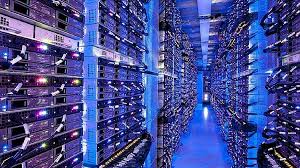
New York is entering a structural turning point driven by the rapid expansion of artificial intelligence infrastructure, accelerating data center development, and mounting pressure on its electricity grid. While the state is actively repositioning itself as a future hub for AI and digital infrastructure, it remains behind established hyperscale markets such as Virginia and Texas, where energy costs are lower and large-scale deployment is more streamlined.
New York’s role is therefore not defined by leadership in existing capacity. Instead, it reflects something more consequential: a full-scale restructuring of how AI-driven demand reshapes the relationship between energy systems, data infrastructure, and economic development.
New York AI Boom: AI demand is now the dominant force shaping the grid
As of May 2026, New York has roughly 207 MW of active data center capacity, placing it in the mid-tier of U.S. markets. However, this baseline is rapidly being overshadowed by forward-looking demand.
Interconnection queue data through May 2026 shows developers seeking more than 12,000 MW (12 GW) of additional capacity across the state, with over 75% of proposed load tied to generative AI and hyperscale computing.
This surge is no longer marginal. It is now the primary variable shaping electricity planning in the state.
According to the New York Independent System Operator (NYISO), its 2025 Power Trends Report and February 2026 updates project statewide electricity demand growth of roughly 1,600 MW to nearly 4,000 MW by 2030. Crucially, NYISO states that the New York AI boom now drives nearly all of this growth through large industrial loads such as data centers. Without them, baseline demand would be flat or declining.
Consequently, that shift marks a fundamental break from traditional load forecasting.
Regulatory pressure is tightening as grid constraints intensify
By April 2026, New York lawmakers began advancing proposals for a multi-year moratorium on large data center projects exceeding 15 MW, reflecting growing concern over electricity affordability and grid reliability.
The emerging regulatory direction is clear: policymakers no longer treat large AI infrastructure projects as standard commercial development. Instead, regulators now assess them as system-level energy assets that directly affect residential pricing, emissions targets, and grid stability.
Approval pathways are becoming more conditional, requiring developers to demonstrate limited impact on public utility costs and greater alignment with energy constraints.
A dual-track buildout: AI campuses and energy megaprojects
Despite regulatory tightening, New York is experiencing simultaneous expansion in both computing and energy infrastructure, creating a dual-track development model.
On the AI side, several large-scale projects illustrate the scale of investment:
At the STAMP campus in Genesee County, Stream Data Centers—working with a Fortune 50 technology partner—expanded planned investment to $19.46 billion in March 2026. The project is designed for a 500 MW load, supported by dedicated on-site substations and significant state and local incentives.
In Niagara County, TeraWulf’s Lake Mariner facility reached 60 MW of active capacity in March 2026, with a $290 million infrastructure expansion agreement signed in May 2026 to support liquid cooling and high-density AI workloads. The long-term target is 750 MW of carbon-free computing capacity.
In Dutchess County, a proposed 1,000 MW data center campus has triggered significant local opposition due to its scale and grid requirements, underscoring the tension between AI expansion and infrastructure limits.
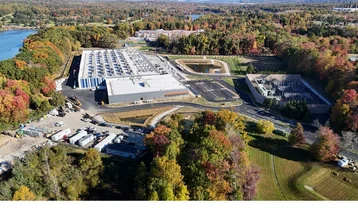
Another major example of expanding AI infrastructure in New York is the Lake Mariner AI Campus in Barker, developed by TeraWulf on a 180-acre portion of a retired 1,800-acre coal plant site. The project reflects a broader shift toward repurposing legacy energy assets for high-density computing infrastructure tied to the AI buildout.
As of May 2026, Lake Mariner had reached roughly 60 MW of active capacity, with a $290 million infrastructure deal signed on May 27, 2026, with Schneider Electric to expand advanced cooling and AI-optimized power systems. Upon full build-out, the campus is projected to reach 750 MW of capacity, with potential expansion to 1 GW across multiple buildings, supported by more than $3 billion in total expected investment, positioning it among the largest AI infrastructure developments in the state.
Energy infrastructure is expanding in parallel — but unevenly
On the energy side, New York is investing heavily in transmission and distributed systems designed to relieve grid pressure and unlock new capacity.
The Propel NY Energy Transmission Line, a 90-mile underground and submarine network, is advancing through planning and evaluation phases as of May 2026. Developed by NYPA and New York Transco, it is designed to strengthen downstate transmission capacity and support offshore wind integration.
The Champlain Hudson Power Express (CHPE) project, a 339-mile HVDC transmission line delivering 1,250 MW of hydroelectric power from Hydro-Québec, is in late-stage construction and expected to begin deliveries in 2026.
However, not all projects are progressing smoothly. The Clean Path NY transmission initiative, designed to deliver up to 3,800 MW of renewable energy into New York City, remains stalled after private sector withdrawal and regulatory deadlock as of early 2026.
Distributed energy is becoming the near-term solution
Alongside large infrastructure, New York is rapidly expanding distributed energy systems.
On May 28, 2026, the Solar Energy Industries Association confirmed that the state’s FY2026–2027 budget allocated $200 million to the NY-Sun Program, accelerating rooftop and community solar deployment as a near-term response to grid constraints.
On the same date, PowerBank Corporation announced a hybrid 5 MW solar and 20 MWh battery energy storage system, following earlier leases totaling 60 MWh of distributed storage capacity across upstate New York.
These investments also reflect a broader shift toward fast-deployment energy assets that can bypass long transmission timelines.
Municipal Data & Power introduces a parallel infrastructure model
Against this backdrop of accelerating AI-driven electricity demand and tightening grid constraints, Municipal Data & Power (MDP) announced on May 28, 2026, the launch preparations for its New York State “Data & Power Sovereignty” Initiative, anchored by a proposed $90 billion Green Energy Bond framework.
The initiative reflects a broader attempt to reconfigure how large-scale digital infrastructure is financed, powered, and integrated into state economies as artificial intelligence expands electricity demand across the grid.
At the center of the proposal is a three-part capital structure allocating approximately:
- $30 billion toward AI data centers and digital infrastructure
- $30 billion toward microgrids, distributed energy systems, and grid resilience infrastructure
- $30 billion toward housing, transportation, and statewide economic development initiatives
Rather than treating data centers and energy systems as separate investment categories, MDP’s framework explicitly links digital infrastructure growth to dedicated energy capacity expansion, effectively bundling compute demand with its own power supply architecture.
A key component of the initiative is the proposed development of Special Industrial Districts (SID). These districts are designed to physically and operationally separate high-density AI computing loads from residential and commercial electricity networks. Within these zones, large-scale computing facilities would operate on dedicated or co-located microgrid infrastructure, reducing reliance on the broader utility system.
According to MDP’s May 28, 2026 statement, the objective is to create a controlled infrastructure environment in which AI-scale computing demand can expand without placing additional strain on residential ratepayers or destabilizing regional grid capacity. The model also aims to improve long-term energy redundancy by decentralizing load concentration across multiple localized power systems.
Beyond energy and data infrastructure, the framework introduces a broader statewide reinvestment strategy. This includes targeted capital deployment into housing development, transportation modernization, workforce training programs, and regional economic development initiatives, designed to distribute economic benefits from digital infrastructure expansion more broadly across the state.
Additionally, MDP positions this approach as a response to increasing structural constraints in traditional utility-scale development models, where long permitting timelines, transmission bottlenecks, and grid congestion have slowed the integration of new large-load infrastructure.
A structural shift in how New York builds its economy
New York’s energy and infrastructure landscape is no longer evolving incrementally. AI-driven electricity demand and constrained grid capacity are reorganizing it.
What is emerging is a hybrid system:
- tightly regulated AI data center expansion
- accelerated transmission investment
- distributed energy deployment
- and new financing models linking infrastructure, energy, and development
The result is not simply an AI investment cycle. It is also a structural redesign of how a major U.S. economy balances digital infrastructure growth with energy system limits.
New York is no longer just planning for AI expansion. It is redesigning the physical and financial architecture required to support it.

Leave a Reply