
The Hartsfield-Jackson Atlanta International Airport rehabilitation programme is a planned infrastructure upgrade initiative intended to improve airport facilities and support passenger traffic growth. The project involves proposed financing to support modernization and expansion works at the airport.
Atlanta is proposing approximately $1 billion in municipal bond borrowing to help finance infrastructure improvements at Hartsfield-Jackson Atlanta International Airport.
According to a securities filing outlining the financing plans, the city intends to issue about $970 million in bonds subject to the alternative minimum tax, in addition to approximately $50 million in non-AMT bonds.
The airport project forms part of broader terminal and infrastructure upgrade activities taking place at several major airports across the United States. As of May 2026, the Hartsfield-Jackson (ATL) is undergoing major upgrades under the ATLNext program, highlighted by the $1.4 billion widening of Concourse D. It is expected to finish in April 2029. The project utilizes modular construction to minimize disruption. Additionally, the ATL SkyTrain is undergoing a 10-year upgrade starting March 2026.
Other Projects
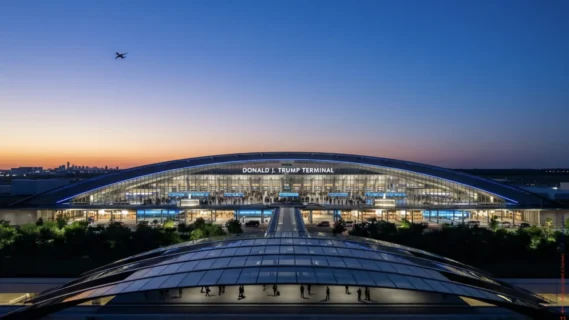
The Hartsfield-Jackson Atlanta International Airport is not the only one advancing as the Washington Dulles International also takes shape. The airport is slated for a $22bn overhaul in a proposed revitalization plan. Under the plan shared by the airport earlier in May, the Metropolitan Washington Airport Authority (MWAA) outlined various scopes. These include a terminal expansion, four new linear concourses and also a new subterranean circulation. Furthermore, the project is expected to be delivered by 2034.
The plan eliminates mobile lounges and also expands the main terminal. The plan would transform the main Eero Saarinen terminal plus awkward midfield concourses into a more conventional, high-capacity hub layout with linear concourses. It will also include underground connections, expanded airport train service, and the potential elimination of mobile lounges.
Also read: ACS-Led Consortium Secures $11B for Atlanta’s SR 400 Express Lanes Project
Project Factsheet
Program goals:
- Enhance passenger experience and service.
- Increase airport capacity and operational efficiency.
- Renew and replace existing facilities.
- Improve the airport’s aesthetic appeal.
Key project components: The program includes a wide range of projects, such as:
- Terminal modernization: Upgrading the domestic terminal complex with new architectural elements, like the soaring steel canopies over the roadways.
- Concourse expansion: Expanding and modernizing concourses, most notably the complex $1.4 billion expansion of Concourse D, which uses an innovative modular construction approach to remain operational.
- New gates: Adding new gates to concourses, including five new domestic gates to Concourse T.
- Airfield improvements: Construction of a new sixth runway, taxiway realignments, and pavement replacement.
- Parking and transit: Rebuilding existing parking structures, constructing new parking facilities, and expanding the SkyTrain automated people mover.
- Air cargo: Expanding air cargo facilities and operations.
Specific projects funded by this bond: The proceeds are intended to finance projects including:
- The Consolidated Rental Car Center (CONRAC).
- SkyTrain expansion.
- Upgrades to parking infrastructure, including new parking decks with EV charging stations.
Details: The bond is expected to be issued in two parts:
- Approximately $970 million of bonds subject to the alternative-minimum tax (AMT).
- Roughly $50 million of non-AMT bonds.
Green Bonds
Furthermore, Atlanta is considering assigning one or more of the issue as “green bonds,” the filing added. If given a greenlight, the green label would align with the offering with ESG trends. Therefore, this would lead to the attraction of impact-focused investors.
Projects such as next-generation parking deck with EV charging stations and energy-efficient terminal upgrades could qualify for green certification. This further enhances the marketability of the bond.
Also read: Atlanta Beltline Unveils $3.5B Light Rail Proposal to Connect Neighborhoods Across the City
Advantage of Bond Financing
By securing financing via bonds rather than bank loans, Atlanta acquires greater control over its airport’s financial trajectory. This approach is considered effective as it avoids the volatility of traditional debt markets, locking in long-term low cost capital.
The bond offering of Atlanta exemplifies how infrastructure-backed municipal-bonds can bridge public investment and private capital. By targeting a high growth and high impact asset such as the Hartsfield-Jackson, Atlanta is not only addressing immediate operational needs but also laying the foundation for decades of economic returns.
Also read: The Longest Commercial Airport Runways constructed in the USA



Leave a Reply