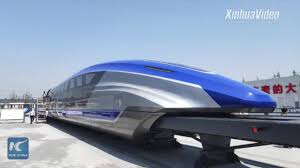
China’s high speed maglev program is a national effort based in Hubei province and at CRRC’s Qingdao plant, aimed at reaching speeds between 600 and 1,000 kilometers per hour. Since our 2020 report, researchers at Hubei’s Donghu Laboratory accelerated a 1.1 tonne test vehicle to 650 kilometers per hour on a one kilometer sled track in June 2025.
Maglev’s Real World Test Contrasts With a Bridge Already Under Construction
That sled test remains a small scale research milestone, not a passenger ready train, and CRRC’s 600 kilometer per hour maglev, unveiled in 2021, has still not been verified running at design speed. That leaves China’s maglev ambitions well behind conventional projects like the Hangzhou Bay Cross Sea Railway Bridge, already targeting a 2027 opening at 350 kilometers per hour.
Project Overview
- Program Name: China High Speed Maglev Program (CRRC 600 and related research)
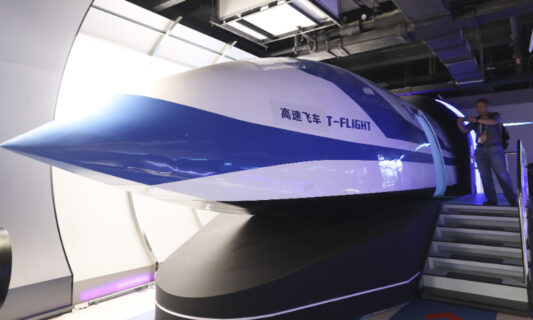
- Location: CRRC Qingdao Sifang plant, Shandong Province; Donghu Laboratory test track, Hubei Province; T Flight vacuum tube trials, Shanxi Province
- Target Speed: 600 to 1,000 kilometers per hour, depending on the specific program
- Lead Organizations: CRRC Qingdao Sifang (CRRC 600 passenger train prototype); Donghu Laboratory (electromagnetic propulsion sled testing); China Aerospace Science and Industry Corporation (T Flight vacuum tube system)
- Key Milestone: CRRC 600 prototype unveiled July 2021 and shown again at the UIC World Congress on High Speed Rail in July 2025; Donghu Laboratory sled test reached 650 kilometers per hour in June 2025
- Status: CRRC 600 remains an unverified static prototype; commercial service not expected for five to ten years per CRRC statements
- State Policy Driver: National Railway Administration’s five year plan (2021 to 2025) for railway science and technology innovation
Project Team
- Lead Manufacturer: CRRC Qingdao Sifang
- Research Partner (sled testing): Donghu Laboratory, Hubei
- Vacuum Tube Research: China Aerospace Science and Industry Corporation
- Technology License: Transrapid technology licensed from ThyssenKrupp
Reported 20th May 2020: China once again has publicized its plans to take the lead in the new global race to make bullet trains travel even faster. By harnessing the power of magnetic levitation, it is thought that Maglev trains in China could have the ability to accelerate from the current top speeds of 350km/h on conventional tracks to between 600 and 1,000km/h. Changjiang Daily, the official news reporter of Wuhan, which is the capital city of Hubei, stated that experimental maglev tracks would be laid in the central province early in early 2020 however due to the current global pandemic, this project was brought to an abrupt halt. The news report cited a key survey carried out by a design institute for the China Railway Group Limited. The China Railway Group Limited was tasked with conducting a feasibility study for a sprawling new network stretching from Guangzhou to Beijing on which trains could travel at between 600km/h and 1,000km/h.
Also read: New electrified powertrains R&D centre to be constructed in Tianjin, China.
The prodigious high speed means that once operational, a 2,200-km journey from Wuhan to Guangzhou could be reduced to about two hours. A 600km/h Maglev train prototype was reported to be ready for trial runs in 2020 and Hubei was to start work on a 200-km section made of vacuum tubes to conduct assessments to verify the cutting-edge, high-temperature superconducting maglev theory and ultimately push the speed limit to 1,000km/h. What is setting in motion this ambitious new project is Beijing’s latest policy paper on nationwide transportation developments publicized in September 2019. It contains a chapter on running new maglev lines between key urban centres to complement the existing network of high-speed railways.




Leave a Reply