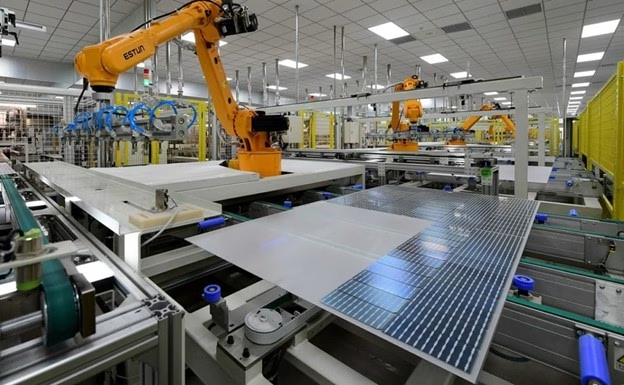
U.S.-based Highland Materials on April 2024 unveiled plans to construct a major solar-grade polysilicon manufacturing facility in Phipps Bend, Tennessee, marking a significant boost for the domestic solar supply chain. The project will occupy 140 acres on a site originally intended for a nuclear power plant that was abandoned when construction was only 40% complete.
The Highland Materials polysilicon facility is actively progressing through its engineering phase, with on-site construction scheduled to begin in the fourth quarter of 2026.
The $1 billion clean energy project—codenamed “Project Rocks” by local development boards—has achieved several major milestones:
Funding
In April 2024, Highland secured $255.6 million in federal Qualifying Advanced Energy Project Credit (48C) tax incentives to support the build.
Land Secured at a Former Nuclear Site
In August 2025, real estate investment firm Pivotal Manufacturing Partners acquired 140 acres at the abandoned Phipps Bend Nuclear Plant site in Hawkins County, Tennessee. Highland Materials signed a long-term ground lease to anchor the new Phipps Bend Advanced Manufacturing & Technology Campus. The site was chosen because it already possesses the massive power infrastructure needed for high-precision manufacturing
Project Capacity and Timeline
According to the U.S. Department of Energy (DOE), the facility will begin operations with an annual production capacity of 16,000 metric tons of polysilicon at “less than standard cost.” Phase 2 Expansion: Output is planned to ramp up to 20,000 MT (and eventually up to 24,000 MT), providing enough domestic material to support roughly 11 gigawatts (GW) of solar cells per year
The company chose Phipps Bend for its Polysilicon Solar Manufacturing Facility because of its robust power infrastructure, strategic location within the Tennessee Valley Authority (TVA) region, and readiness for high-precision, large-scale manufacturing.
Next-Generation, Energy-Efficient Process
Highland will deploy a scaled-up aluminum-silicon alloy smelting system, in which impure raw silicon is combined with pure aluminum. This method has a lower melting temperature than conventional polysilicon production, reducing energy use to 20–40 kWh per kilogram of silicon produced—well below typical industry levels. The company says this will significantly shrink the plant’s environmental footprint while maintaining high product quality.
What is a Polysilicon Solar Manufacturing Facility?
Polysilicon, also called polycrystalline silicon, is the ultra-pure form of silicon that serves as the foundation for over 90% of the world’s solar panels. Its production begins with quartz (silicon dioxide), which is refined into metallurgical-grade silicon through high-temperature reduction with carbon. This raw silicon is then purified using processes such as the Siemens method, where it is converted into trichlorosilane gas, distilled to remove impurities, and decomposed at high temperatures to deposit pure silicon onto heated rods.
The resulting polysilicon rods, with a purity exceeding 99.9999%, are broken into chunks, melted, and cast into crystalline ingots. These ingots are sliced into thin wafers, which form the base material for high-efficiency photovoltaic cells.
Strategic Importance
The manufacturing of solar polysilicon is energy-intensive and largely dominated by plants in China, making it a strategically sensitive commodity. By building a large-scale facility in Tennessee, Highland Materials aims to reduce U.S. reliance on imports, stabilize supply for domestic solar projects, and contribute to the nation’s renewable energy goals. Solar panel manufacturing plants like the US$200M solar panel manufacturing plant in Ohio that is in the pipeline will greatly benefit from this crucial raw material.
The facility is expected to bring 400 permanent jobs to northeast Tennessee, ranging from trained manufacturing roles to laboratory technicians.
Additionally, the project forms part of a wider expansion in U.S. solar manufacturing, complementing downstream module production efforts including SEG Solar’s new 4.6 GW facility planned for Greater Houston.

Factsheet: Highland Materials Polysilicon Plant – Phipps Bend, TN
- Location: Phipps Bend, Tennessee, USA
- Land Area: 140 acres (former nuclear plant site)
- Initial Capacity: 16,000 metric tons/year
- Full Capacity: 20,000 metric tons/year (by year 4)
- Solar Cell Output Equivalent: ~11 GW annually
- Technology: Aluminum-silicon alloy smelting system
- Energy Consumption: 20–40 kWh per kg of silicon produced
- Federal Support: $255.6M (48C tax credit)
- Strategic Benefit: Reduces reliance on imported polysilicon, boosts U.S. solar supply chain


Leave a Reply