
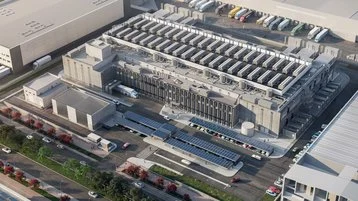
Microsoft’s Madrid data center project in Spain continues progressing in 2026 as the company expands its European cloud and artificial intelligence infrastructure pipeline. The development, first announced in partnership with Ferrovial, remains part of Microsoft’s multibillion-dollar digital infrastructure strategy across Europe. In addition, the Madrid region continues attracting hyperscale investment because of rising AI demand, renewable energy access and strong connectivity to European markets.
Madrid Data Center Project Expands Across Key Spanish Locations
The project includes planned facilities in San Sebastián de los Reyes, Algete and Meco near Madrid. Furthermore, Microsoft continues advancing permitting and planning activities linked to new hyperscale campuses across the Madrid region. Recent reports indicate that related projects in Alcalá de Henares and Aragón are also moving through approval stages as Spain strengthens its position within Europe’s growing data center market.
Construction activity around Madrid has accelerated as developers race to meet growing AI computing requirements. Consequently, Spain has emerged as one of Europe’s fastest-growing hyperscale markets alongside Frankfurt, Dublin and Milan. Several developers, including Apto and Pure Data Centres, recently announced multibillion-dollar projects around Madrid.
Madrid Data Center Project Supports Europe’s AI Infrastructure Growth
The Madrid data center project also aligns with Microsoft’s broader European cloud expansion strategy. The company previously announced plans to invest more than $12 billion across several European regions to support Azure, Microsoft 365 and AI-driven cloud services.
Industry analysts state that Spain’s lower land costs, renewable energy capacity and available development sites continue attracting hyperscale developers. However, supply chain constraints and power availability remain critical challenges across the sector. Discussions across industry forums also highlight delays tied to equipment shortages and grid limitations affecting global data center construction schedules.
Global Data Center Construction Market Continues Expanding
The Madrid project connects closely with broader international hyperscale expansion trends, including Southeast Asia’s rapidly growing AI infrastructure market. Similar momentum continues in Malaysia, where AirTrunk is pursuing a $2.3 billion financing package for its JHB2 hyperscale data center expansion in Johor.
Cancellation of Swedish data centre expansion
Microsoft cancelled its expansion plans for one of its Swedish data centre sites in September 2022. The company cited a decline in demand for cloud services and secure data services in the area.
The Swedish Staffanstorp data centre was the subject of the plans; it was finished at the end of 2021. This was a component of Microsoft’s recently launched Sweden Central cloud region, which also saw the opening of its Gävle, Sandviken, and Staffanstorp facilities. The business made the decision to search for a different site location in Sweden to construct an entirely new facility.
Read Also: Construction of SoLa Impact Hyde Park mixed-use complex begins
Microsoft’s data centres in the world
Some years ago, Microsoft reported that server component shortages had restricted how much it could invest in its data centre business. Those restrictions appear to be gone as the business plans to continue constructing a number of new data centres every year for the foreseeable future.
At the moment, Microsoft runs more than 200 data centres. Over 34 nations around the world are home to its operational and planned data centres. They are also connected by more than 165,000 miles of subsea cable.
Project Fact Sheet
Project name: Madrid Data Center Project
Location: Madrid region, Spain
Developer: Microsoft
Main contractor: Ferrovial
Project type: Hyperscale data center campus
Primary facilities locations: San Sebastián de los Reyes, Algete and Meco
Current status: Planning, approvals and phased expansion activities ongoing in 2026
Sector: Digital infrastructure and AI-ready cloud computing facilities
Estimated regional investment: More than U$12 billion across Europe
Core services: Azure, Microsoft 365, Dynamics 365 and AI cloud services
Sustainability target: Renewable-powered operations and energy-efficient infrastructure
Strategic purpose: Expand cloud computing and AI processing capacity across Europe
Construction focus: Server halls, electrical systems, cooling infrastructure and substations
Market significance: Supports Spain’s emergence as a major European hyperscale hub
Project Team
Project owner: Microsoft
Main construction contractor: Ferrovial
Cloud infrastructure platform: Microsoft Azure
Technology services provider: Microsoft
Regional permitting authorities: Madrid regional planning authorities
Infrastructure partners: Utility and energy network operators in Spain
Sustainability framework: Renewable energy integration partners
Target users: Enterprise cloud clients, AI companies and public sector organizations
Supporting regions: Madrid, Aragón and surrounding Spanish digital infrastructure corridors
Industry sector: Hyperscale data center construction and AI infrastructure development



Leave a Reply