The MTA 2025 to 2029 Capital Plan is a USD 68.4 billion programme to overhaul New York City’s aging transit network, expanded from the USD 65 billion figure approved at board level, and it has moved rapidly into active delivery since the original article was published. Governor Hochul signed the FY2026 budget legislation in May 2025 to fully fund the plan, and the Capital Program Review Board granted final approval in June 2025, clearing the last procedural hurdle. The MTA committed a record USD 15.8 billion in capital contracts during 2025 alone, surpassing the previous single year high of USD 11.4 billion set in 2022, and completed USD 6.7 billion in project work across the same period.
Federal Headwinds Test the Interborough Express as Key Contracts Land
Among the most significant recent milestones connected to the wider regional transit build-out surrounding the Penn Station transformation project, the MTA awarded a USD 166 million engineering and design contract in August to a joint venture of HDR and Jacobs for the Interborough Express light rail line between Brooklyn and Queens, moving that project from planning into active design. In November 2025, Kawasaki Rail Car was awarded a USD 1.5 billion contract to build 378 new R268 subway cars to replace rolling stock approaching 50 years of age. However, federal funding risk has emerged as a complicating factor in 2026, with the Trump administration having withheld or attempted to redirect earmarked transit dollars in New York. The MTA is now actively exploring alternatives to federal funding for the USD 5.5 billion Interborough Express to insulate the project from political interference, while also clawing back withheld funds for Second Avenue Subway Phase 2 through legal action.
Project Overview
- Project Name: MTA 2025 to 2029 Capital Plan
- Location: New York City, USA (subway, commuter rail, bus, bridges and tunnels)
- Developer / Owner: Metropolitan Transportation Authority (MTA)
- Total Cost / Value: USD 68.4 billion (approved figure; original board approval was USD 65 billion)
- Scale / Capacity: 1,500 new subway cars, 2,500 buses including 500 zero emission models, signal modernization across multiple lines, accessibility upgrades at over 65 stations, USD 2.75 billion for Interborough Express
- Construction Start: Active delivery underway from 2025
- Expected Completion: 2029 (five year programme)
- Funding / Financing: Congestion pricing revenue (over USD 5 billion committed in 2025), increased Payroll Mobility Tax generating USD 1.4 billion annually, USD 3 billion from New York City, federal government anticipated at approximately 20%, MTA self funding and asset sales; USD 3 billion efficiency target
- Current Status: Active delivery phase; USD 15.8 billion committed in 2025 alone; federal funding under pressure
- Key Milestone: USD 166 million Interborough Express design contract awarded to HDR and Jacobs JV (August 2025); USD 1.5 billion Kawasaki subway car contract signed (November 2025)
Project Team
- Metropolitan Transportation Authority (MTA) — Programme Owner and Client
- MTA Construction and Development (MTA C&D) — Programme and Project Delivery
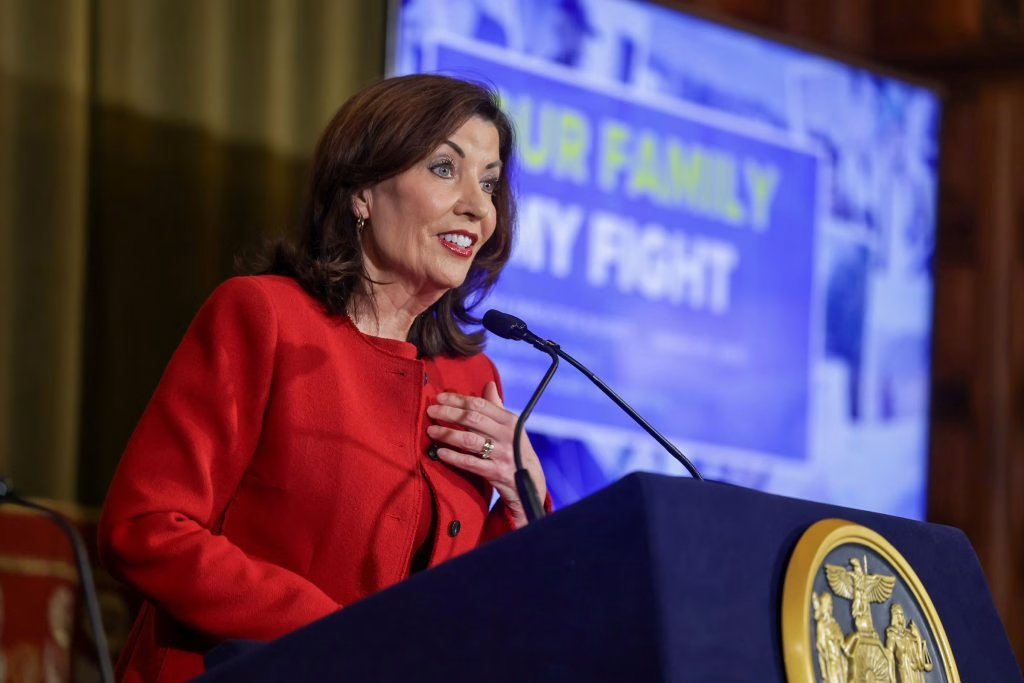
- Governor Kathy Hochul / New York State — Programme Funder and Legislative Sponsor
- Capital Program Review Board — Final Regulatory Approval Authority
- Kawasaki Rail Car Inc. — Subway Car Manufacturer (USD 1.5 billion contract, 378 R268 cars)
- HDR / Jacobs Joint Venture — Engineering and Design, Interborough Express (USD 166 million contract)
- AECOM / LiRo Joint Venture — Project and Construction Management (Penn Station Access component)
- U.S. Federal Railroad Administration (FRA) — Federal Funding Contributor (under dispute)
- U.S. Department of Transportation — Federal Oversight and Funding Authority
Reported 30th March 2025: In a significant move for New York City’s future, the MTA board has officially approved a $65 billion, five-year capital plan aimed at overhauling the city’s aging mass transit system. The decision, made during a board meeting on Wednesday, comes after months of funding uncertainty and political negotiation. Fortunately, a key turning point arrived with the passage of Governor Kathy Hochul’s budget, which included an increase in the payroll mobility tax. This adjustment, targeted at large businesses, is projected to bring in $1.4 billion annually to support the ambitious upgrades.
Also Read New York City lays out plans for the largest mass timber residential project on Staten Island
Key Funding Sources Backing the MTA New York Transit System plan
Beyond the state’s contribution, the plan also hinges on several other sources of funding. The City of New York is expected to contribute $3 billion, while the federal government is anticipated to cover 20% of the total costs. Although a lawsuit and political friction between local officials and the Trump administration loom in the background, MTA officials remain optimistic that federal funding will continue uninterrupted. However, it’s worth noting that there is still a $3 billion gap in the financial plan. To address this shortfall, MTA leaders are exploring multiple strategies, such as cutting costs on past construction projects and selling surplus agency-owned real estate.
Modern Upgrades and Accessibility Improvements
The capital plan itself includes several high-impact improvements. For example, it allocates funding to purchase 1,500 new subway cars and make 60 stations fully accessible for all riders. Additionally, new anti-fare-evasion turnstiles are planned to be installed across the system. This modernization effort is long overdue, especially considering recent reports from Gothamist that exposed the deteriorating and outdated technology currently in use throughout the subway network. Perhaps most notably, the plan designates $2.75 billion for advancing Governor Hochul’s Interborough Express project, a transit line connecting Brooklyn and Queens.
Also Read 2 Solar Projects Totaling 450MW Coming to New York
Final Approval and What’s Next
Although this marks the second time the MTA board has approved the plan, the first attempt was rejected by top state lawmakers last December, the outlook is now far more favorable. With a clear state budget in place and major funding commitments secured, MTA officials are confident that the Capital Program Review Board will grant the final sign-off. Ultimately, this capital plan represents a crucial step toward delivering a safer, more efficient, and future-ready transit system for millions of New Yorkers.
MTA New York City Transit System plan Overview
Total Investment: $65 billion—the largest capital plan in MTA history
Timeline: 2025 through 2029
Primary Goals:
Achieve a state of good repair across subways, buses, commuter rail, bridges, and tunnels
Modernize infrastructure, including signaling systems and fare collection
Expand accessibility with at least 60 new ADA-compliant subway stations
Advance the Interborough Express project connecting Brooklyn and Queens
Key Funding Sources:
$15 billion from congestion pricing revenue, $1.4 billion annually from increased Payroll Mobility Tax on large businesses, $14 billion anticipated from federal funding, $3 billion from New York City, $3 billion from MTA self-funding, including cost savings and asset sales
Major Projects:
Procurement of 1,500 new subway cars and 2,500 buses (including 500 zero-emission models)
Signal modernization on key subway lines
$2.75 billion allocated for the Interborough Express
$7.1 billion dedicated to accessibility improvements
Economic Impact:
Estimated to generate $106 billion in statewide economic output over five years
Supports approximately 72,700 jobs annually during the plan’s duration


Leave a Reply