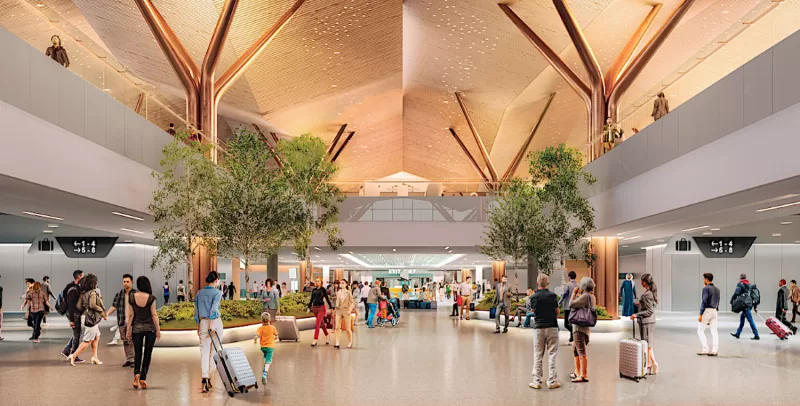
The Terminal Modernization Program (TMP) at Pittsburgh International Airport is an infrastructure redevelopment project focused on updating terminal facilities and operations. The programme fully opened to the public on November 18, 2025, ahead of the holiday travel period.
The project, initially budgeted at $1.57 billion, was completed at a final cost of $1.72 billion. The development forms part of ongoing efforts to adapt airport infrastructure to current passenger and operational requirements. It ranks as one of the major airport terminal upgrades in the US.
Other Projects
The Pittsburgh International Airport terminal transformation is completed by other similar projects across the United States such as the Richmond International Airport expansion plan.
Dubbed Wheels Up 2030, the airport aims to expand the airport to accommodate new passengers and destinations in coming years. The scope entails transforming the airport from its Federal Aviation Administration designation as a small hub airport to a medium-sized.
Moreover, it seeks to be able to handle up to 1% of the nation’s annual passenger boardings. Capital Region Airport Commissioner President and CEO Perry Miller noted the project is a commendable step. He noted it is a ““a really big game changer” for the airport and the region as a whole.” Once complete, it is expected to attract flyers and economic development traditionally lost to Washington Dulles and Regan National airports.
Another project is the Charlotte Douglas International Airport that is advancing its fourth runway, one deemed to be one of a kind. A new partnership between the airport and UNC Charlotte is bringing cutting edge technology to one of the airport’s biggest expansion projects. “We want to be doing cutting edge research that really capitalizes on this partnership to advance the research that addresses the needs and challenges of today’s airports, today’s aviation industry,” Professor of Civil Engineering Technology & Construction Management Dr. Tara Cavalline said.
Through the partnership, the airport is launching an advanced “digital twin” program. It is one that will embed sensors directly into the pavement to collect real-time data. The goal to better understand how runways perform over time, improving safety, efficiency, and long-term maintenance.
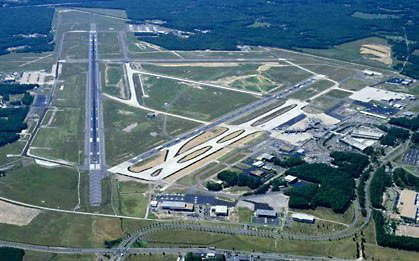
A Terminal Built for Today’s Travelers
The current facility, opened in 1992, was constructed during the heyday of US Airways, when more than 80% of passengers were making connections. Today, the dynamic has reversed—nearly 97% of the airport’s 10 million yearly travelers are origin and destination (O&D) passengers.
To meet these changing demands, the new terminal—described as “built for Pittsburgh, by Pittsburgh”—will feature a more efficient layout tailored to local travelers, including an expanded security checkpoint and consolidated ticketing and baggage claim areas.
Modern Design, Local Identity
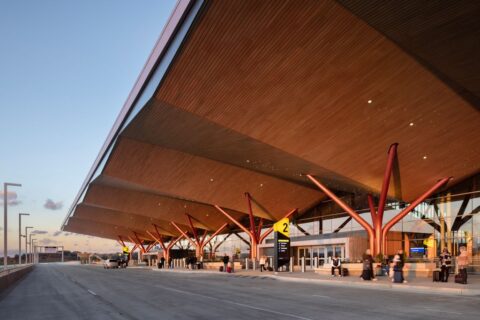
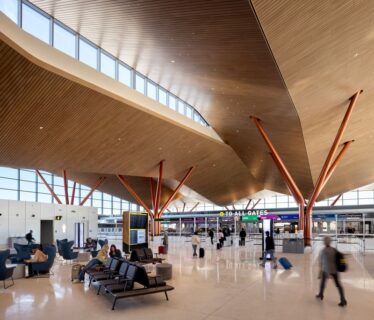
Architectural firms Gensler and Luis Vidal + Architects designed the new terminal to reflect Pittsburgh’s identity. Tree-like support columns, a flowing roofline inspired by the region’s hills, and constellation-style lighting pay homage to the area’s natural beauty and sense of place.
Visitors will enjoy outdoor terraces, an indoor meet-and-greet space, and more than 20 new concessions on both sides of security, enhancing both convenience and comfort.
Also Read
The latest on Austin-Bergstrom International Airport Journey With AUS project
Milwaukee Mitchell Airport modern terminal construction
DFW International Airport Expansion Gets $4 Billion Boost from American Airlines
Efficiency, Sustainability, and Innovation
The terminal’s new 12-lane TSA checkpoint features advanced screening technology allowing liquids and laptops to remain in bags, plus automated bin returns. A reimagined baggage system will eliminate over eight miles of conveyor belts, cutting curb-to-gate time in half.
The project also includes a new smart parking garage, redesigned roads, and reconfigured international arrivals for easier access.
Powered by its own microgrid—featuring solar panels and natural gas generators—the airport is already a national leader in energy independence. Sustainability goals continue with LEED Gold certification and the use of 86,000 tons of recycled concrete.
FACTSHEET: Pittsburgh International Airport Terminal Project
Project Cost: $1.57 billion
Construction Began: July 2021
Expected Completion: Late 2025
New Terminal Features:
– 12-lane security checkpoint
– Smart parking garage
– 20+ new concessions
– Outdoor terraces and indoor meet-and-greet area
– Reconfigured international arrivals
Jobs Created: 14,000 (direct and indirect)
Economic Impact: $2.5 billion
Power Supply: On-site microgrid (100% self-powered)
Sustainability: LEED Gold target, recycled materials
Design Inspiration: Nature, technology, and Pittsburgh’s community
Design Summary
The future terminal at Pittsburgh International Airport will enhance the airport’s passenger flow, efficiency, and overall experience. The project was designed by Gensler and HDR in collaboration with luis vidal + architects, and embodies the natural beauty, innovation and community identity of Pittsburgh.
Fast Facts
The total project cost is $1.7 billion.
The terminal is 811,000 square feet in size.
Levels: 3
Construction started in October 2021
Completion: Fall 2025
Architects: luis vidal + architects
In addition, the project brings a completely modernized terminal environment, centered on the convenience of the passengers and the efficiency of the operations.
Design Philosophy: Nature, Technology & Community (NaTeCo)
The design is based on the “NaTeCo” concept, which integrates nature, technology, and community into a cohesive architectural vision. The terminal features elements inspired by the rolling hills, forests, and gardens of Pittsburgh, creating a serene and inviting atmosphere.
In addition, the architecture is a testament to the city’s technological advancements and sense of community. The roof shapes are similar to the surrounding hills, the columns are like forest trees, and the landscaped terraces add greenery throughout the facility.
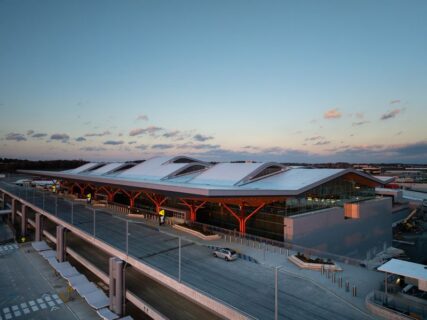
Improved Operations & Passenger Experience
The new terminal makes it easier to navigate the airport by combining check-in, security, baggage claim and ground transportation into a single building. This eliminates the need for the previous automated people mover system and greatly enhances passenger flow.
Furthermore, the departures and arrivals are split into two levels, minimising walking distances and making the passenger journey from landside to airside more intuitive.
Designed by luis vidal + architects, the new “Petal Tunnel” links the landside terminal to the re-designed airside core. It is inspired by the Fort Pitt Tunnel in Pittsburgh and the petal shapes of the Phipps Conservatory.
The revamped airside core, meanwhile, offers passengers instant sight of dining, retail, work and relaxation spaces on arrival from the tunnel.
Other site wide enhancements include:
New roadways to improve traffic flow
A 1,300-foot terminal drop-off area
A new parking garage with three times the covered parking space.
Exterior/Interior Public Art installations that are integrated.
Operating systems have also been optimized. The length of the baggage system conveyor has been shortened from approximately 8 miles to 4 miles, which removes the APM connection and results in an annual savings of about $18 million in operational and maintenance costs.
Also, there were ample waiting spaces with terrace access and additional seating to accommodate Pittsburgh’s robust meeter and greeter tradition.
Architectural Highlights
The roof of the terminal is a sweeping design, and the 38 architecturally exposed steel columns are a representation of the forests and Allegheny Mountains of Western Pennsylvania. The ceiling lighting is inspired by the night sky of the region, with a focus on the constellations.
Furthermore, metal ceilings are designed to look like warm wood without warping, and large curtainwall glazing allows natural daylight to penetrate the terminal throughout.
Another key element is biophilic design. Four landscaped terraces — two before security and two after security — showcase native Western Pennsylvania plant species and provide travelers with open-air relaxation areas.
Sustainability is also a key element of the project. The terminal is built using locally sourced and recycled materials, and rainwater harvesting systems are used for terrace landscaping. The development is seeking LEED Gold certification.
In summary, the design aims to enhance the overall passenger experience by making it more comfortable and environmentally friendly.
Design Team
About Gensler
Gensler is a 1965-founded global design and architecture firm. The company specializes in the integration of creativity, research and innovation to create buildings and urban spaces that enhance the quality of life for people.
The company has about 6,000 employees and operates in over 100 countries. It has aviation projects like Incheon International Airport Terminal 2, Harvey Milk Terminal 1 at San Francisco International Airport, Eagle County Regional Airport, and the new Terminal 1 at San Diego International Airport.
The firm has also won several Prix Versailles awards and was named the 1 Airport Facility Architecture Firm of 2024 by Building Design + Construction.
Carolyn Sponza, Pittsburgh Studio Lead and Principal at Gensler, is the main spokesperson.
PR Contact: Courtney Strent
About HDR
HDR is a 100% employee-owned architecture, engineering and professional services firm with over 100 years of experience. HDR was established to assist with electrification projects and now provides architecture, engineering, environmental and construction services throughout the world.
It has aviation experience with more than 160 airport clients globally, including 29 of the FAA’s Core 30 airports. The company has a reputation for technical expertise and project delivery excellence in aviation infrastructure projects.
Bill Peduzzi, Aviation Director at HDR, is the main spokesperson.
PR Contact: Dan Golden
About luis vidal + architects
luis vidal + architects is an international architecture and design practice established in 2004 and based in the United States, Spain, Chile and the Dominican Republic. The firm’s specialties include airports, hospitals, cultural facilities, educational centers, offices, and mixed-use developments.
The company has created over 30 large-scale international airport terminals and is known for its user-centric airport design that prioritizes freedom, movement and user experience.
Significant projects include the international terminal at Logan International Airport, Arturo Merino Benítez International Airport, and the expansion of Dallas Fort Worth International Airport, as well as Heathrow Terminal 2. Other projects underway are a new international terminal at John F. Kennedy International Airport.
Main speaker: Luis Vidal, Founding Principal
PR Contact: Rachel Judlow
Development Team Factsheet
Architectural Support: Architectural Innovations
Acoustic Design: Cerami/Trinity Consultants
Local Artisan/Craft Business Liaison: Monmade
Public Art Consulting: Renee Piechocki
The design of the Baggage Handling System was carried out by BNP Associates.BNP Associates designed the Baggage Handling System.
Concession Planning: CPI Australia
Simpson Gumpertz & Heger is a code consulting firm.
The project was designed by Cost Estimation, which is part of the AtkinsRéalis group, Connico and Crawford Consulting.
Façade Consulting: Front
Carter Design Group is an irrigation consulting firm.Carter Design Group is an irrigation consulting company.
Landscape Architecture: OJB Landscape Architecture
Landscape Architecture Support: UpStudio
Lighting Design: Fisher Marantz Stone
3D Visualization: Illustrate My Design, Neoscape
Engineering Team
The project was designed by MEP Engineer, Buro Happold.
MEP/Fire Protection Support: ED3 Consultants
Advantus Engineers provides Sustainability Consulting Support.
Fire Protection Support: Allen + Shariff
Electrical Engineering Support: Sigma Associates
Burns Engineering is a leading provider of fire alarm, IT/paging, telecom, and security solutions.
Passenger Boarding Bridges/Aircraft Logistics: Aero Systems Engineering
Site & Infrastructure Engineering: Monaloh Basin Engineers
Structural Engineering & Sustainability Consulting: Thornton Tomasetti
Structural Engineering Support: Navarro & Wright
Wind and Snow Modeling: RWDI


Leave a Reply