
The First Solar Innovation Center is a thin film solar research and development facility located in Lake Township, Wood County, Ohio, near the company’s Perrysburg manufacturing campus. It now operates as the Jim Nolan Center for Solar Innovation, covering 1.3 million square feet, and JobsOhio credits it with 180 jobs and a $16 million payroll.
First Solar Innovation Center Anchors Ohio Research Momentum
First Solar describes the facility as the largest solar R&D site in the Western Hemisphere, within a roughly $500 million R&D infrastructure investment that began as a $270 million plan in 2022. Meanwhile, Ohio keeps attracting research linked projects, including the Bayer New Albany pharmaceutical campus, a $2.2 billion manufacturing plan.
Project Overview
- Project Name: First Solar Innovation Center (Jim Nolan Center for Solar Innovation)
- Location: Lake Township, Wood County, near Perrysburg, Ohio
- Project Value: Roughly $500 million R&D infrastructure investment, according to First Solar; announced in 2022 at $270 million for the center itself
- Owner: First Solar
- Key Components: 1.3 million square foot facility with a pilot manufacturing line for full size prototypes of thin film and tandem PV modules
- Delivery: Original target was completion in 2024; commissioned in July 2024
- Jobs: 180 jobs and a $16 million payroll, according to JobsOhio; First Solar projected about 300 new R&D jobs by 2025
- Strategic Impact: Gives First Solar an R&D sandbox separate from commercial production, so that development work no longer ties up a manufacturing line
- Research Milestone: First Solar announced a 23.1 percent CdTe cell efficiency record alongside the opening, certified by the National Renewable Energy Laboratory
Project Team
- Owner and Developer: First Solar
- State Economic Development: JobsOhio
- Efficiency Certification: National Renewable Energy Laboratory
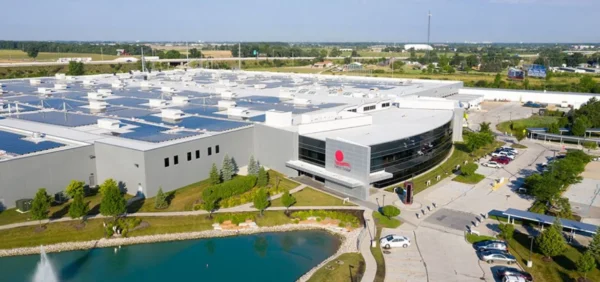
Reported 1st November 2022: First Solar, Inc has announced that it plans to invest approximately $270 million in a dedicated research and development (R&D) innovation center in Perrysburg, Ohio. The new facility is thought to be the first of its kind in the country (PV).
It is expected to speed up American leadership in the development and production of advanced thin film photovoltaics. The new R&D center will be situated next to First Solar’s current Perrysburg production facility.
The facility will have a floor space of over 1.3 million square feet. In addition, it will have a cutting-edge pilot production line. This will enable the creation of full-sized prototypes of tandem and thin film PV modules. The project is anticipated to be finished in 2024 following the approval of necessary permits and numerous state, regional, and local incentives.
About the Ohio First Solar Innovation Center developer
At its Perrysburg site, First Solar, which has already spent more than $1.5 billion on R&D, currently runs a dual-purpose manufacturing line that supports both the company’s commercial production of solar modules and its efforts in product development. Nevertheless, the line is unable to support both operations at once.
Also Read: US$ 20bn Intel semiconductor project breaks ground in Ohio
The company is the only US-based business and sole producer of thin film PV modules among the top ten solar power producers worldwide. Since 1999, the company has consistently invested in the development of cadmium telluride (CadTel). This makes it the second most popular PV technology in the world after crystalline silicon.
Furthermore, the company has protected crucial intellectual property related to the semiconductor material and its special manufacturing techniques.
Commentary on the project
“We have a record backlog of shipments and steady demand for our modules. The company will confront the dual challenges of optimizing current and projected production capacity. We need to meet our commitments while maintaining the momentum of our technology roadmap.
According to First Solar’s CEO Mark Widmar, this investment enables us to establish an R&D sandbox independent from our commercial manufacturing processes, guaranteeing that we may speed up innovation without having to pay to shut down mission-critical tools.

Leave a Reply