
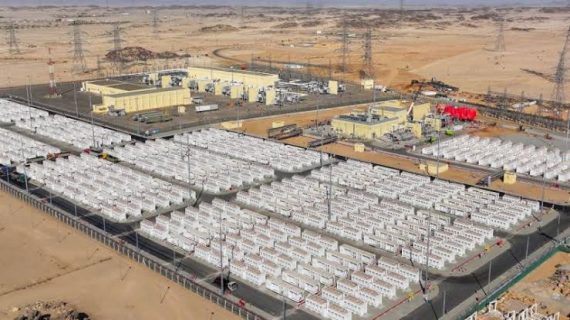
Saudi Arabia has completed grid connection of the Najran-Madaya-Khamis BESS Projects, marking a major milestone in its utility-scale energy storage programme. The three installations deliver a combined nameplate capacity of 7.8GWh across southwestern Saudi Arabia. Each facility provides 2.6GWh of storage capacity. Furthermore, the development strengthens the national electricity network’s ability to manage supply fluctuations and accommodate increasing renewable energy generation. Sungrow announced the grid connection milestone on December 18, 2025. The company supplied the battery storage systems for the three installations.
National Grid Saudi Arabia awarded the engineering, procurement and construction contract to Riyadh-based Algihaz Holding. The contract covers the development of all three facilities. MEED estimated the combined value of the EPC contracts at more than US$800 million in August 2024. However, the project parties have not publicly confirmed a final construction cost.
The installations form part of Saudi Arabia’s wider efforts to expand electricity storage infrastructure. In particular, large battery systems can store electricity when generation exceeds demand. They can then release power when consumption increases or renewable generation declines.
Najran-Madaya-Khamis BESS Projects strengthen Saudi Arabia’s grid
The three facilities occupy separate locations in the Kingdom’s southwestern region. These are Najran, Madaya and Khamis Mushait. Each installation contributes 2.6GWh, bringing the combined storage capacity to 7.8GWh.
Sungrow supplied more than 1,500 PowerTitan 2.0 battery energy storage systems for the development. The manufacturer completed production of the systems within 58 days. The equipment integrates battery containers, power conversion systems and medium-voltage components. This configuration supports installation and connection to the electricity network.
The three facilities connect to Saudi Arabia’s transmission network at 380kV. Their deployment therefore adds substantial storage capacity to the national power system. In addition, the installations can support grid stability by balancing electricity supply and demand.
The project is owned by Saudi Electricity Company (SEC), while National Grid SA acts as the offtaker. Algihaz Holding delivered the facilities under a full turnkey EPC contract. Its scope included engineering, procurement, construction and integration of high-voltage transformer equipment.
Sungrow estimates that the project’s annual charging and discharging capacity will reach 2.2 billion kilowatt-hours. The company says this volume could meet the annual electricity needs of approximately 400,000 Saudi households. However, the figure represents the expected energy throughput rather than the facilities’ installed storage capacity.
Saudi Arabia’s investment in large-scale battery storage also reflects a wider regional shift towards grid-scale energy storage. In Oman, Nama Holding signed a 1GW battery storage agreement with State Grid International Development covering installations at Duqm and Ibri. The Duqm-Ibri BESS project in Oman comprises two 500MW facilities connected to the national electricity transmission network. Although the two countries are pursuing separate developments, both projects demonstrate growing Gulf investment in battery infrastructure to strengthen electricity networks and support renewable energy integration.
Najran-Madaya-Khamis BESS Projects support renewable energy expansion
Saudi Arabia is increasing investment in battery storage as it pursues its energy transition objectives. The systems can help manage variable electricity generation from solar and wind installations. They also provide flexibility as the Kingdom expands renewable power capacity.
The development builds on Saudi Arabia’s earlier investment in large-scale renewable energy infrastructure. For example, the Red Sea destination project incorporated a separate 1,000MWh battery storage facility. That development supports a renewable-powered tourism destination using solar and wind generation. .
Nevertheless, the Red Sea installation and the Najran-Madaya-Khamis BESS Projects are separate developments. The former serves a dedicated tourism destination, while the latter comprises three grid-scale installations. Their different capacities and applications reflect the expanding role of battery storage across Saudi Arabia’s electricity sector.
The 7.8GWh development also comes amid several other storage procurement initiatives. Saudi Power Procurement Company has pursued additional battery storage capacity through separate tender programmes. These initiatives should not be confused with the three installations delivered by Algihaz Holding and Sungrow.
With grid connection completed, the Najran-Madaya-Khamis BESS Projects have reached a significant delivery milestone. The facilities are expected to support electricity system flexibility and renewable energy integration. Their contribution will depend on full energisation and operational performance across the three sites.
Project Fact Sheet
Project: Najran-Madaya-Khamis BESS Projects
Location: Najran, Madaya and Khamis Mushait, Saudi Arabia
Combined storage capacity: 7.8GWh
Capacity per facility: 2.6GWh
Grid connection: Completed December 18, 2025
Grid connection voltage: 380kV
–Estimated EPC contract value: More than $800 million
Battery technology: PowerTitan 2.0
Equipment supplied: More than 1,500 systems
Expected annual charging and discharging capacity: 2.2 billion kWh
Project Team
Owner: Saudi Electricity Company
Offtaker: National Grid SA
EPC contractor: Algihaz Holding
Battery storage technology supplier: Sungrow
Also Read: US $267m Antara residential development in Riyadh, Saudi Arabia opened



Leave a Reply