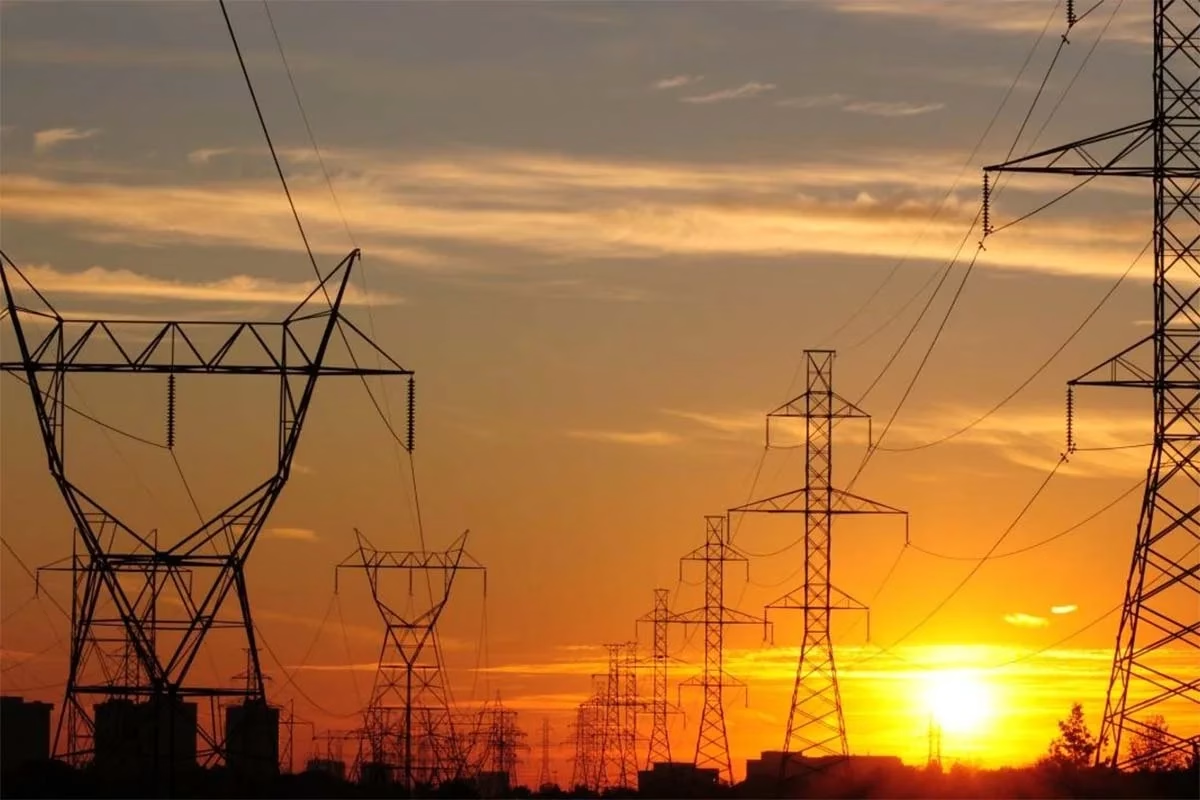
The Tanzania 400MW Power Import Deal will see the country import up to 400MW of electricity from Ethiopia marks a significant milestone in East African regional energy integration. The “route” for this power is a three-country transmission path known as the Ethiopia–Kenya–Tanzania (EKT) wheeling arrangement. The primary routes involved in the Tanzania 400MW power import deal are part of the larger regional initiative to strengthen the Eastern Africa Power Pool (EAPP). The arrangement centers on the flow of power primarily originating from Ethiopia’s large hydropower generation facilities. The electricity first travels along the Ethiopia-Kenya 500kV High-Voltage Direct Current (HVDC) Interconnector from substations in Ethiopia to the Suswa Substation in Kenya. Once on the Kenyan grid, this power is “wheeled” across the country’s transmission lines down to the border region. The final and most critical route for this specific import is the completed Kenya-Tanzania 400kV High Voltage Alternating Current (HVAC) Interconnector, a 510 km transmission line that runs from Kenya’s Isinya Substation south to the border at Namanga, and then continues through Tanzania’s new Arusha Substation before terminating at the Singida Substation. This multi-country path allows Tanzania to receive clean, reliable, and more affordable power, significantly enhancing grid stability, particularly in its northern regions. . The deal seeks to leverage Ethiopia’s growing hydropower capacity, particularly from projects like the Grand Ethiopian Renaissance Dam (GERD).
This strategic import, which began with a lower capacity and is set to scale up, primarily aims to stabilize and strengthen the power supply, especially in Tanzania’s Northern Zone, addressing persistent regional shortages and high transmission losses from distant domestic generation sources. By utilizing Kenya’s transmission grid, the agreement not only provides a reliable and cost-effective energy source for Tanzania but also reinforces economic and infrastructural cooperation within the Eastern Africa Power Pool (EAPP), positioning both Tanzania and Kenya as key transit hubs in the region’s emerging power market.
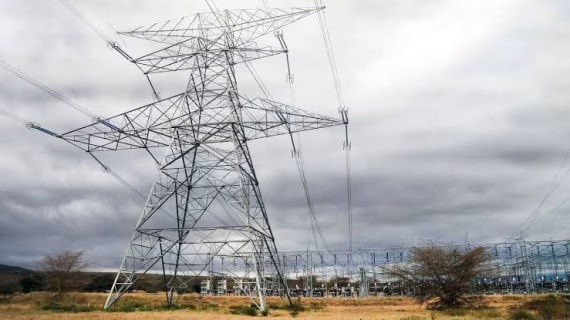
Interconnectors are emerging as a trend for power importation between countries in Africa. They are a source of income for power exporters, contributing to the overall economies of the power exporting countries. Countries that are developing power interconnectors in including Mozambique and Malawi. The countries are developing the Mozambique-Malawi Interconnection Project. The Mozambique-Malawi Interconnection Project will allow Malawi to import at least 50MW of power from Mozambique.
Reported on July 28, 2025
Tanzania’s power import deal has taken shape as the agreement was finalized with Kenya to receive electricity from Ethiopia. The import scheme is to be done through the completed Isinya-Singida interconnector. Moreover, the deal is expected to boost regional supply issues in Tanzania’s northern zones. This is a monumental step in integrating East Africa’s power markets under the EAPP. Beyond imports, it positions Tanzania as a future exporter through the forthcoming Tanzania-Zambia interconnector. The scheme is part of the larger Southern African Power Pool, which will facilitate the Mission 300. Spanning about 507 kilometers, the 400 kV Isinya-Singida transmission line will be energized and used for operations. Kenya contributed 96 kilometers of the interconnector while Tanzania contributed 414 kilometers. The interconnector has a 2,000 MW transfer capacity which forms part of the East Africa Electricity Highway. It is expected to integrate 13 Eastern Africa Power Pool (EAPP) member countries.
Also read:
Kenya-Tanzania Power Interconnection Project
The Scope of Agreement on Tanzania’s Import Power Deal with Kenya
The scope of agreement on Tanzania’s import power deal with Kenya entails more than 100 MW of power supplied from Ethiopia. Tanzania intends to import electricity from Ethiopia via Kenya under the Ethiopia–Kenya–Tanzania (EKT) wheeling arrangement. Initially 100 MW, the electricity is planned to rise to 200 MW within three years. A formal power exchange agreement was signed between Kenya Power and TANESCO. Furthermore, a transmission access (wheeling) agreement with KETRACO was also signed, enabling Tanzania to purchase the power through Kenya’s grid. Despite national generation capacity reaching approximately 1,694 MW (excluding the 2,115 MW Julius Nyerere Hydropower Plant), Tanzania faces regional supply deficits.
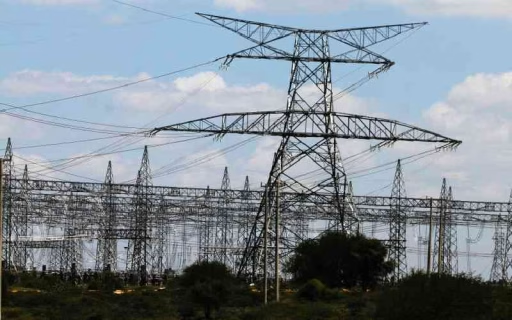
Particularly this is clear in the Northern Zone due to transmission losses from long distances and inefficiencies, costing nearly Ksh.32 billion annually. Imports help stabilize power supply in regions far from central generation hubs, ensuring reliability despite overall domestic sufficiency. The entire interconnector project cost is approximately $309.26 million (-Ksh.41 billion), financed jointly by the Government of Kenya and the African Development Bank. Tanzania is positioned as a pivotal hub bridging EAPP (East Africa) and SAPP (Southern Africa) markets. It will unlock economic returns from exporting surplus generation.
Also read:
Construction of Isinya (Kenya)-Namanga (Tanzania) electricity transmission line completed
World Bank approves US $455 m loan for Tanzania power projects
Leave a Reply