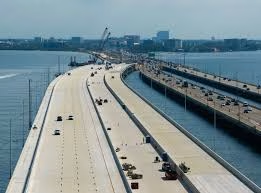
Howard Frankland Bridge construction continues to advance as crews push toward final delivery of the major infrastructure project across Tampa Bay. The project remains one of Florida’s most significant transport upgrades, improving capacity, safety, and regional connectivity.
Howard Frankland Bridge construction reaches final stages in 2026
Howard Frankland Bridge construction has entered its final phase, with overall completion expected by spring or summer 2026. The new southbound bridge opened to traffic in March 2025, marking a major milestone in the project timeline.
Currently, crews are finalizing structural elements, installing lighting, and completing aesthetic features on the new span. At the same time, demolition of the old northbound bridge is nearly complete, with progress exceeding 90% in recent updates.
Additionally, construction of express lanes and a shared pedestrian and bicycle path continues across the corridor. Meanwhile, authorities have introduced temporary speed reductions along the corridor to improve safety during intensified construction activities.
Howard Frankland Bridge construction cost and capacity updates
Howard Frankland Bridge construction now carries an updated cost of approximately $973.4 million, reflecting increases from earlier estimates. Despite the cost rise, the project remains on schedule, with officials confirming delivery within the planned 2026 timeframe. The completed bridge will significantly expand capacity, including additional general-use lanes and express toll lanes in both directions.
Furthermore, the upgraded structure will improve evacuation efficiency and resilience against extreme weather events. Importantly, the project also introduces a dedicated shared-use path, enhancing non-motorized transport connectivity between Tampa and St. Petersburg. Consequently, the bridge will support long-term regional growth while easing congestion on one of Florida’s busiest corridors.
Howard Frankland Bridge construction aligns with broader infrastructure expansion across Florida’s transport network. Notably, the project complements the $582m Florida highways project, which targets corridor upgrades, congestion reduction, and improved logistics efficiency across the state. Together, these developments highlight a coordinated approach to modernizing Florida’s infrastructure, ensuring long-term mobility and economic competitiveness.
Demolition and construction strategy driving safer and modern infrastructure
The demolition and construction within the Howard Frankland Bridge project aim to replace aging infrastructure with a safer, higher-capacity crossing that meets modern transport demands. Crews are demolishing the old northbound bridge because it has reached the end of its structural lifespan and cannot efficiently support current traffic volumes.
At the same time, they are constructing a new, wider bridge with additional lanes, express toll corridors, and a shared-use path. This approach improves traffic flow, reduces congestion, and enhances safety for motorists and non-motorized users. Moreover, the new structure incorporates resilient design features to withstand extreme weather, ensuring long-term durability and reliability across Tampa Bay.
The New Bridge
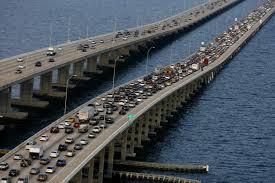
The $865 million new span, opened to traffic this summer, raises Tampa Bay capacity by 50 percent. Constructed to today’s building standards, the bridge is designed to withstand hurricane forces and connects directly to the newly finished Gateway Expressway and I-275 Express project.
The new bridge has express and general-purpose lanes, giving drivers more travel option and relieving the route from Tampa to St. Petersburg. A bicycle and pedestrian path will open in 2026, producing another non-vehicle link across the bay.
The new bridge was built by Archer Western Construction, part of The Walsh Group, which served as the lead contractor on the project.
Demolition of the Old Span
With traffic flowing on the new bridge, work crews began disassembling the original Howard Frankland Bridge, which was opened in 1959. Removal of the old structure will make the channel safer for mariners and finish the transition to the new span.
FDOT Secretary Jared W. Perdue, P.E., said: “Our crews are moving quickly to demolish the old Howard Frankland Bridge while advancing on projects that will redefine the region’s mobility for generations.”
Part of Moving Florida Forward
The replacement of the Howard Frankland Bridge is FDOT’s District 7’s biggest transportation project in history and the centerpiece of Florida’s Moving Florida Forward program. In 2023, the initiative is charging ahead on more than 20 congestion-relief projects statewide, years ahead of expectations.
Since its inception, the Florida Legislature has invested around $7 billion in state reserves to accelerate such projects as the Howard Frankland and I-275 widening, and more than $68 billion will be invested in transportation improvements over the next five years to maintain infrastructure in line with the needs of residents, tourists, and companies.
Project Fact Sheet
Project Name: Howard Frankland Bridge Reconstruction
Location: Tampa Bay, Florida, USA
Client: Florida Department of Transportation (FDOT)
Project Cost: $973.4 million (updated)
Scope: New bridge construction, demolition of old span, express lanes, shared-use path
Length: Approximately 5.8 miles
Start Date: 2020
Current Status (2026): Final construction phase; over 95% complete
Key Milestone: Southbound Bridge opened March 2025
Expected Completion: Spring/Summer 2026
Key Features: Express lanes, pedestrian/bicycle path, resilient design
Traffic Capacity: Increased by up to 50%
Project Team
Project Owner: Florida Department of Transportation (FDOT)
Main Contractor: Archer Western / Traylor Bros. Joint Venture
Construction Manager: FDOT District Seven project team
Engineering & Design: Multidisciplinary infrastructure and transport engineering consultants
Key Stakeholders:
Subcontractors: Regional civil, structural, and marine construction firms
Suppliers: Materials providers for concrete, steel, and roadway systems



Leave a Reply