
Construction of the Keystone XL pipeline was cancelled and shelved following TC Energy’s termination of the project in 2021. This was after years of legal battles and regulatory reversals. While the original cross-border crude oil pipeline – intended to move Alberta oil sands crude into U.S. refining hubs – remains abandoned and no construction has resumed, renewed political interest in 2026 has revived discussion of partial successor projects. The projects will use infrastructure portions of the original Keystone XL corridor rather than restart the original line itself.
Recent developments in April-May 2026 indicate the granting of federal approval for a separate cross-border pipeline proposal led by South Bow and Bridger Pipeline. Analysts and officials describe as a “Keystone XL–related” revival in concept but not in a legal or engineering continuity. The new initiative would follow a different U.S. route through Montana and Wyoming. It will also incorporate some previously built Canadian pipe. Like its predecessor, the new route also aims to increase Canadian crude exports into the United States. It however remains in early permitting and commercial commitment stages.
As of June 2026, the situation reflects a split reality. The original Keystone XL project remains permanently cancelled with no construction activity, while a politically supported replacement concept is advancing through early regulatory channels. The new project will still have to maneuver pending long-term permits, shipper commitments and potential legal challenges. The latter is especially important, with environmental groups increasingly lobbying against oil and natural gas pipelines across the U.S., as is the case with the Mountain Valley Southgate pipeline project.
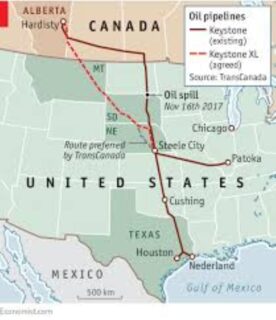
Construction of Keystone XL Pipeline Project in the United Sates to Start
Reported April 3, 2020 – Construction of the Keystone XL Pipeline in the United Sates is set to begin after TC Energy announced that it will proceed with construction. The project will see an investment of US $8bn in the North American economy. At 1,210-miles (1,947-kilometres) in length, the Project will deliver 830,000 barrels per day (Bbl/day) of crude oil from Hardisty, Alberta to Steele City, Nebraska. From Steele, it will connect with TC Energy’s existing facilities to reach U.S. Gulf Coast refiners. The project aims to meet critical needs for transportation fuel and useful manufactured products. With pre-construction activities underway, the pipeline is expected to enter service in 2023.
According to Russ Girling, TC Energy’s President and Chief Executive Officer, the company appreciates the ongoing backing of landowners, customers, Indigenous groups and numerous partners in the U.S. and Canada. The partners helped secure project support and key regulatory approvals for the project. Keystone XL pipeline is also poised to put thousands of people to work. Additionally, the project is expected to generate substantial economic benefits and strengthen the county’s energy security.
“During construction, we will continue to take guidance from all levels of government and health authorities. This will be to determine the most proactive and responsible actions in order to ensure the safety of our crews and community members during the current COVID-19 situation. Construction will advance only after every consideration for the health and safety of our people. Their families and communities have been also taken into account in this consideration.” said Girling.
The Keystone XL Pipeline Project
The Project is underpinned by new 20-year transportation service agreements for 575,000 Bbl/day with a group of strong, credit-worthy counterparties. They will generate approximately US $1.3bn of earnings before interest, taxes, depreciation and amortization (EBITDA) on an annual basis. In addition, once the Project is in service, current contracts for 115,000 Bbl/day from Hardisty to the U.S. Gulf Coast on the existing Keystone line will shift to the new facilities under renewed 20-year contracts. Subject to terms and conditions outlined in the agreements, 50% of any difference between the estimated capital cost and final cost of the Project are subject to a sharing mechanism and will be reflected in the pipeline tolls.
Also read: Completion date of OB3 gas pipeline project in Nigeria pushed to 2021
As part of the funding plan, the Government of Alberta has agreed to invest approximately US $1.1bn as equity in the project. This will cover construction costs through the end of 2020. The remaining capital investment of approximately US $6.9bn is expected to be largely made in 2021 and 2022. It will be funded through the combination of a US $4.2bn project level credit facility to be fully guaranteed by the Government of Alberta and a US $2.7bn investment by TC Energy.
Project Financing
The company’s capital investment will be funded through a combination of internally generated cash flow, hybrid securities and common equity. This will also be through the activation of its dividend reinvestment program in 2021 and 2022. To provide additional financial flexibility in support of its credit metrics and capital program, including the project, the company intends to also file a US $1.0bn equity shelf. The company aims to enable an at-the-market equity issuance program which will be utilized if and as deemed appropriate. Once the Project is completed and placed into service, TC Energy expects to acquire the Government of Alberta’s equity investment. This will be under agreed terms and conditions and aim to refinance the US $4.2bn credit facility in the debt capital markets.
“Strong commercial and financial support positions us to prudently build and fund the project. This is along with our existing US $30bn secured capital program. The program is also being undertaken in manner consistent with maintaining our strong financial position and credit metrics.” added Girling. “Once completed, 98% of the company’s consolidated EBITDA is expected to come from regulated or long-term contracted assets,” he affirmed.
Leave a Reply