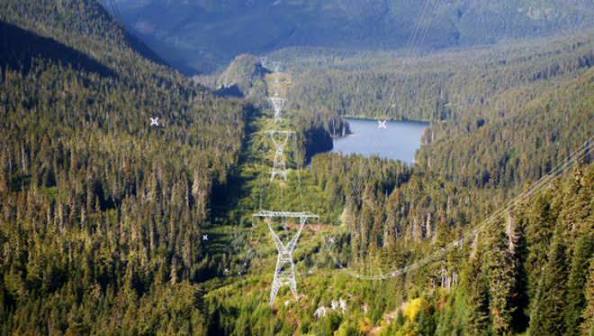
Project Secures Federal Funding Commitment: The North Coast Transmission Line, a multi-phase project twinning BC Hydro’s existing 500-kilovolt power line between Prince George and Terrace, secured $3.5 billion in federal funding Thursday as part of the newly announced Canada-British Columbia Cooperative Prosperity Agreement. Prime Minister Mark Carney and BC Premier David Eby unveiled the agreement in Vancouver, describing it as a deal that will help unlock more than $150 billion in new investment across the province.
The funding commitment is designated to deliver electricity to communities and industrial projects across northwest British Columbia, supporting a transmission corridor that BC Hydro says will more than double clean electricity capacity in the region.
Carney called British Columbia the “linchpin” of a more prosperous Canada during the announcement.
Broader Federal-Provincial Agreement
The North Coast Transmission Line funding is one component of a larger package under the Cooperative Prosperity Agreement. The agreement also includes a $10 billion federal investment to upgrade the Roberts Bank container terminal at the Port of Vancouver, aimed at increasing export capacity and reducing cargo wait times. A separate $3 billion commitment will fund replacement of the George Massey Tunnel, expanding the Highway 99 crossing from four lanes to eight.
The agreement also directs additional funding toward the Port of Prince Rupert and Port of Stewart in northern British Columbia to support trade corridors for critical minerals and other resources, along with $500 million to expand the Red Chris copper mine, which Carney said would boost national copper production by more than 15 percent.
The agreement further affirms the federal government’s commitment to maintaining the northern oil tanker ban off British Columbia’s coast. Eby said the memorandum of understanding does not require the province to support a proposed Alberta pipeline to the coast, though it acknowledges a separate federal-Alberta understanding on a trans-provincial pipeline route. The agreement states that British Columbia “must share meaningfully” in the economic benefits of any new pipeline, with mechanisms such as an annual royalty payment and an environmental response fund still to be determined.
Carney described the agreement as comprehensive and said it would help fund public services relied on across the country.
Project Scope and Timeline
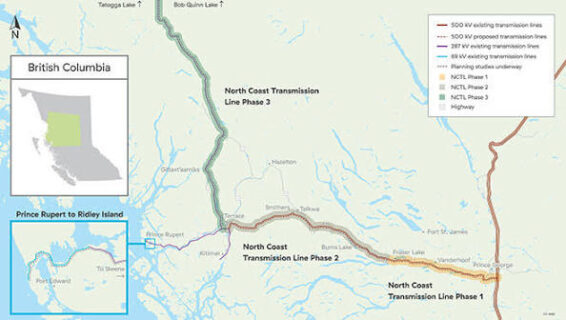
The North Coast Transmission Line is being developed by BC Hydro in multiple phases. Phase 1 will run approximately 170 kilometers from the Williston substation near Prince George to Glenannan, west of Fraser Lake. With construction expected to begin in summer 2026 and completion targeted for 2030. Phase 2 will twin the line for approximately 275 kilometers from Glenannan to the Skeena substation near Terrace. Reported start dates for this phase vary across sources, with more recent reporting indicating construction beginning in 2027 and completion targeted for 2032.
A proposed third phase would extend the line approximately 350 kilometers north from Terrace to Bob Quinn Lake near the Alaska border. Though details and cost estimates for that phase have not yet been finalized. Project cost estimates for Phases 1 and 2 combined have ranged from $3 billion in earlier estimates to $6 billion in more recent projections.
The project was referred to Canada’s Major Projects Office on November 13, 2025. The Canada Infrastructure Bank has already provided a $139.5 million loan to BC Hydro to support pre-construction activities, including engineering, fieldwork, procurement, and consultation with First Nations communities.
Industrial Demand and Economic Impact
The transmission line will support development of the Ksi Lisims LNG project. A proposed floating liquefied natural gas facility on Nisga’a Treaty lands near Prince Rupert. BC Hydro signed a memorandum of understanding with Ksi Lisims LNG confirming plans to deliver up to 600 megawatts of electricity to the facility. The line will also support multiple critical mineral mining projects across northwest British Columbia, including copper, nickel, lithium, graphite, and cobalt developments.
The Province of British Columbia estimates the completed project will create approximately 9,700 direct full-time jobs. Contribute nearly $10 billion annually to provincial GDP. And generate approximately $950 million per year in public revenues for the province and municipal governments. The province also states the project could prevent two to three million tonnes of carbon emissions annually.
BC Hydro has advanced a co-ownership partnership with First Nations along the transmission corridor. Wes Sam, Chief of Ts’il Kaz Koh and chair of K’uul Power, said the arrangement allows First Nations to co-own the transmission line from construction through its operating life.
Regulatory and Legislative Context
British Columbia passed the Renewable Energy Projects (Streamlined Permitting) Act in spring 2025 to accelerate development of the North Coast Transmission Line. By simplifying the decision-making process and exempting the project from standard environmental assessment requirements. Rather than routing the project through the BC Utilities Commission’s typical independent review process, the province has indicated it intends to order certification for the line directly.
Both the North Coast Transmission Line and Ksi Lisims LNG have been added to the federal government’s list of priority projects considered nationally significant.
Additionally, The federal funding announcement comes as power infrastructure investment accelerates across Canada to meet rising industrial and digital electricity demand. In Alberta, the Greenlight Electricity Centre, a 932-megawatt gas-fired power plant in Sturgeon County, reached a positive final investment decision the same day, backed by Pembina Pipeline Corporation, Morgan Stanley Infrastructure Partners, and Kineticor Asset Management. While Greenlight will deliver dedicated gas-fired power to a single data center customer, the North Coast Transmission Line is designed to expand grid capacity across an entire industrial corridor, reflecting two distinct approaches to Canada’s growing power needs.
North Coast Transmission Line Factsheet
Project Overview
- Name: North Coast Transmission Line (NCTL), also known as the North Coast Electrification Project
- Developer: BC Hydro
- Location: Prince George to Terrace, with proposed extension to Bob Quinn Lake, British Columbia
- Type: Twinning of existing 500-kilovolt transmission infrastructure
Funding
- Federal commitment announced July 2, 2026: $3.5 billion
- Announced under: Canada-British Columbia Cooperative Prosperity Agreement
- Canada Infrastructure Bank pre-construction loan: $139.5 million
- Prior cost estimates for Phases 1 and 2: $3 billion to $6 billion
Project Phases
- Phase 1: Approximately 170 kilometers, Williston substation to Glenannan; construction starting summer 2026; targeted completion 2030
- Phase 2: Approximately 275 kilometers, Glenannan to Skeena substation near Terrace. Construction start reported as 2027 in most recent sources. Targeted completion 2032
- Phase 3 (proposed): Approximately 350 kilometers, Terrace to Bob Quinn Lake; cost and timeline not yet finalized
Expected Economic Impact
- Direct full-time jobs: Approximately 9,700
- Annual contribution to provincial GDP: Nearly $10 billion
- Annual public revenue: Approximately $950 million
- Estimated annual emissions avoided: Two to three million tonnes
Key Industrial Customers
- Ksi Lisims LNG: Up to 600 megawatts under signed memorandum of understanding
- Multiple critical mineral mining projects across northwest British Columbia
Regulatory Milestones
- Renewable Energy Projects (Streamlined Permitting) Act passed: Spring 2025
- Referred to Canada’s Major Projects Office: November 13, 2025
- Federal funding commitment announced: July 2, 2026



Leave a Reply