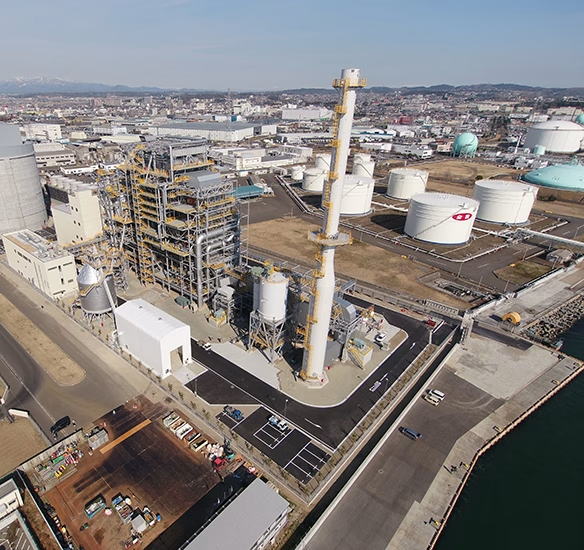
Sendai Port biomass power plant in Miyagi Prefecture, Japan has started commercial operations according to developer, Sumitomo. The 112 MW power plant, operated by a special-purpose vehicle owned by Sumitomo Corporation and partners, now supplies renewable electricity to Japan’s Tohoku region. Sendai Port has an annual generation capacity of approximately 800,000 MWh enough to power about 260,000 homes. Ranking among Japan’s largest dedicated biomass-fired power stations, Sendai Port also marks a milestone for the Asian country’s renewable energy push.
Project Overview
Sumitomo’s power plant sits on a 3.4 hectare industrial site at the Sendai-Shiogama port, and was launched in 2021. The plant uses wood-based biomass, including pellets, chips, thinning timber, and residues.
Sendai’s owner has also committed to supply chain traceability and forest management as a means of sustainability. The start of commercial operations at the Sendai power plant is also not only marked by sustainability as the attainment of Japan’s carbon neutrality goals is in sight. The plant is expected to offer dependable 24/7 renewable energy supply, complementing other sources like wind, solar and nuclear. Sendai’s operations start also comes as the country plans to restart its Mihama nuclear plant in Fukui Prefecture and complete Toshiba’s Onikoube Miyagi solar farm in Osaki City. November also saw the launching of the Japan’s largest battery storage system in Miyagi Prefecture.
Sendai Port also forms part of Sumitomo’s strategy targeting at least 30 percent of its owned generation capacity to be renewable by 2035.
Sendai Port Biomass Power Plant Project Factsheet
Operator: Sendai‑ko Biomass Power GK
Ownership: Sumitomo Corporation Group, Tokyo Gas Ltd., Hokuriku Electric Power Company and Sumitomo Corporation Tohoku Ltd.
Location: Miyagino-ku in Sendai City, Miyagi Prefecture.
Installed Capacity: 112 MW
Technology Use: Sumitomo’s high-efficiency circulating fluidized bed (CFB) boiler.
Annual Generation Capacity: 800,000 MWh
Homes Powered: 260,000
Fuel Use: Wood biomass. Sumitomo also reports sourcing under internationally recognized forest certification schemes, and supply chain tracing.
Project Cost: Approx. 90 billion Japanese Yen (574 million dollars).

Project Timeline
April 2021: Order awarded for the power plant’s boiler and combustion equipment.
March 2021: Construction starts under Sendai-ko Biomass Power GK joint venture.
2021 through 2025: Construction phase continues. Boiler and turbine components also procured.
November 2025: Construction completed. Sendai Port commissioned and start operations.
Sendai Port Biomass Power Plant Project: What to Watch For
While biomass is generally considered a renewable energy source, issues around sustainability and forest management practices often arise. To counter this, fuel supply chain must be strictly managed. This is especially after recent rise in global concern on the impact bioenergy generation expansion brings to forests and carbon budgets. Sumitomo assures of Sendai Port power plant through looking at variables like certification for the waste residues, and responsible sourcing practices.
All in all, Sumitomo’s Sendai Port shows that large-scale biomass can still be relied upon to deliver dependable renewable power. This is especially important as countries continue bridging the gap between intermittent renewables and traditional thermal baseload. For the developer and Japan’s Tohoku region, the plant is a path to both energy security and carbon neutral operations.
Leave a Reply