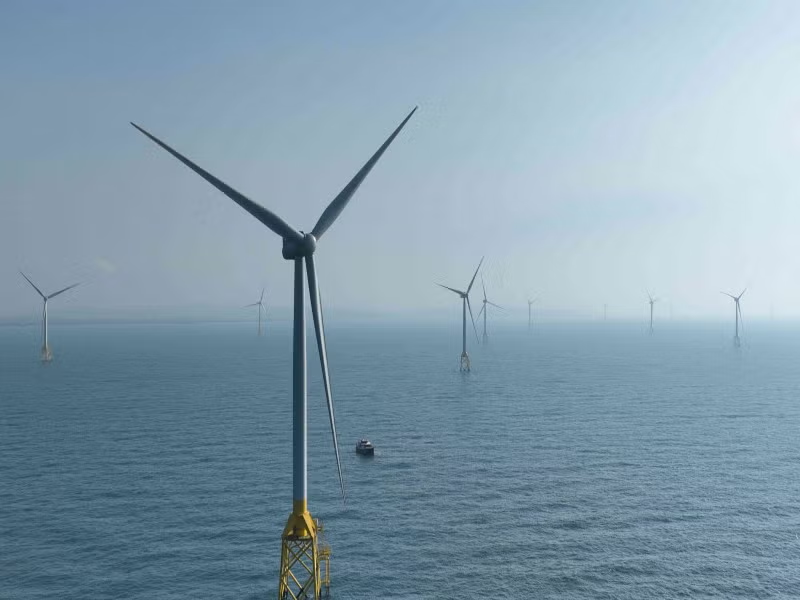
Danish energy giant Ørsted has escalated its legal battle with the United States government, filing a second major lawsuit related to the high-profile suspension of its offshore wind projects along the Atlantic coast. This latest legal action, filed in early 2026, targets the federal government’s handling of lease agreements and financial penalties following Ørsted’s decision to halt the Ocean Wind 1 and Ocean Wind 2 projects in late 2023.
The lawsuit represents a significant deepening of the rift between the world’s leading offshore wind developer and US federal agencies, highlighting the ongoing financial and regulatory friction within the American renewable energy sector. By challenging the federal government’s refusal to mitigate lease costs or return “bonus bids” associated with the suspended sites, Ørsted is seeking to recover hundreds of millions of dollars in capital lost during the industry-wide downturn that derailed several major projects. On a positive flip-side, Ørsted’s Revolution Wind offshore wind project has been cleared to restart construction by a federal judge ahead of completion this year.
The Core of the Dispute: Lease Terms and “Force Majeure”
The crux of Ørsted’s second lawsuit centers on the interpretation of lease agreements managed by the Bureau of Ocean Energy Management (BOEM). Ørsted argues that the unprecedented economic shifts—a legal landscape that remains turbulent even after Empire Wind was saved as a judge blocked the federal suspension of Equinor’s New York offshore farm—including skyrocketing inflation, supply chain bottlenecks, and interest rate hikes—constituted a form of “force majeure” or unforeseen suspension that should have triggered a pause in financial obligations rather than a forfeiture of assets.
The company is specifically challenging the federal government’s retention of approximately $300 million to $500 million in bonus bids and lease payments for the New Jersey sites. Ørsted contends that the federal government’s “inflexible” approach to project timelines and financial milestones violated the spirit of the lease contracts, which were intended to foster a nascent industry rather than penalize developers for macroeconomic volatility beyond their control.
A Pattern of Litigation: The First vs. Second Lawsuit
This federal lawsuit follows a separate, ongoing legal dispute in the State of New Jersey.
- The First Lawsuit: Primarily focused on the $100 million guarantee that Ørsted was forced to pay the state after cancelling the projects. Ørsted has been fighting to reclaim these funds, arguing that the cancellation was a result of market failure rather than a lack of good-faith effort.
- The Second Lawsuit (The Federal Filing): This new action targets the US Department of the Interior and the IRS/Treasury. It challenges the federal government’s refusal to allow for a “non-forfeiture suspension” and the denial of certain tax credit qualifications (under the Inflation Reduction Act) that Ørsted claims it was entitled to before the projects were suspended.
Implications for the US Offshore Wind Industry
The outcome of this litigation is being closely monitored by other major developers, such as Equinor and Avangrid, who have also faced similar economic pressures. If Ørsted is successful in proving that federal agencies were too rigid in their application of lease penalties, it could set a precedent for more flexible project “pausing” mechanisms in the future.
However, the federal government maintains that the lease terms are clear and that developers must bear the commercial risks of their projects. This legal standoff comes at a delicate time for the Biden-Harris administration’s clean energy goals, as the government races to restore confidence in the offshore wind pipeline—a sector marking global milestones as Japan’s first floating offshore wind farm in Goto, Nagasaki begins commercial operation—to meet its 2030 capacity targets.
Ørsted vs. US Federal Government: Factsheet
Plaintiff: Ørsted A/S (Denmark)
Defendants: US Department of the Interior, BOEM, US Treasury
Projects Involved: Ocean Wind 1 & Ocean Wind 2 (New Jersey)
Estimated Financial Claim: $300M – $500M (Bonus bids and lease fees)
Filing Date: January 2026 (Second Federal Suit)
Primary Legal Arguments:
Failure to recognize economic “force majeure.”
Violation of lease agreement suspension clauses.
Unjust retention of bonus bids following project termination.
Strategic Context: Part of a broader effort to recover billions in impairments taken by Ørsted in 2023.
Leave a Reply