
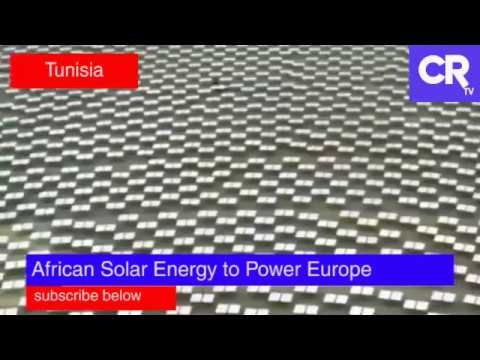
Electric energy generated in North Africa will soon reach Europe to power it for many years to come. A massive solar power project in Tunisia with a capacity of 4.5 GW will become the biggest solar power plant in the world, and the first designed specifically for export.
The TuNur project, is 50% under U.K. company Nur Energie and 50% belongs to investors in Tunisia and Malta. It will export electrical energy with under-the-sea cables to Malta, France and Italy.
Concentrated Solar Power (CSP)
TuNur will be on concentrated solar power (CSP) technology. It will use the method known as power tower systems. This type of CSP uses a large field of flat mirrors—heliostats. They track the sun throughout the day and focus all the sunlight onto a unique receiver on top of a tower. There, at the receiver, a heat transfer fluid generates steam. This in turn, drives standard turbine-generators to produce electricity. More advanced designs, such as the TuNur project, use molten nitrate salt as a heat-transfer fluid. This is mainly because it can also act as an energy-storage system that allows continuous dispatch of energy even during cloudy weather or during the night.
This ability to store energy before powering a generator makes CSP technology a perfect match as a fossil-fuel backup that could allow existing fossil fuel plants to run clean operations at the same or lower cost. This is achievable by replacing the source of energy that produces the steam—fossil fuel—with clean solar power from a CSP plant. According to the Department of Energy, between 11 and 21 GW of CSP could be built and integrated into existing fossil fuel plants in the United States. This is enough electricity to power between three and six million homes.
The Project
The TuNur project is in three stages. The 250 MW first stage will be one of biggest thermal solar power plants in the world. It will be delivering power to Malta. From the project site—Rjim Maatough in Southern Tunisia—to its destination in Malta, there will be a 250 MW HVDC line.
The second stage, with an average capacity of 2,250 MW will deliver electricity to Italy. This is through a 2,000 MW HVDC transmission line that will end north of Rome. 9,000 GWh per year, low-carbon power will go to some countries in Europe. The third stage with 2 GW of capacity will end in France.
When the project is complete, the power plant will cover over 25,000 hectares. This is three times the area of Manhattan.
According to Kevin Sara, chief executive officer at Nur Energie, “CSP is a reliable technology. Sahara on the other hand is an area of the perfect solar resource”. The growing energy demand and need for low carbon and constant power in Europe makes North Africa the best region for large scale solar development,” added Sara.