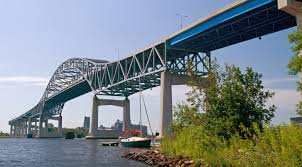
A major interstate bridge replacement linking Duluth, Minnesota, and Superior, Wisconsin has moved forward with the award of oversight contracts.
Parsons Corporation announced on June 16 that it has been selected to provide design oversight and construction oversight services for the John A. Blatnik Bridge replacement project, an estimated $1.1 billion to $1.4 billion design-build undertaking connecting Duluth, Minnesota, and Superior, Wisconsin.
The award extends Parsons’ involvement in the project after the company previously completed preliminary engineering and design work for the replacement bridge. Under the new contract, Parsons will continue supporting the project through final design and construction oversight as the two states prepare to begin major construction activities later this year.
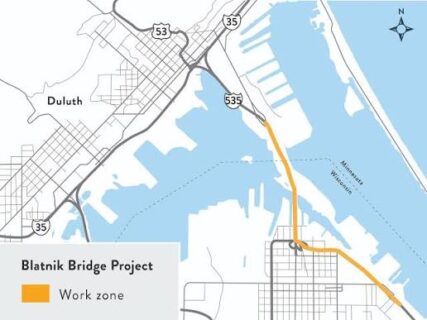
The John A. Blatnik Bridge carries Interstate 535 over St. Louis Bay and the Port of Duluth-Superior, which serves as the western terminus of the St. Lawrence Seaway and is recognized as the world’s most inland ocean-going port. The crossing is a key freight and commercial corridor linking Minnesota and Wisconsin with markets across the eastern United States and Canada.
Originally opened in 1961, the bridge currently carries an average of about 33,900 vehicles each day. Transportation officials have determined that the structure has reached the end of its service life, prompting plans for a complete replacement rather than continued rehabilitation.
According to project plans, the new bridge will be built along the existing alignment and include a direct connection to U.S. Highway 53 in Superior, Wisconsin, allowing for uninterrupted traffic flow. The replacement will span two active navigation channels, two railroad corridors, and multiple city streets.
Funding
Parsons secured its selection after a series of major funding milestones for the project. In March 2026, the U.S. Department of Transportation released more than $1 billion in federal funding that it had previously awarded under the Infrastructure Investment and Jobs Act. The project received a $1.058 billion federal INFRA grant in January 2024, while Minnesota and Wisconsin each committed $400 million toward the replacement effort.
Project teams have completed environmental reviews and permitting, and Minnesota transportation officials expect to announce the design-build contractor in the summer of 2026. Construction will begin in the fall of 2026.
To accelerate the construction schedule, officials plan to close the existing bridge in early 2027 and demolish it during the early stages of the project. Traffic will detour to nearby U.S. Highway 2 while crews build the replacement structure, with the closure expected to last approximately four to five years.
Officials expect the new crossing to open to traffic in 2031. At peak construction, the project will support roughly 1,100 workers annually, ranking it among the largest infrastructure investments in the region and the largest public works project in Minnesota history.
“Projects like this leave a lasting impact for decades to come,” said Mark Fialkowski, president of Infrastructure North America at Parsons. “We take an invested interest in making sure this project is delivered efficiently and successfully.”
The Blatnik Bridge replacement is another major interstate transportation project advancing in the Midwest, following the start of construction on the $4.05 billion Brent Spence Bridge Corridor Project in May 2026. Together, the projects highlight a broader wave of investment in aging highway and freight infrastructure across the region.
Major milestones
The Parsons award marks the latest milestone for the long-planned bridge replacement. The project secured its full funding package in early 2024 after receiving a $1.058 billion federal INFRA grant under the Infrastructure Investment and Jobs Act, alongside $400 million commitments from both Minnesota and Wisconsin.
By May 2024, transportation officials had completed the environmental review process and issued a Finding of No Significant Impact, confirming the preferred bridge alignment and clearing the way for the next phase of development. The project team also selected the design-build delivery method to accelerate construction and reduce the overall schedule.
Additional progress followed in 2025, including the completion of environmental permitting and the launch of the request-for-proposals process to select the design-build contractor. In August 2025, officials also secured a HUBZone designation for Census Tract 310.01 in Douglas County, Wisconsin, a move intended to increase opportunities for local small businesses to participate in the project.
With Parsons now overseeing design and construction activities and officials set to select the design-build contractor in summer 2026, the bridge replacement moves from planning into full-scale construction set to begin in the fall.
John A. Blatnik Bridge Replacement Project: Key Facts
- Location: Duluth, Minnesota, to Superior, Wisconsin.
- Current Bridge Opened: 1961.
- Average Daily Traffic: Approximately 33,900 vehicles.
- Project Type: Full replacement of the existing Interstate 535 bridge.
- Design-Build Project Value: Estimated at $1.1 billion to $1.4 billion.
- Total Project Funding: Approximately $1.8 billion.
- Federal Funding: $1.058 billion INFRA grant awarded in January 2024 and released in March 2026.
- State Funding: Minnesota and Wisconsin have each committed $400 million.
- Parsons’ Role: Design oversight and construction oversight.
- Design-Build Team Selection: Expected to be announced in summer 2026.
- Construction Start: Fall 2026.
- Full Bridge Closure: Early 2027 for approximately four to five years.
- Expected Completion: 2031.
- Estimated Construction Workforce: Approximately 1,100 workers annually.
- Significance: Largest public works project in Minnesota history and a key interstate freight corridor.




Leave a Reply