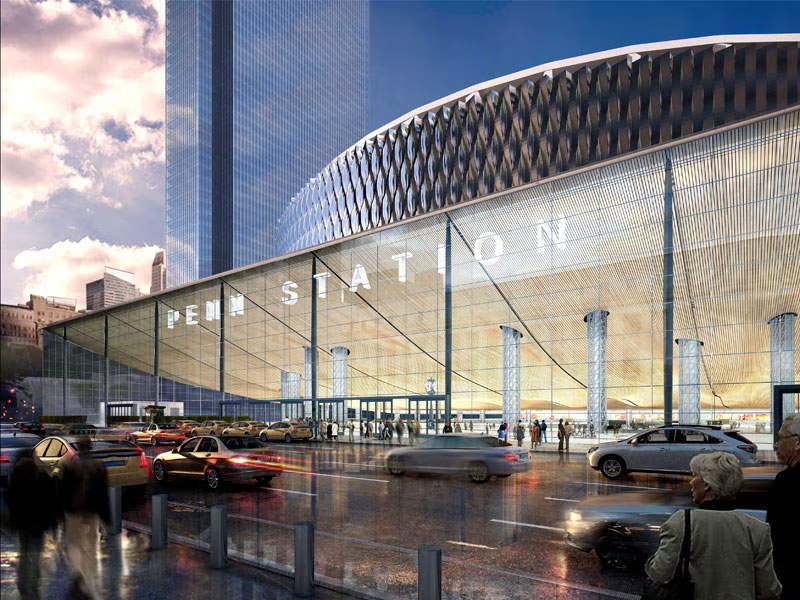
New York Penn Station, located in Midtown Manhattan, New York City, is set for a generational overhaul after the U.S. Department of Transportation and the Amtrak Board of Directors selected the Penn Transformation Partners (Halmar and Skanska) consortium as the lead private master developer for the project. The consortium, a joint venture between construction majors Halmar International and Skanska, was chosen through a competitive procurement process that evaluated proposals from three shortlisted teams, ultimately prevailing over bids led by Macquarie Capital and Fengate Capital. The project, estimated to cost between USD 6 billion and USD 8 billion, will deliver an entirely new station beneath one of the world’s most constrained active rail environments. The transformation includes a grand new entrance on Eighth Avenue opening into a new train hall with 55-foot-high ceilings, the replacement of the existing cramped concourses with open, modern passageways, expanded track capacity including at least limited through-running on the regional rail network, and a comprehensive overhaul of the station’s existing subterranean structure. New retail spaces and improved wayfinding will round out the passenger experience upgrades, all while Madison Square Garden is retained in place and given new classical stone cladding. With construction targeted to begin before the end of 2027, Penn Station serves over 600,000 passengers daily across Amtrak, NJ Transit, and Long Island Rail Road, making it the busiest transportation facility in the Western Hemisphere.

Northeast Corridor’s Infrastructure Ambitions Signal a Decade of Transformation
The Penn Station award lands at a moment when the Northeast Corridor is seeing its most concentrated burst of investment in decades, and the scale of ambition here is genuinely different from what has come before. The Gateway Program, which includes the Hudson Tunnel Project, has been grinding toward financial close for years and is now advancing in parallel with the Penn overhaul; together they represent an attempt to fix a corridor where a single track failure can strand hundreds of thousands of commuters from Washington to Boston. Penn Station itself has long been the chokepoint at the center of that vulnerability, a station designed to handle 200,000 daily passengers that now handles three times that volume in spaces that were already considered substandard when they opened in 1968. The comparison to Moynihan Train Hall, which opened across Eighth Avenue in 2021 and transformed the old Farley Post Office into a soaring, naturally lit concourse, is instructive: Moynihan proved that genuine architectural ambition is possible within the constraints of an active rail corridor, and it set a benchmark Penn Transformation Partners will now be expected to match or exceed. The design work by Practice for Architecture and Urbanism and HOK, which informed the winning proposal, draws explicitly on the demolished McKim, Mead and White station that once stood on the same site, a building whose loss in 1963 galvanized the American historic preservation movement. That the new station must coexist with an active arena seating 20,000 people while reconstruction proceeds beneath live tracks makes this one of the most technically demanding transit construction programs undertaken in North America. The broader investment climate around the project has also strengthened considerably since the MTA first unveiled its transit revival strategy in 2024 in its US$65 billion system modernisation plan, with the agency since securing support for its expanded 2025–2029 capital programme and accelerating early works tied to signal upgrades, accessibility improvements and long-term network resiliency measures across the New York metropolitan transit system.

Project Fact Sheet
- Project Name: New York Penn Station Transformation
- Location: Midtown Manhattan, New York City, USA
- Project Value: USD 6 billion to USD 8 billion
- Client / Owner: Amtrak (project owner); U.S. Department of Transportation (program oversight)
- Master Developer: Penn Transformation Partners (Halmar International and Skanska joint venture)
- Key Components: New Eighth Avenue monumental entrance and train hall, replacement of existing concourses, expanded track capacity with through-running capability, subterranean structure overhaul, retail and wayfinding upgrades, Madison Square Garden exterior recladding
- Procurement Model: Competitive private master developer selection
- Construction Start: Targeted before end of 2027 (subject to contract, permitting, and financial close)
- Passengers Served Daily: Over 600,000 across Amtrak, NJ Transit, and Long Island Rail Road
- Additional Funding Announced: USD 200 million through the Partnership-Northeast Corridor Program
- Strategic Impact: Addresses capacity constraints at the busiest transit hub in the Western Hemisphere; aligns with broader Northeast Corridor modernization program
Project Team
- Client / Owner: Amtrak
- Co-Funding Partners: NJ Transit; U.S. Federal Railroad Administration (FRA)
- Master Developer (JV): Penn Transformation Partners — Halmar International and Skanska
- Design Architect: Practice for Architecture and Urbanism (PAU)
- Executive / Managing Architect: HOK
- Infrastructure Development Partner: ASTM (Italian infrastructure management group, parent of Halmar International)
- Project and Construction Manager: AECOM / LiRo-Hill joint venture
- Real Estate Partner: Vornado Realty Trust
- Program Oversight: U.S. Department of Transportation; Federal Railroad Administration
Leave a Reply