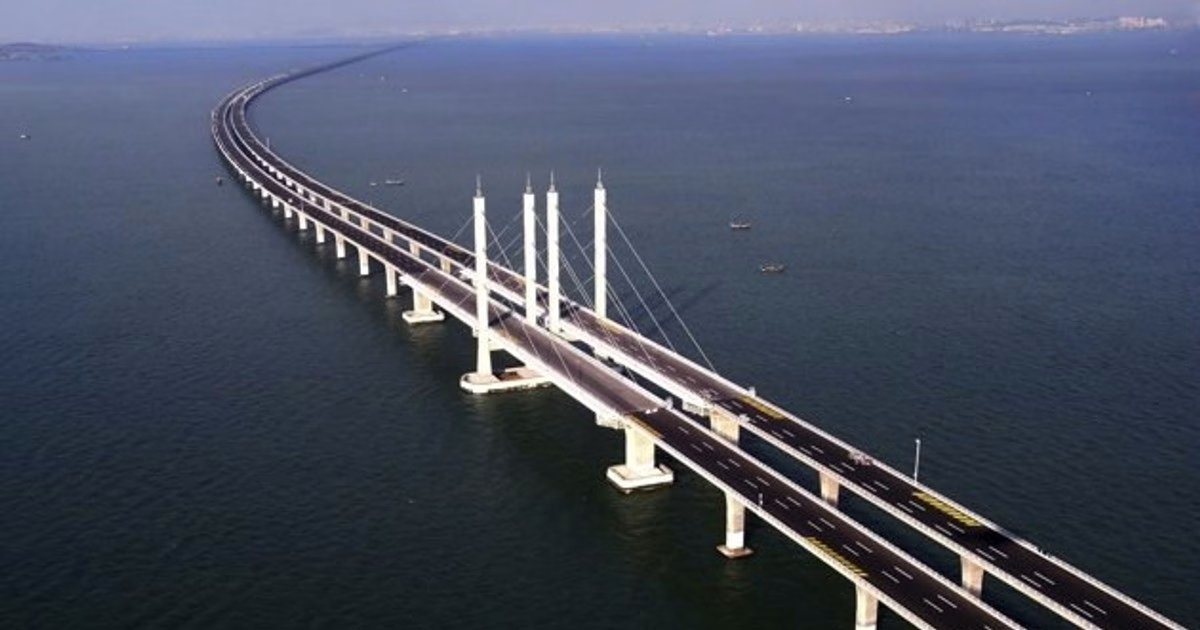
The Moses Bridge project is a proposed cross-border transport link between Saudi Arabia and Egypt, intended to span the Strait of Tiran between Ras Hamid and Sharm El-Sheikh. The governments of Saudi Arabia and Egypt have reactivated discussions on the project, which was initially introduced in 2016.
The project, estimated at approximately $4 billion, is planned to be financed by Saudi Arabia. According to Egypt’s transport authorities, planning activities have been completed, with the project under consideration for implementation either as a bridge or a tunnel.
The proposed link would provide an alternative to existing maritime transport services currently operating between the two countries. Moreover, it facilitates Saudi Arabia’s vision of its future NEOM city. With the ability to accommodate over a million pilgrims annually, the *Moses Bridge* is a promise of spiritual and economic prominence.
Other Projects:
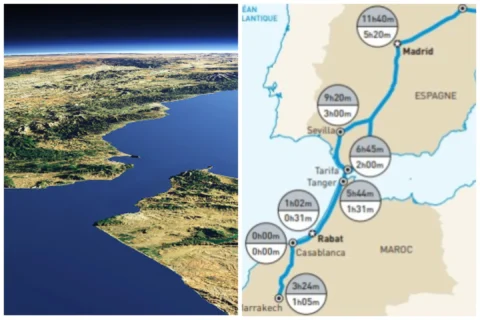
Other than the Moses Bridge, the Morocco-Spain rail tunnel is also advancing amid global chokepoint risks. The rising tensions in the Strait of Hormuz are prompting countries to reassess global trade routes. Moreover, it is imploring them to seek new pathways to reduce exposure to potential disruptions. Attention is increasingly turning to the Strait of Gibraltar as a strategic route capable of supporting additional trade and logistics flows. The Strait of Gibraltar remains the only natural link between the Atlantic Ocean and the Mediterranean Sea. Furthermore, it is among the busiest maritime routes globally, with about 300 vessels crossing daily. The planned tunnel would consist of two rail tubes carrying both passengers and freight, with a journey time of about 30 minutes. Cost estimates vary, with total project costs ranging between $18 billion and $23 billion. On the other hand, Spain’s share alone is estimated at more than $10.5 billion.
Also read:
Morocco-Spain High-Speed Rail Route Set to Link Madrid to Casablanca
Implementation Scope and Significance of the Moses Bridge
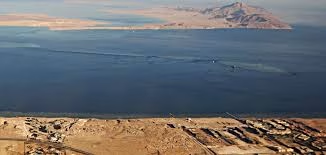
The Moses Bridge is great in terms of strategic and cultural significance. To begin with, the project is finally implementation-ready, a significant shift after decades of dawdling. Its application encompasses infrastructure serving the movement of both passengers and cargo across the Red Sea. Second, the bridge will anchor economic ties between Egypt and Saudi Arabia through more rapid, efficient trade. Furthermore, it will serve as an alternate route for pilgrims to visit Mecca, reducing pressure on millions of pilgrims traveling to Mecca. Furthermore, the Moses Bridge enhances NEOM, enhancing regional connectivity as stipulated under Saudi Vision 2030. Symbolically, it hails shared heritage and a uniting architecture founded on shared interests. The fact that earlier propositions had been politically challenged aside, the current momentum proves strong diplomatic will. Most importantly, the bridge is an inspiration for cooperation, innovation, and long-term development between two continents.
Also read:
Morocco-Spain High-Speed Rail Route Set to Link Madrid to Casablanca
Spanish Firm Awarded Contract to Conduct Morocco-Spain Undersea Rail Line Study
Project Overview
- Project Name: Moses Bridge
- Project Type: Bridge / tunnel (under study)
- Estimated Cost: ~$4bn
- Purpose: Cross-border transport link (road/rail potential)
- Status: Reactivated / planning complete
Key Stakeholders
- Lead Sponsor: Saudi Arabia
- Partner: Egypt
- Authorities: National transport agencies (both countries)
Location
- Route: Ras Hamid – Sharm El-Sheikh
- Crossing: Strait of Tiran
- Region: Red Sea
- Continents Linked: Asia–Africa
Scope
- Fixed link (bridge or tunnel)
- Passenger and cargo transport
- Alternative to ferry routes
- Pilgrimage travel support
Funding / Delivery Model
- Saudi-funded project
- Government-led development
- Final structure (bridge/tunnel) TBD
Status
- Stage: Advanced planning
- Progress: Studies completed
- Next: Final design and execution decision
Key Risks & Challenges
- Environmental sensitivity (Red Sea)
- Engineering complexity
- Political coordination
- Final design uncertainty
Strategic Significance
- Direct Africa–Asia land link
- Supports NEOM connectivity
- Enhances trade and logistics
- Facilitates Hajj and Umrah travel
- Strengthens bilateral cooperation

Leave a Reply