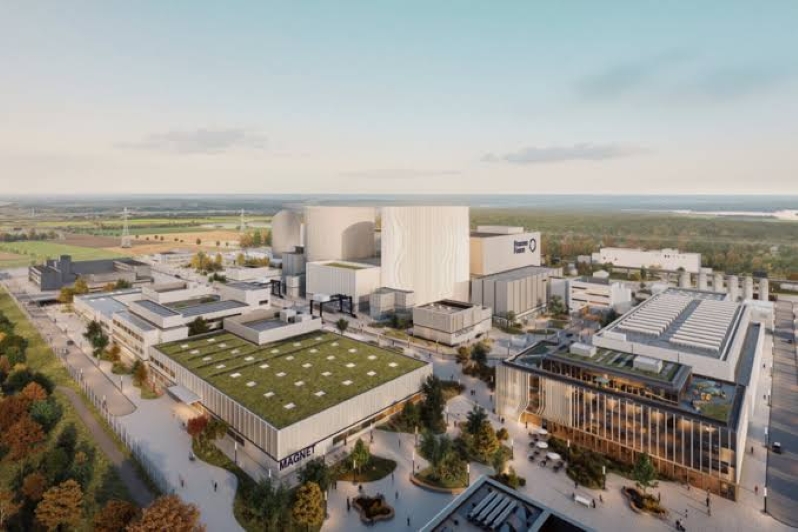
Europe’s ambition to build its first commercial fusion power plant has taken a major step forward after Munich-based Proxima Fusion secured a €411 million financing round backed by investors including Google and German energy utility RWE.
The funding, one of the largest ever raised by a European fusion company, backs Proxima’s plans to develop a stellarator-based fusion demonstration reactor before constructing what it hopes will become Europe’s first commercial fusion power plant at the former Gundremmingen nuclear power station in Germany in the late 2030s.
The investment reflects growing confidence that fusion could become a key component of Europe’s long-term clean energy strategy. It is also expected to help meet the rapidly rising electricity demand from industry, electrification and AI data centers.
The planned Proxima fusion power plant in Europe
At the center of Proxima’s strategy is the development of Europe’s first commercial stellarator-based fusion power plant.
Earlier this year, Proxima Fusion, RWE, the Free State of Bavaria and the Max Planck Institute for Plasma Physics signed a framework agreement to jointly pursue development of the commercial facility.
Under current plans, RWE has proposed the site of its former Gundremmingen nuclear power station in Bavaria as the preferred location for the future commercial reactor.
Before commercial deployment, the company intends to construct its “Alpha” demonstration stellarator near Munich, targeting operation around 2031. The demonstration facility is also expected to validate the technology, manufacturing processes and engineering systems needed for commercial-scale electricity generation.
The commercial power station would follow later in the decade. Construction is subject to successful technical milestones, regulatory approvals and continued public-private financing. Bavaria has also indicated potential financial support alongside expected contributions from the German federal government and private investors.
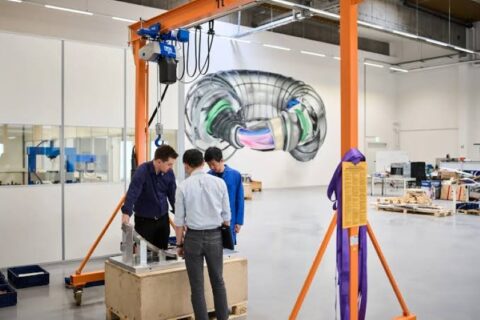
Why Proxima chose the stellarator
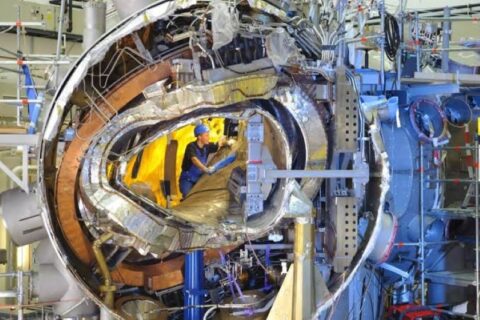
Unlike the more common tokamak design pursued by many fusion developers worldwide, Proxima is developing a quasi-isodynamic stellarator.
A stellarator uses complex twisted magnetic fields to confine ultra-hot plasma continuously without relying on the large plasma currents required by tokamaks.
While significantly more difficult to design and manufacture, stellarators are considered by many researchers to offer improved plasma stability and continuous operation. This potentially makes them better suited for commercial electricity generation.
Recent advances in computational modelling, superconducting magnets and precision manufacturing have also renewed industry interest in stellarators after decades of limited development.
Proxima fusion power plant: Project financing
The project combines private venture capital with anticipated public funding.
Current plans indicate that approximately 20% of the commercial project cost would come from Proxima and private investors. Bavaria proposes another 20%, while the remaining funding would likely require support from Germany’s federal government and European funding programs.
€411 million financing accelerates commercialization
The new €411 million funding round values Proxima Fusion at approximately €2.4 billion. It includes participation from Alphabet’s Google alongside German utility RWE. The financing follows the company’s record €130 million Series A round completed in 2025. It also provides resources to advance engineering, manufacturing and regulatory work required for commercial deployment.
Google’s participation represents its first investment in a European fusion company. It also highlights increasing interest from major technology firms seeking reliable carbon-free electricity supplies for rapidly expanding AI infrastructure.
RWE’s continued involvement reflects growing utility interest in fusion as a potential future baseload generation technology that could complement renewable energy portfolios.
Energy from nuclear fusion
Unlike conventional nuclear fission, fusion seeks to generate electricity by replicating the process that powers the sun. It produces abundant carbon-free energy without long-lived radioactive waste or greenhouse gas emissions.
Although commercial fusion remains technically challenging and no private company has yet demonstrated sustained net electricity production, governments, utilities and technology companies are increasing investments in the sector as part of broader energy security and decarbonization strategies.
Europe has been a global leader in fusion science through institutions such as the Max Planck Institute for Plasma Physics, the ITER program in France and the STEP fusion power plant in the UK. However, commercialization efforts have increasingly shifted toward private companies capable of turning decades of scientific research into deployable power plants.
Proxima Fusion, founded in 2023 as the first spin-out from the Max Planck Institute for Plasma Physics, has emerged as one of Europe’s leading contenders in that race.
Outlook on the planned Proxima fusion power plant in Europe
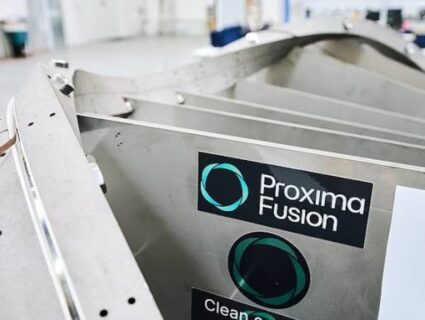
Over the next several years Proxima Fusion will focus on completing detailed engineering and manufacturing its first high-temperature superconducting magnets. The company will also advance through regulatory approvals and developing its Alpha demonstration stellarator. Successful commissioning of that facility will determine the timeline for construction of the commercial power plant at Gundremmingen.
While significant scientific, engineering and financial hurdles remain before commercial fusion becomes a reality, the latest investment represents one of the strongest endorsements yet of Europe’s ambition to deliver commercial fusion electricity within the next two decades.
For Europe, successful delivery of the Proxima project would establish the continent’s first commercial fusion power plant. This is while helping preserve its leadership in fusion research against growing competition from the United States, China and the United Kingdom.
Europe’s first commercial stellarator fusion power plant project factsheet
Developer: Proxima Fusion
Technology: Quasi-isodynamic stellarator magnetic confinement fusion
Commercial plant location: Former Gundremmingen Nuclear Power Station in Bavaria, Germany
Demonstration project: Alpha Stellarator, Garching/Munich region
Latest funding announced: €411 million
Company valuation: €2.4 billion
Key investors: Google (Alphabet), XTX Markets, RWE and existing investors
Key project partners: RWE, Free State of Bavaria, Max Planck Institute for Plasma Physics
Commercial operation target: Late 2030s
Power generation: Carbon-free fusion electricity


Leave a Reply